AI Generated Image
The Kamana Linga: The Trimbak Lord Brought by Ravana into the Tribal Heartlands
The Kamana Linga is the wish-fulfilling form of Shiva worshipped at Baba Baidyanath Dham in Deoghar, Jharkhand. Its story brings together Ravana’s devotion, Vishnu’s intervention, and a sacred presence that could not be carried away to Lanka. Understanding this shrine means looking beyond its origin legend to the regional traditions and living pilgrimage that continue to shape it.
What Does Kamana Linga Mean?
Kamana Linga means the linga associated with the fulfilment of desires. At Deoghar, devotees approach Shiva with prayers for healing, well-being, and the resolution of personal difficulties. The name expresses a devotional belief in Shiva’s grace rather than a guarantee that every request will be granted.
This distinction helps explain the shrine without reducing worship to a transaction. A wish may bring someone to the temple, but prayer can also become an occasion for gratitude, reflection, or surrender. Read this way, the name holds both human longing and the possibility of accepting an outcome beyond one’s control.
Baba Baidyanath Dham is recognised in Deoghar’s official district account as one of India’s twelve Jyotirlingas, the especially revered manifestations of Shiva. The Kamana Linga is therefore not a separate destination within Deoghar; it is a devotional description of the deity at this major shrine.
Understanding Baidyanath and the Trimbak Connection
The reference to the ‘Trimbak Lord’ needs a little care. Tryambaka, associated with Shiva as the three-eyed god, belongs to Shiva’s wider sacred vocabulary. However, Baidyanath Dham in Deoghar and Trimbakeshwar near Nashik are distinct pilgrimage sites. Trimbakeshwar is itself recognised as a separate Jyotirlinga in Maharashtra.
Keeping those identities separate prevents an evocative description from becoming a geographical mistake. The Ravana narrative discussed here concerns the linga established at Deoghar, not the transportation of the Trimbakeshwar shrine from Maharashtra.
Baidyanath also carries the meaning ‘Lord of Physicians’. One familiar explanation connects that name with Shiva healing Ravana after his extraordinary acts of penance. This healing tradition adds another dimension to the shrine: the deity is approached not only as a granter of wishes, but also as a compassionate restorer.
How Did Ravana’s Linga Become Anchored at Deoghar?
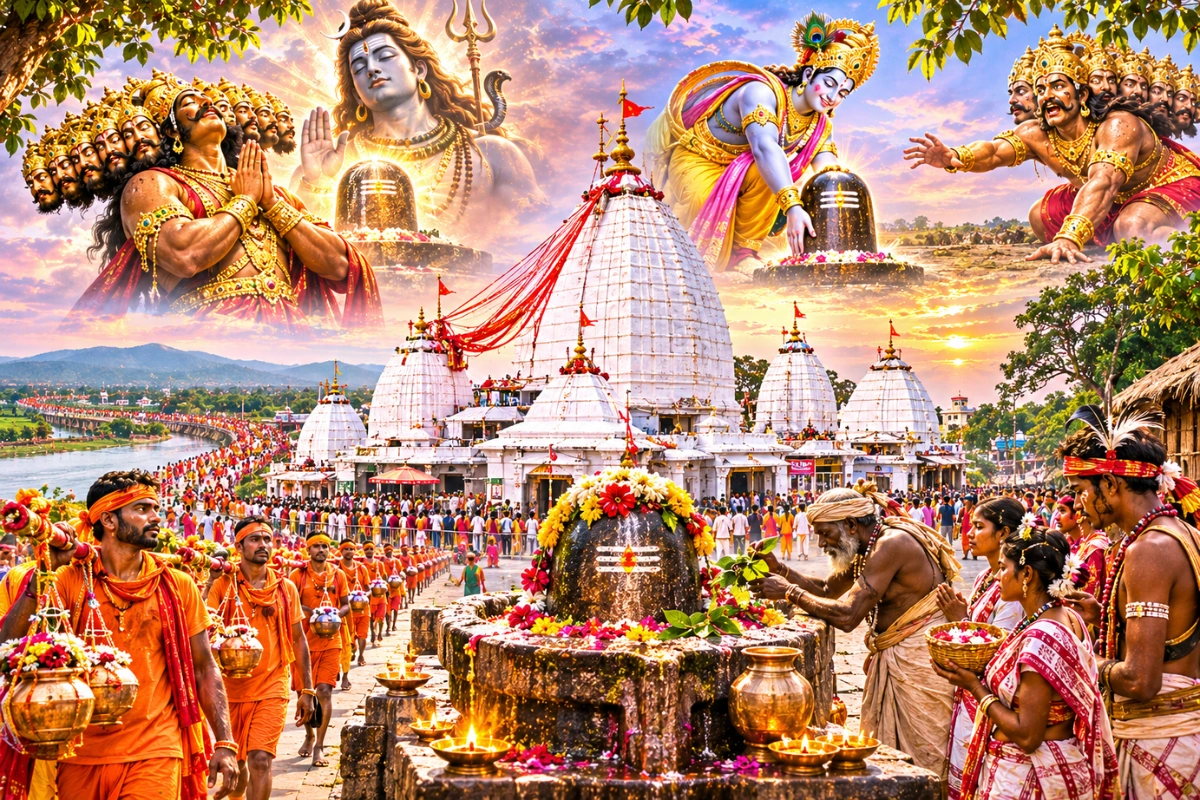
According to a widely told Deoghar legend, Ravana obtained a sacred linga from Shiva on the condition that he never place it on the ground before reaching Lanka. Vishnu intervened through a disguise, the linga was set down at Deoghar, and Shiva’s condition made it permanently rooted there. Details differ between tellings, but the interrupted journey is central to the shrine’s sacred story.
Ravana’s Worship and Shiva’s Condition
Ravana, the powerful king of Lanka, was also an ardent devotee of Shiva. In a familiar telling, he undertook severe penance in the Himalayas and offered nine of his heads in sacrifice. As he prepared to offer the tenth, Shiva appeared, stopped him, and restored the heads he had sacrificed.
Ravana sought the ultimate sacred gift: to bring Shiva’s presence to his kingdom. Shiva granted him a linga to carry to Lanka but attached an uncompromising condition. If Ravana placed it on the earth anywhere along the journey, it would remain at that spot forever.
The condition is the turning point. Ravana could receive the divine gift, yet he could not treat it as an ordinary possession. His strength would not override the terms on which Shiva had agreed to accompany him.
Vishnu’s Intervention on the Journey
The gods feared the consequences of Shiva’s presence becoming established in Ravana’s kingdom. In the Vishnu-centred version, Vishnu enlisted Varuna, the deity of water, whose intervention caused Ravana an urgent need to relieve himself near Deoghar. Unable to set the linga down, Ravana needed someone to hold it temporarily.
Vishnu appeared in disguise and accepted the burden. While Ravana was delayed, the disguised helper placed the linga on the ground. On returning, Ravana tried to lift it, but it would not move: Shiva’s warning had taken effect, and the linga was permanently anchored at Deoghar.
Other tellings identify the helper differently, including as Ganesha. These variations should be acknowledged rather than blended into a supposedly uniform account. The enduring point is that Ravana’s intended destination did not become Shiva’s final dwelling place.
The Tribal Heartlands Are Part of the Story
Deoghar belongs to the Santhal Pargana region, making its wider setting important to any account of the shrine. The district census handbook preserves several traditions connecting the linga with local worshippers, including a hunter named Baiju and a Bhil witness instructed in its worship. It also records a Santal legend explaining the name Baidyanath. These are distinct strands, not interchangeable versions of one community’s history.
Their presence changes the emphasis of the story. Alongside the king who sought to carry Shiva away stand local figures associated with recognising, tending, or worshipping the sacred presence. That contrast invites an interpretation in which devotion is not measured only by royal power or spectacular sacrifice.
The phrase ‘tribal heartlands’ should therefore invite attention to people, not merely suggest a picturesque forest setting. A careful reading leaves room for regional voices without claiming that every Adivasi community shares the same beliefs. Nor should a sacred legend be presented as archaeological proof of the temple’s earliest history. The more useful approach is to recognise several layers of memory around one place.
Shravan Turns the Legend into Living Devotion
During the holy month of Shravan, the shrine’s importance becomes visible through the Shravani Mela. Millions of devotees participate in this pilgrimage, with saffron-clad Kanwarias walking approximately 105 kilometres barefoot from Sultanganj to Deoghar, carrying water collected from the Ganga. Their destination is Baba Baidyanath, where they pour the sacred water over the lingam.
The journey connects river, road, and shrine through a single offering. A kanwar commonly carries water vessels suspended from a bamboo support balanced across the shoulders. Chants of ‘Bol Bam’ accompany the pilgrims along the route, giving the undertaking a collective devotional rhythm.
The pilgrimage’s essential sequence is straightforward:
- Collect Ganga water at Sultanganj. The water is carried onwards as an offering to Shiva.
- Undertake the journey to Deoghar. The barefoot walk makes physical effort part of the devotional observance.
- Offer the water over the lingam. Known as jalabhishek, this ritual brings the journey to its sacred conclusion.
There is a meaningful contrast here with Ravana’s journey. In the legend, he tries to bring Shiva to his own kingdom. In the pilgrimage, devotees bring themselves—and their offerings—to the place where Shiva remains. This is an interpretation rather than a claim about the ritual’s single historical origin, but it offers a useful way to read the two journeys together.
Approaching the Shrine with Understanding
For visitors, knowing the story can make the experience more thoughtful. It helps distinguish the shrine’s devotional identity from the many details that vary across oral and written accounts. There is no need to decide that one local retelling invalidates every other version.
If you plan to attend during Shravan, treat preparation as part of respecting the pilgrimage. The Bhagalpur district administration publishes information about control rooms, health camps, resting places, and other facilities around the Sultanganj end of the route. Check current official notices rather than relying on an old itinerary or an assumed temple schedule.
A few practical habits support a considerate visit:
- Listen before comparing versions. Ask how a storyteller understands the account rather than interrupting to correct unfamiliar details.
- Distinguish participation from observation. Learn the expectations of a ritual before joining it, especially when carrying or handling offerings.
- Keep photography secondary. Ask permission before photographing people, and follow restrictions wherever they apply.
- Avoid obstructing worship. Leave space for pilgrims carrying water and follow instructions from authorised personnel.
These habits keep attention where it belongs: on the people worshipping, the meaning of their actions, and the shared space around the shrine.
A Sacred Presence Beyond Possession
The Kamana Linga brings desire and surrender into the same story. Ravana’s wish begins the journey, but his inability to move the linga marks the limit of possession. The annual pilgrimage offers a different response: not carrying the deity away, but making the effort to arrive.
Read together, legend, regional memory, and living worship make Deoghar more than the endpoint of an interrupted journey. They invite readers to consider what devotion asks of a person—and what it means to approach the sacred without expecting to control it.
Also Read: Explore Chamundi Hills: Mysuru’s Sacred Temple
To read more such news, download Bharat Express news apps