



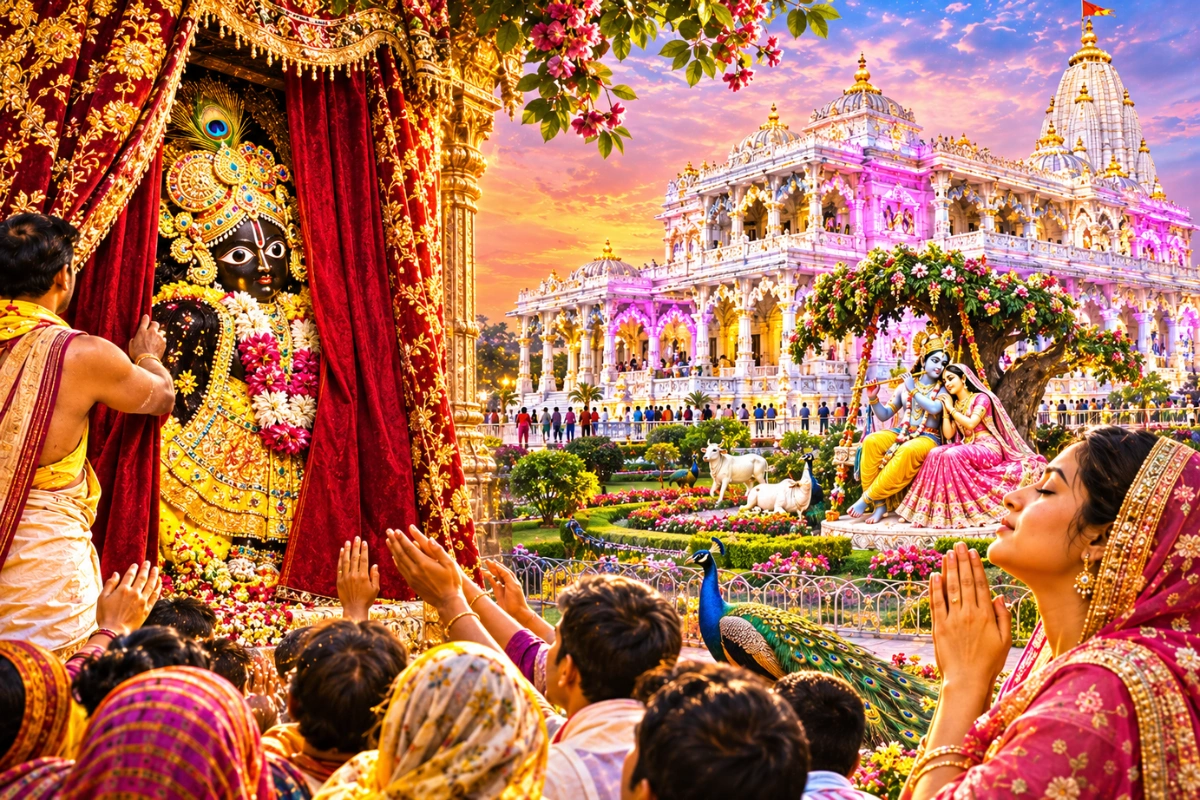
AI Generated Image
The Madness of Divine Love: Where No Bell Rings and the Curtain Draws Every Minute
Shree Vrindavan Bankey Bihari and Prem Mandir (Vrindavan, Uttar Pradesh) offer two distinct encounters with Krishna devotion: the intimate, interrupted glimpses of Bankey Bihari and the expansive devotional storytelling of Prem Mandir. Together, these temples invite a deeper understanding of sacred love—not simply as an emotion, but as attention, service, longing, and surrender. Their traditions reveal why Vrindavan holds such a powerful place in the devotional imagination.
Why Is Vrindavan Considered the Heart of Bhakti?
Vrindavan is celebrated as the heart of Bhakti because its sacred landscape centres on a personal, loving relationship with Krishna. In Hindu tradition, this is the place of his childhood pastimes, where devotion finds expression through remembrance, pilgrimage, and worship. Its importance lies not only in individual monuments, but also in the way an entire town becomes a setting for approaching the divine.
Bhakti is devotion practised as a relationship. Its emotional vocabulary includes friendship, parental tenderness, service, and the yearning of a lover for the beloved. These are not interchangeable feelings; they offer different ways of directing affection towards God.
This helps explain Vrindavan’s civilisational significance. Temples, sacred groves, and pilgrimage traditions give inherited beliefs a visible geography. The revival associated with Chaitanya Mahaprabhu also forms part of the town’s devotional history. Vrindavan is therefore more than a collection of beautiful buildings: it is a landscape through which religious memory continues to be encountered.
For visitors, the useful shift is simple: do not approach every shrine as another sight to complete. Ask what kind of relationship its worship invites. That question makes unfamiliar customs easier to understand without reducing them to curiosities.
Swami Haridas and the Manifestation of Bankey Bihari
According to the temple’s devotional account, Bankey Bihari manifested through the devotion of Swami Haridas at Nidhivan. Radha and Krishna appeared before him and, in response to his prayer, became accessible in a single divine form. Devotees understand the deity as the presence of the divine couple, not merely an artistic representation.
The name also carries meaning. The Mathura district administration explains ‘Bankey’ through Krishna’s posture, bent in three places, known as tribhanga. It records that Haridas Swami originally worshipped the deity at Nidhivan under the name Kunj-Bihari.
The legend makes devotion, rather than conquest or worldly achievement, the turning point of the story. Haridas does not demand a spectacle; his loving worship becomes the occasion for divine presence. Read this way, the account offers a devotional ideal: closeness is received through service, not seized through entitlement.
It is important to preserve the distinction between sacred tradition and independently verifiable history. Describing this as a devotional account does not diminish its meaning. It allows readers to understand what worshippers believe without presenting a miraculous manifestation as an established historical event.
The Madness of Divine Love: Where No Bell Rings and the Curtain Draws Every Minute
At Bankey Bihari Mandir, no temple bells are rung because the deity is served with the tenderness offered to a child. Within this tradition, loud ringing would disturb the divine child’s peaceful state. The absence of bells expresses care rather than a lack of celebration.
Yet an absence of bells does not mean an absence of human sound. Devotee accounts describe crowds calling ‘Radhe Radhe’, with chanting and collective excitement filling the temple atmosphere. In moments of devotional ecstasy, worshippers may sway with the chant, their attention gathered towards the sanctum.
Before the deity, the priest repeatedly draws the sanctum curtain closed and pulls it back, interrupting prolonged eye contact. The temple’s own account connects this interrupted darshan with the overwhelming beauty of Bihariji and the belief that sustained gazing could cause a devotee to lose self-awareness.
This is sometimes described devotionally as preventing worshippers from fainting or swooning under the intensity of the idol’s gaze. That explanation belongs to religious belief, not a medically established effect. Likewise, ‘every minute’ captures the recurring rhythm poetically; it should not be treated as a guaranteed stopwatch interval.
The curtain can also suggest a lesson: a glimpse need not become possession. You receive the moment, then release it. Waiting becomes part of attention rather than an obstacle to it.
What Does Divine Love Madness Mean Beyond Romantic Obsession?
Here, divine love madness describes a poetic condition in which devotion becomes more important than pride, performance, or the desire to control an experience. It is a way of interpreting spiritual longing, not a diagnosis or an instruction to abandon judgement. The phrase is most useful when it points towards humility rather than emotional excess.
Readers exploring divine madness archetypes of romantic love may recognise familiar patterns: yearning, separation, surrender, and the hope of reunion. Bhakti gives such feelings a devotional direction while also recognising relationships beyond romance. Friendship, service, and parental affection are equally important reminders that divine connection need not imitate a love affair.
Three distinctions can keep this language grounded:
- Longing is not ownership. Let the desire for closeness deepen attention without turning it into a demand for constant reassurance.
- Surrender is not helplessness. You can loosen your need to control an experience while retaining boundaries and practical responsibility.
- Wonder is not proof. An intense feeling may be meaningful without establishing that every interpretation attached to it is true.
Understood this way, spiritual madness is metaphorical: love interrupts self-importance. Enchanted love need not mean being dazzled beyond reason; it can mean becoming more receptive to ordinary acts of care. A useful personal test is whether the experience leaves you more patient, honest, and considerate afterwards.
Prem Mandir Gives Sacred Love a Visible Narrative
Prem Mandir offers another expression of devotion in Vrindavan. Established by Jagadguru Shri Kripalu Ji Maharaj and inaugurated in February 2012, it is explicitly presented as the Temple of Divine Love. Its marble architecture, carved panels, and depictions of divine pastimes make religious storytelling central to the encounter.
Rather than treating the complex only as a photographic backdrop, choose one scene and spend time with it. Notice the figures, their gestures, and the relationships being represented. If its meaning is unfamiliar, consult the temple’s interpretive material instead of assuming that every decorative detail tells the same story.
The two temples can prompt different kinds of attention. At Bankey Bihari, consider the meaning of the interrupted glimpse; at Prem Mandir, consider how a story unfolds through a built environment. Neither experience needs to compete with the other, and neither requires you to manufacture a particular emotion.
Transcendent love becomes easier to contemplate when you stop asking whether you have felt something extraordinary. A quieter question may be more fruitful: what does this encounter invite you to notice, remember, or change?
Visiting with Attention Rather Than Urgency
A meaningful visit needs practical preparation as well as openness. Bankey Bihari Mandir’s official guidance states that darshan timings vary by season and identifies weekends, public holidays, auspicious days, and annual festivals as periods of heavy attendance. It advises older visitors, people with disabilities, pregnant visitors, and families with young children to avoid peak days.
Use this short checklist before setting out:
- Check official timings. Confirm each temple’s schedule rather than relying on an old itinerary; allow room for closures and changes.
- Plan around your group’s needs. Choose manageable conditions rather than treating the busiest celebration as compulsory.
- Follow staff directions. Keep moving when asked, and do not hold your position at the expense of another person’s access.
- Leave space between visits. Give yourself time to rest and reflect instead of rushing directly from one emotional setting to another.
- Let observation be enough. You may chant respectfully or remain quiet; neither response needs to become a performance.
Most importantly, do not mistake discomfort for spiritual achievement. You do not need to endure an unsuitable crowd or force an overwhelming experience to make the visit worthwhile. Respectful participation includes respecting your own limits and those of the people beside you.
Carrying the Glimpse Beyond the Temple
The most useful takeaway is not that devotion must be dramatic. It is that love can change the quality of attention: how patiently you wait, how gently you make room, and how readily you release the need to possess a moment.
Let the visit remain an invitation rather than a test. Whether you leave with deep emotion, quiet curiosity, or unanswered questions, sacred love can begin with a modest practice: noticing more carefully and responding with greater care.
Also Read: Sabka Malik Ek: Shirdi’s Global Compassion
To read more such news, download Bharat Express news apps