AI Generated Image
Sabka Malik Ek: The Dusty Village That Became a Global Beacon of Compassion
The Shirdi Sai Baba Temple in Shirdi, Maharashtra, is the spiritual heart of a former village that now welcomes pilgrims from around the world. Its significance rests on Sai Baba’s message of religious unity, humility and service. ‘Sabka Malik Ek: The Dusty Village That Became a Global Beacon of Compassion’ captures that journey: from modest beginnings to a place where devotion finds practical expression in caring for others.
Understanding Shirdi means looking beyond its famous shrine. Its stories, sacred spaces and community meals invite a larger question: what does compassion look like when it becomes part of everyday life?
What Does Sabka Malik Ek Mean in Shirdi?
‘Sabka Malik Ek’ means that there is one divine master of all. Associated with Shirdi Sai Baba, the phrase expresses the unity of God and encourages respect across religious boundaries. The Shree Saibaba Sansthan Trust, which administers the temple, identifies this teaching as central to its purpose.
In practical terms, the message asks people to look past labels before deciding who deserves kindness. A hungry person’s need does not become less important because their prayer sounds different. Nor should someone’s caste, wealth or background determine whether they receive dignity.
Shirdi’s significance lies partly in making that principle tangible. The Trust’s account describes Dwarkamai as a place open to people across caste boundaries, including those excluded by prevailing social hierarchies. That openness offers a useful way to understand the place: unity is not simply a statement about heaven, but a responsibility towards the person standing beside you.
A Simple Fakir and the Shelter of Dwarkamai
Before approaching Shirdi through the grandeur of pilgrimage, begin with a modest dwelling. Sai Baba described himself as a simple fakir and lived in an abandoned Dwarkamai. The Trust’s account describes a damaged mud structure, sparse possessions and a resident largely uninterested in material comfort.
This setting matters because it shifts attention away from status. Spiritual authority, in this story, did not depend on fine surroundings or accumulated wealth. A humble shelter became a place where people sought reassurance and guidance.
One of the best-known local legends concerns the evening lamps. According to devotional tradition, when shopkeepers refused to provide oil, Sai Baba returned to his dwelling and miraculously lit oil lamps with water. The story belongs to the sacred narrative preserved around his life; it should be understood as a religious account rather than a scientifically verified event.
Its meaning need not rest only on the extraordinary flame. Read as a moral story, it invites reflection on generosity, the withholding of help and the possibility of answering rejection without bitterness. For a modern reader, those questions remain useful even without sharing the devotional belief.
How Do Shraddha and Saburi Turn Belief into Compassion?
Shraddha, commonly understood as faith, and Saburi, meaning patience or perseverance, are paired virtues associated with Sai Baba’s teachings. They encourage steadfastness rather than demands for immediate results. Alongside his emphasis on equality and religious harmony, they provide a framework for practising selflessness and universal charity.
The connection becomes clearer when these ideas are treated as habits rather than slogans:
- Shraddha Supports Sincere Action: Help because another person matters, not because praise or repayment is guaranteed. Faith can mean continuing to act responsibly when the outcome remains uncertain.
- Saburi Sustains That Action: Caring for someone, resolving a disagreement or serving a community often takes longer than expected. Patience means remaining engaged without insisting that progress follow your timetable.
- Selflessness Redirects Attention: Before asking what an act of generosity says about you, consider whether it genuinely meets someone else’s need.
- Universal Charity Widens the Circle: Offer assistance without first sorting people into familiar and unfamiliar groups. Compassion becomes more meaningful when it crosses a boundary you would otherwise preserve.
These are practical applications, not promises that faith removes hardship. Together, they suggest a demanding but accessible discipline: remain grounded, avoid contempt and keep doing useful work. A shared meal, a patient conversation or help offered discreetly can give these teachings substance.
Village Life Beneath an International Pilgrimage Centre
Shirdi’s transformation is striking because its story begins in a small village rather than an imperial capital. The district administration describes how Sai Baba’s worldwide following brought prominence to the settlement and continues to draw people of different faiths.
The image of dusty trails is a helpful starting point, but not a complete picture. Contemporary Shirdi should not be mistaken for a village frozen in time. Its international pilgrimage identity belongs alongside, rather than outside, its rural beginnings.
That distinction matters when reading rural stories. Indian villages are not simply picturesque settings for extraordinary figures; village life also provides the everyday context through which stories acquire meaning. In Shirdi’s devotional accounts, familiar objects such as lamps and begging bowls connect spiritual teaching with ordinary needs.
Its cultural heritage therefore deserves more than a hurried photograph. Notice how a place, an object or a remembered act helps explain the relationship between belief and daily conduct. This approach makes the village past meaningful without romanticising poverty or treating present-day residents as scenery.
A Shared Meal at the Solar-Powered Kitchen
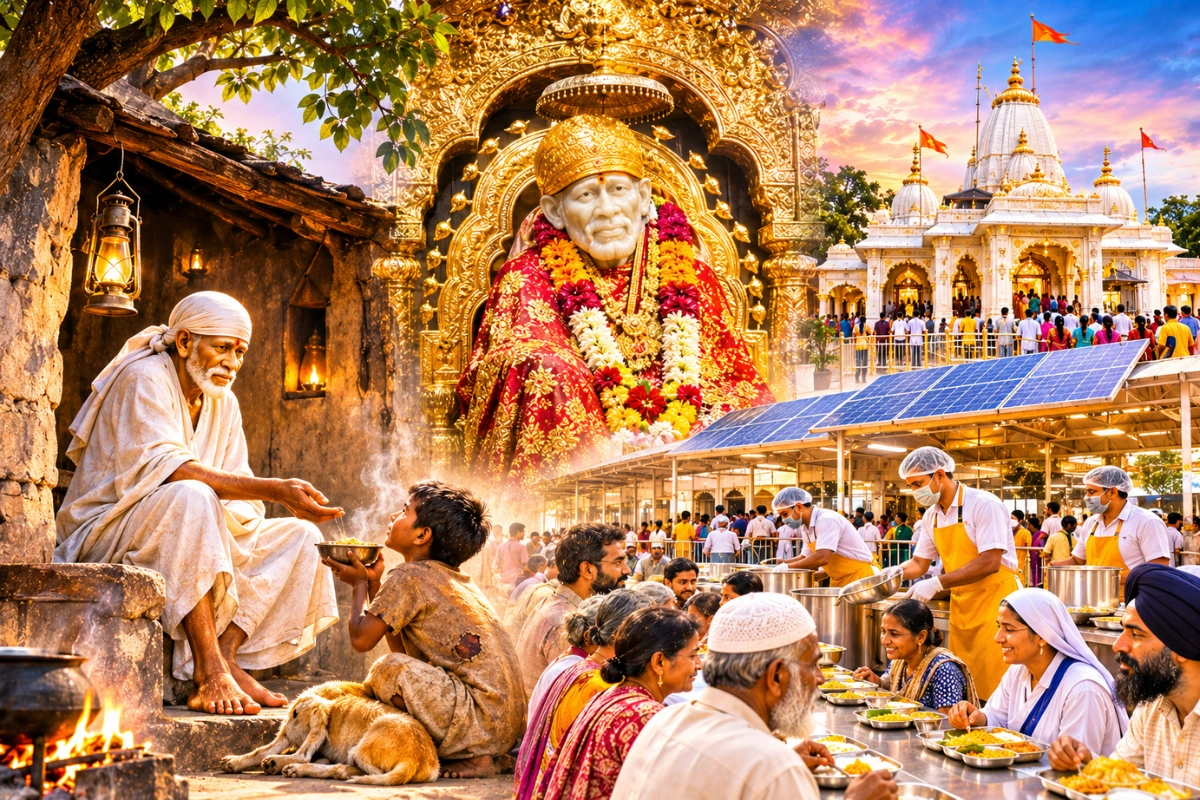
Shri Sai Prasadalaya gives Shirdi’s ethic of service a concrete form. The Trust describes it as a free-food institution continuing Sai Baba’s practice of feeding others. Its mega solar-powered kitchen in India uses concentrated sunlight to generate steam for cooking, linking community care with technology.
Shirdi welcomes people across faiths and from around the world, while the Prasadalaya’s stated principle is food for all. Together, these commitments make shared dining an expression of welcome across faith, caste and nationality. Daily dining can exceed 50,000 people on busy occasions, with reporting describing peaks of around 85,000.
The scale needs careful wording. The Trust describes nearly 50,000 meals a day, but that should not be turned into a guarantee that over 50,000 people eat there every single day. Solar-powered also does not mean exclusively solar-operated: reporting confirms that LPG supports cooking tasks alongside the solar steam system.
Those distinctions do not diminish the achievement. They make it more understandable. Feeding large numbers requires equipment, supplies, energy, cleaning and coordination—not just good intentions. The kitchen offers a practical lesson: compassion becomes dependable when someone builds the systems needed to deliver it.
What Should Visitors Notice Beyond the Main Shrine?
Visitors can deepen their understanding by connecting the Samadhi Mandir with Dwarkamai, Gurusthan and the Prasadalaya. The main shrine houses Sai Baba’s tomb; the other spaces illuminate different aspects of his life, devotional memory and continuing service. Maharashtra Tourism identifies these places as important parts of the Shirdi experience.
Rather than collecting stops, give each place a purpose:
- Begin with the Samadhi Mandir. Approach it as an active place of worship, not merely a landmark. Allow others room for prayer and follow staff directions.
- Pause at Dwarkamai. Consider the contrast between a modest dwelling and its spiritual importance. Let that contrast challenge assumptions about what makes a place worthy of attention.
- Read Legends with Care. Distinguish documented history from devotional testimony. Respecting a community’s beliefs does not require presenting every miraculous account as established fact.
- Treat Shared Food Respectfully. Take only what you expect to eat and follow dining arrangements. Avoid photographing strangers without permission, especially during worship or meals.
- Check Arrangements Through the Trust. Verify booking requirements and visitor information before making plans. The Trust warns about fraudulent websites and unofficial accommodation listings.
Leave room in the visit for observation rather than rushing from one queue to another. You need not share every belief to listen attentively, behave considerately and understand why these spaces matter to others.
Carrying the Message Beyond Shirdi
Shirdi’s story offers more than an inspiring contrast between humble origins and worldwide recognition. It invites a personal test: whether admiration for compassion changes how we behave.
Carry something practical away. Feed someone without seeking credit, remain patient with a person whose needs interrupt your plans, or offer help across a social boundary. The most meaningful tribute to a message of shared humanity is not simply repeating it. It is making another person feel its consequences.
Also Read: Bridge Of Redemption: Holy Wells And Epic Corridor
To read more such news, download Bharat Express news apps