



AI Generated Image
The Bridge of Redemption: 22 Holy Wells and the Longest Carved Corridor on Earth
Shree Ramanathaswamy Temple (Rameswaram, Tamil Nadu) brings together a powerful story of redemption, 22 sacred wells and monumental pillared corridors. Dedicated to Lord Shiva, this living pilgrimage site connects the legend of Lord Ram with rituals of purification and remarkable stone craftsmanship. Understanding those connections makes a visit more meaningful than simply admiring its scale.
Why Is Rameswaram Called a Bridge of Redemption?
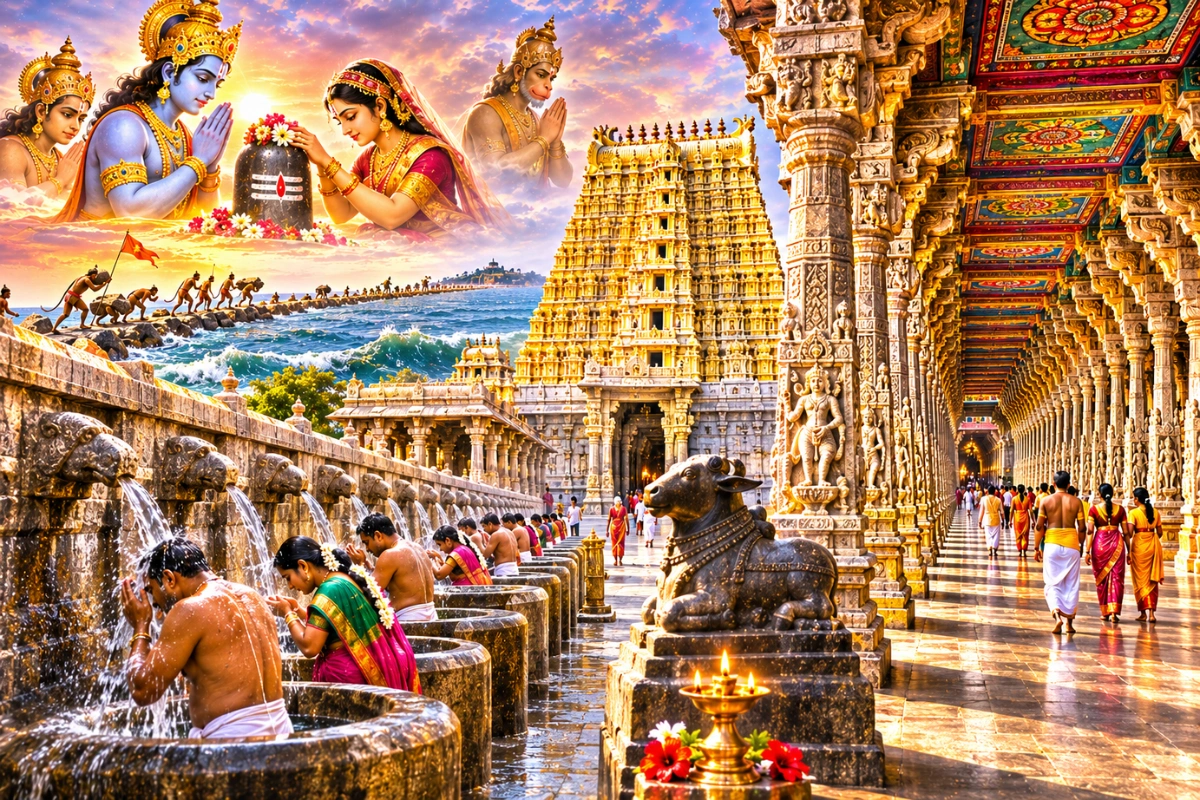
Rameswaram can be understood as a bridge of redemption because its sacred narrative moves beyond victory to repentance: after defeating Ravana, Lord Ram worshipped Shiva here to seek absolution. The bridge belongs to the Ramayana’s story of the crossing to Lanka; redemption belongs to the worship that followed. Together, they offer a way to understand the temple’s enduring spiritual appeal.
In one traditional account, Lord Ram crafted a Lingam of sand here for that worship. Another widely told version attributes the creation of the sand Lingam to Sita: Hanuman had been sent to obtain a Lingam, but his return was delayed, so she prepared one before the auspicious moment passed. Official tourism accounts preserve both versions, making it worth acknowledging the variation rather than presenting a single telling as undisputed history.
The central meaning remains consistent. Even a righteous victory does not remove the need for humility, reflection or reconciliation. Read this way, the legend asks something more demanding than celebrating the defeat of an enemy: it asks what responsibility remains afterwards.
That is what makes the phrase bridge of hope fitting as an interpretation. The story leaves room for renewal after conflict. Visitors need not share every devotional belief to appreciate its invitation to examine their actions and begin again.
A Southern Anchor in India’s Sacred Geography
The temple forms the southern anchor of Adi Shankaracharya’s Char Dham, the fourfold pilgrimage circuit traditionally associated with the philosopher and teacher. Its other destinations are Badrinath in the north, Dwarka in the west and Puri in the east. This is the all-India Char Dham, distinct from the Himalayan circuit often called Chota Char Dham.
Ramanathaswamy also houses one of the 12 Jyotirlingas, placing it among Hinduism’s especially revered shrines to Shiva. Its association with Ram gives it another layer of significance: the district administration describes the site as a meeting point of Shaivite and Vaishnavite devotion. Here, the worship of Shiva and the story of Ram belong to the same sacred landscape.
These connections explain why the temple matters beyond its island setting. It can be approached as a local place of worship, a destination within a national pilgrimage and a setting where different devotional traditions meet. For a visitor, that broader context changes the experience: the corridors are not isolated monuments but part of a much larger religious geography.
What Happens at the 22 Sacred Theerthams?
Devotees traditionally bathe in the 22 sacred Theerthams before entering the inner worship areas for darshan. The wells themselves are within the temple complex, so ‘bathing before entering the temple’ is better understood as purification before approaching the principal shrine, not before crossing the complex’s outer boundary. The practice is associated with cleansing and spiritual renewal.
The ritual gives water a central role in the pilgrimage. Rather than treating arrival as a single moment at the entrance, it makes preparation part of worship. For someone participating, the important consideration is not simply completing a count of wells, but understanding why the bathing precedes the encounter with the deity.
Mineral Differences and Devotional Meaning
The wells are often described as having distinct mineral properties. There is a measurable basis for speaking of differences between them: a pilot study published in 2015, using samples collected in January 2014, recorded variation in water chemistry, including hardness and dissolved mineral constituents. That supports a careful statement about differing mineral profiles, not a claim that every well has a scientifically established therapeutic effect.
Keep three distinctions in mind when reading descriptions of the Theerthams:
- Sacred Significance: Purification and redemption belong to the devotional understanding of the waters.
- Physical Characteristics: Mineral composition can be investigated through water sampling and analysis.
- Claims of Cures: Neither sacred status nor mineral variation alone demonstrates a medical benefit.
You can respect the ritual without confusing these different kinds of meaning. If you plan to participate, ask temple staff how the bathing arrangements work during your visit. Leave enough flexibility to follow local guidance rather than relying on a rigid schedule copied from an older travel account.
Granite Corridors That Reward a Slower Walk
The outer corridor is celebrated for over 1,200 intricately carved granite pillars, commonly counted as 1,212. Their repeated alignment creates the temple’s most recognisable architectural view: column after column receding into the distance. The effect combines monumental scale with details that reward close attention.
The familiar tagline captures that sense of wonder:
The Bridge of Redemption: 22 Holy Wells and the Longest Carved Corridor on Earth
The final phrase needs qualification. India’s national tourism portal describes the temple’s corridors using world-longest language, while another official account calls its Third Corridor Asia’s longest. ‘Longest carved corridor on Earth’ is therefore best treated as an evocative description, not a precisely defined, independently verified architectural record. What is beyond doubt is the extraordinary prominence of the corridors in the temple’s identity.
Look Beyond the Disappearing Perspective
Begin with the long view, but do not let it become the only thing you notice. Choose a pillar and look at how its carved surfaces differ from the broad structural forms around it. Then step back and consider how individual pieces contribute to the rhythm of the whole.
A useful way to organise your attention is to look at three scales:
- The Whole Corridor: Notice the alignment and the relationship between the two rows of supports.
- A Small Group of Pillars: Compare shapes and ornament rather than assuming every column is identical.
- One Carved Detail: Give a single feature the attention you might otherwise reserve for the entire passage.
Treat this as a looking exercise, not a checklist to finish. You do not need specialist vocabulary to notice proportion, repetition or craftsmanship. A slower walk can reveal more than another attempt to capture the perfect vanishing-point photograph.
Preparing for a Respectful, Unhurried Visit
Approach Ramanathaswamy as a functioning place of worship first and an architectural destination second. Its sacred role is not background decoration for the corridors; it is the reason the complex continues to draw pilgrims. Planning around that purpose helps keep your visit considerate.
Before setting out, use a short preparation checklist:
- Confirm Arrangements Directly: Check current opening periods, bathing access, charges, entry conditions and photography restrictions through official temple channels or staff.
- Plan for Changing Clothes: If participating in the Theertham bathing, bring suitable dry clothing and ask where changing is permitted.
- Keep Belongings Manageable: Carry only what you need, and establish storage arrangements before joining any queue.
- Allow Breathing Room: Avoid scheduling an onward departure so tightly that prayer, bathing or waiting becomes a source of stress.
- Ask Before Joining a Ritual: A brief, respectful question is better than copying an action whose meaning or procedure you do not understand.
If travelling with companions, discuss priorities beforehand. One person may want to focus on worship, another on the architecture, and another may prefer not to participate in bathing. Agreeing on those preferences can prevent the visit from becoming a hurried negotiation at the entrance.
The same principle applies to looking and photographing. Where photography is permitted, avoid blocking circulation or treating worshippers as subjects without consent. Where it is restricted, let observation replace the camera; the experience does not become less valuable because it remains unrecorded.
The Meaning That Remains After the Visit
The strongest way to experience this temple is to keep its story, ritual and architecture in conversation. The legend invites reflection on responsibility; the wells express preparation and renewal; the corridors invite sustained attention. Each offers a different way to slow down.
Seen together, they make the bridge of redemption more than an attractive phrase. It becomes a lens for approaching the visit: not as a race through famous sights, but as an opportunity to consider how people seek forgiveness, practise devotion and give those aspirations lasting form.
Also Read: Discover The Submerged Kingdom: Krishna’s Maritime Empire
To read more such news, download Bharat Express news apps