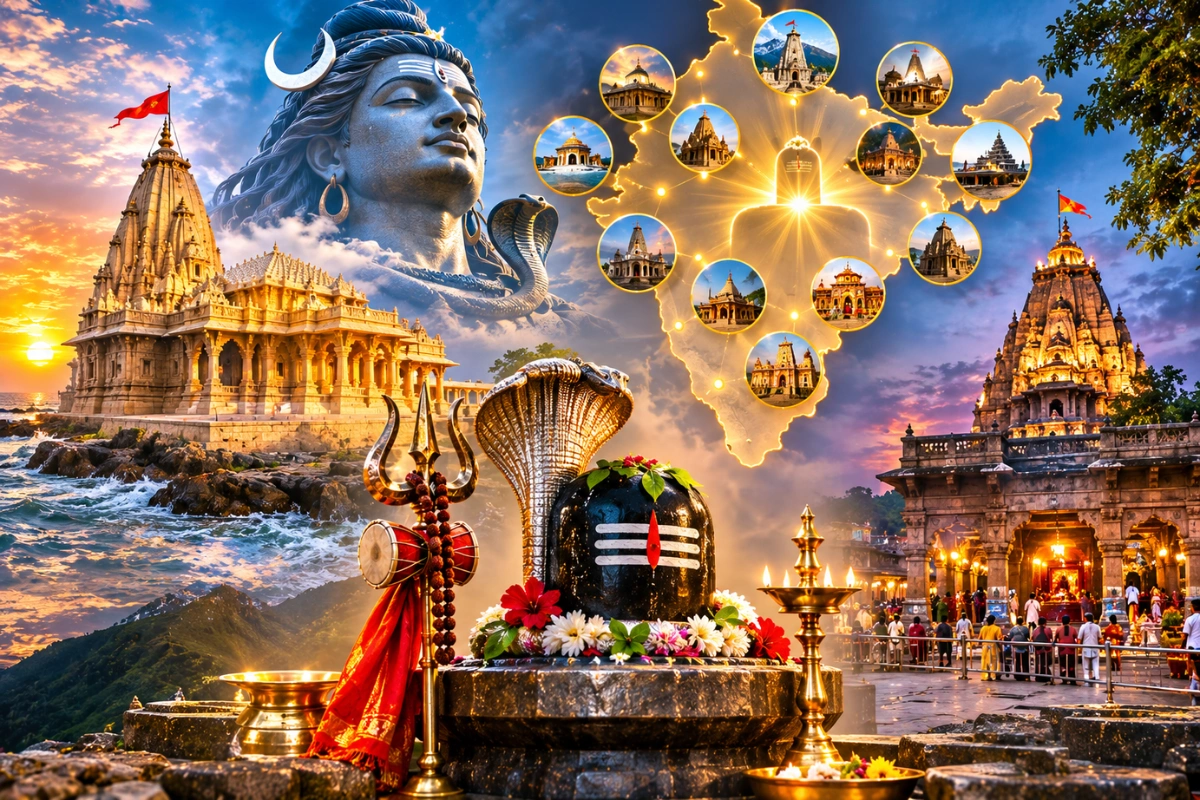
AI Generated Image
The Resilient Flame: The Jyotirlingas That Survived Empires and Time
The Jyotirlingas are sacred manifestations of Lord Shiva, worshipped at twelve principal shrines across India. Their significance extends beyond architecture: they connect living devotion with stories of destruction, rebuilding, protection and renewal. Somnath and Mahakaleshwar offer particularly powerful ways to understand this endurance, while the wider pilgrimage reveals a sacred geography that transcends any single kingdom or era.
What Are Jyotirlingas, and How Many Are There in India?
There are twelve principal Jyotirlingas in Hindu tradition. The term combines jyoti, meaning light, with linga, meaning sign or mark. Together, they express Shiva’s radiant presence. These shrines are revered as places of divine manifestation rather than simply twelve notable examples of temple architecture.
According to the Shiva Purana tradition, Shiva appeared as an infinite pillar of light. This image offers a way to contemplate divinity beyond ordinary limits: a presence without a measurable beginning or end. The twelve Jyotirlingas of Lord Shiva give this expansive idea particular places where devotees can gather, pray and seek darshan.
This distinction matters when considering their survival. A temple building can be damaged or replaced without diminishing the meaning believers attach to its sacred site. Resilience, in this context, includes both the rebuilding of stone structures and the renewal of commitment to worship.
The 12 Jyotirlingas in India: A Sacred Geography
A widely followed list connects the twelve names with the following locations. Maharashtra Tourism’s published pilgrimage leaflet uses these identifications, making them a useful starting point for understanding the circuit.
| Jyotirlinga | Commonly Identified Location | State |
|---|---|---|
| Somnath | Prabhas Patan, near Veraval | Gujarat |
| Mallikarjuna | Srisailam | Andhra Pradesh |
| Mahakaleshwar | Ujjain | Madhya Pradesh |
| Omkareshwar | Omkareshwar, Khandwa district | Madhya Pradesh |
| Kedarnath | Kedarnath | Uttarakhand |
| Bhimashankar | Bhimashankar, Pune district | Maharashtra |
| Kashi Vishwanath | Varanasi | Uttar Pradesh |
| Trimbakeshwar | Trimbak, Nashik district | Maharashtra |
| Vaidyanath, or Baidyanath | Deoghar | Jharkhand |
| Nageshwar | Near Dwarka | Gujarat |
| Ramanathaswamy | Rameswaram | Tamil Nadu |
| Grishneshwar | Near Ellora | Maharashtra |
These locations follow the published circuit outlined above. Regional traditions also associate particular Jyotirlinga names with other shrines. Aundha Nagnath and Parli Vaijnath are important examples in Maharashtra’s devotional landscape. Recognising these variations helps readers avoid treating one itinerary as a dismissal of another community’s faith.
Seen together, the shrines invite a broader understanding of pilgrimage. The destination is not merely the next temple on a checklist. It is an opportunity to encounter how a shared devotion takes root in different places, languages and local traditions.
Why Is Somnath Called ‘The Shrine Eternal’?
Somnath is called ‘The Shrine Eternal’ because its repeated restoration has become an enduring expression of devotion and cultural renewal. Standing at Prabhas Patan in Gujarat, on the shores of the Arabian Sea, it brings together a sacred legend of restored light and a history of rebuilding after destruction. The epithet also appears in K. M. Munshi’s work Somanatha: The Shrine Eternal.
The Moon’s Return to Light
In sacred tradition, Chandra, the Moon God, lost his radiance under a curse and worshipped Shiva at this site. Through divine grace, his light was restored. Somnath’s name, understood as ‘Lord of the Moon’, preserves this association with recovery and renewal.
The legend offers more than an explanation of the name. For a devotee contemplating loss, the return of light can become an image of hope. It also gives Somnath’s later history a resonant spiritual setting: renewal belongs to the shrine’s sacred story as well as its reconstruction.
Rebuilding Without Simplifying History
Somnath suffered repeated attacks and destruction over the centuries, followed by successive restorations. Official accounts identify the attack of 1026 as a major turning point and describe later contributions by rulers and devotees, including Ahilyabai Holkar. Its endurance was therefore not the result of a single act of rescue, but of the efforts of different generations.
The formulation that the temple was ‘destroyed seven times by invaders and rebuilt eight times by the will of Bharat’ should not be presented as an established historical tally. Accounts differ in how they count attacks, repairs, reconstructions and replacement shrines. The securely supported point is that repeated destruction was followed by determined renewal. That history is powerful without forcing it into an uncertain numerical formula.
Sardar Patel’s Vision of Restoration
After Independence, Sardar Vallabhbhai Patel visited Somnath in 1947 and resolved to rebuild it. The reconstructed shrine’s consecration in 1951 became a landmark of cultural self-confidence. In this sense, supporters regarded Sardar Patel’s vision of civilisational restoration as fulfilled, although Patel died before the ceremony.
This distinction keeps the tribute accurate. Patel helped set the restoration in motion, while others carried the work forward. Somnath’s modern renewal, like its earlier history, depended on a commitment that extended beyond one lifetime.
What Makes Mahakaleshwar the Lord of Time?
Mahakaleshwar in Ujjain is worshipped as Shiva in his form as the Lord of Time, or Kala, and death. The name Mahakal brings together maha, meaning great, and kaal, associated with time and death. Its spiritual significance lies in approaching a divine presence understood to transcend the limits governing human life.
The temple is especially famous for its daily Bhasma Aarti, which uses sacred ash. This early-morning worship places ash at the heart of devotion. Madhya Pradesh Tourism explains that the ash used today is prepared from cow dung, distinguishing the present practice from accounts associating the ritual’s past with funeral ash.
Viewed symbolically, ash offers a striking reminder of impermanence. Possessions, status and physical strength cannot stop time. Worship at Mahakal invites a different response to that reality: humility, attention and devotion rather than the illusion of complete control.
Mahakaleshwar’s architectural history also includes destruction and restoration. The temple’s official history records its destruction during Iltutmish’s invasion in 1235, while Madhya Pradesh Tourism dates the present structure to the eighteenth century. Its endurance is therefore best understood as the renewal of sacred life, not the uninterrupted survival of an unchanged building.
Civilisational Immortality Through Living Devotion
For devotees, Somnath and Mahakaleshwar symbolise civilisational immortality: the capacity to transmit faith and meaning despite historical upheaval. This is a spiritual interpretation of endurance, not a claim that buildings escape decay. The distinction allows reverence and historical understanding to strengthen one another.
Millions travel to Ujjain to seek Mahakal’s blessings and visit Somnath as part of their pilgrimage. Government reporting documents substantial visitor numbers at both destinations, although city arrivals and temple visits should not be treated as identical measures. These journeys demonstrate the continuing importance of sacred places in contemporary life.
Their civilisational significance becomes clearest when pilgrimage is understood as participation. Visitors do not simply observe what earlier generations preserved. By learning the stories, respecting worship and passing that understanding onwards, they can help sustain this inheritance.
The Jyotirlingas in Maharashtra and Regional Devotion
Bhimashankar, Trimbakeshwar and Grishneshwar form the commonly listed group of three Jyotirlingas in Maharashtra. Maharashtra Tourism also encourages visitors to recognise Aundha Nagnath and Parli Vaijnath within the wider Shiva pilgrimage landscape. This makes the state particularly useful for understanding the relationship between a familiar national circuit and regional devotional traditions.
Avoid reducing these temples to interchangeable stops. Read each shrine’s account of its deity, legends and worship before arriving. Where identifications differ, listen respectfully and distinguish local belief from the particular list you are following.
Visiting Jyotirlinga Temples with Greater Understanding
A meaningful pilgrimage needs room for attention, not just movement. Use these principles to prepare without turning the journey into a race:
- Separate legend from chronology. Appreciate sacred narratives as religious traditions while checking historical dates and reconstruction claims against reliable sources.
- Confirm ritual arrangements directly. Consult the relevant temple administration for current entry procedures, permitted belongings, dress requirements and special-worship arrangements.
- Choose depth over completion. Allow time to understand one shrine rather than compressing several into hurried visits.
- Respect worshippers’ privacy. Ask before photographing people and follow restrictions around sanctums and ceremonies.
- Carry the learning home. Record what you discovered about each shrine’s history and traditions, not merely that you visited.
The Flame Carried Forward
The enduring lesson of the Jyotirlingas is not that sacred places remain untouched by time. It is that devotion can inspire people to restore, reinterpret and care for them. Somnath and Mahakal invite a thoughtful response: remember the past accurately, approach the present respectfully and help preserve what future generations will inherit.
Also Read: Trikuta Cave Trek: A 14-KM Spiritual Adventure
To read more such news, download Bharat Express news apps