AI Generated Image
The Realm of Infinite Faith: Why 80,000 Souls Daily Offer Their Pride to Lord Venkateswara
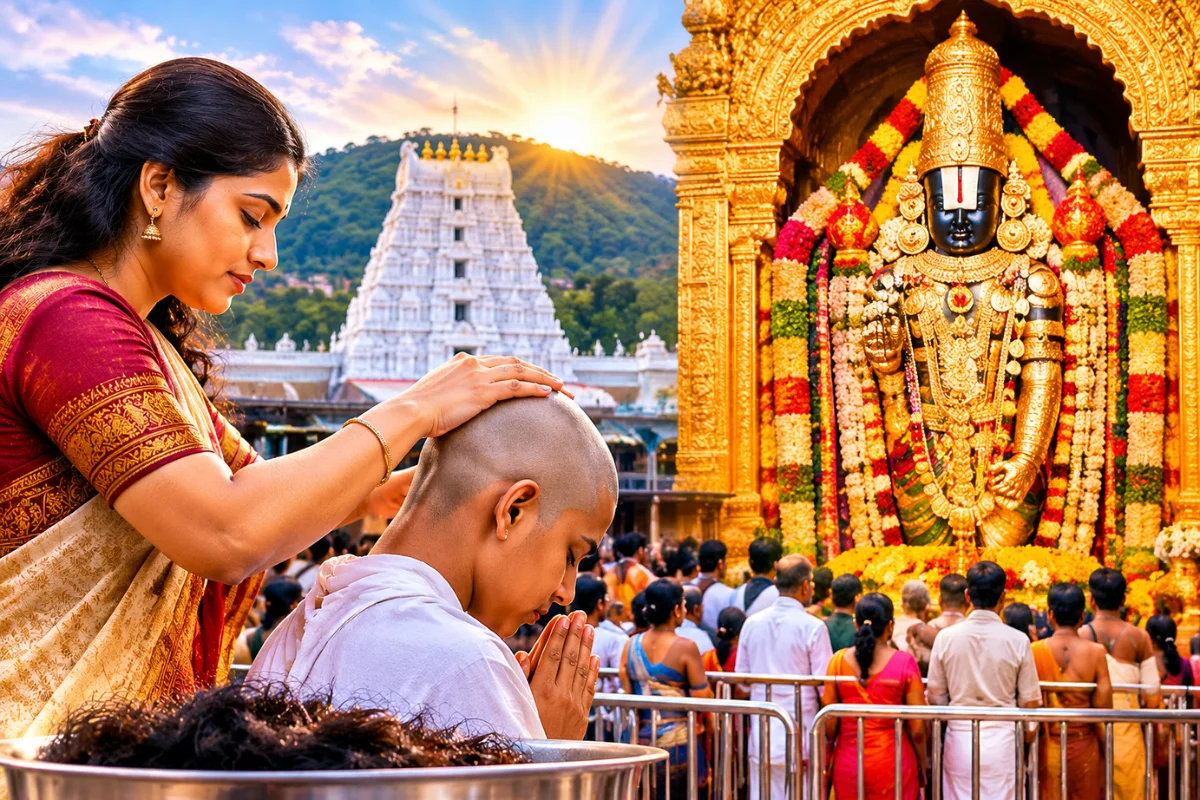
Offering hair to Lord Venkateswara at Tirumala is a devotional practice associated with surrender, gratitude and the fulfilment of vows. Tirumala Tirupati Devasthanams (TTD) describes tonsuring as an expression of saranagati, or surrender to the divine. Understanding this offering means looking beyond the shaved head to the intention behind it—and distinguishing the number of temple visitors from those who actually offer their hair.
Why Do Devotees Offer Their Hair to Lord Venkateswara?
Devotees offer their hair to Lord Venkateswara to fulfil vows, express gratitude and symbolically surrender their ego. A TTD publication explains that some pilgrims associate tonsuring with removing pride from the mind and heart, while others undertake it while seeking blessings or expressing gratitude for prayers they believe have been answered. The same outward act can therefore carry different personal meanings.
The symbolism invites a simple reflection: what happens when something closely tied to appearance is willingly given away? Viewed through this devotional lens, the offering becomes a way of loosening attachment to how one is perceived. Its significance lies not in treating beauty as wrong, but in refusing to make appearance the measure of personal worth.
Calling this an offering of pride is therefore best understood as a spiritual interpretation, not a judgement about every pilgrim. A shaved head cannot reveal someone’s inner life. What matters is the sincerity with which a person approaches the act, rather than an observer’s assumptions about their devotion.
Understanding the 80,000 Figure
The image of 80,000 people surrendering their pride each day is powerful, but it requires an important distinction. The number of people receiving darshan is not the same as the number undergoing tonsure. Darshan refers to the sacred encounter of seeing the deity, while tonsuring is a separate offering recorded independently in TTD’s reports.
For example, on July 27, 2026, TTD reported that 80,003 pilgrims received darshan and 32,918 underwent tonsure. The following day, it recorded 78,709 darshan visitors and 31,312 tonsures. These figures illustrate both the scale of devotion and why 80,000 daily hair offerings should not be presented as a verified constant.
Respecting this distinction does not diminish the tradition. Tens of thousands of individual offerings need no exaggeration to be meaningful. Behind each recorded tonsure is an intention that a daily total cannot explain: a promise, a prayer, an expression of gratitude or a family observance.
The Deity at the Heart of the Devotion
Lord Venkateswara is worshipped as a form of Vishnu at Tirumala. TTD identifies him by names including Srinivasa and Balaji, while its description of the shrine also refers to him as the Lord of the Seven Hills. These names belong to the devotional setting in which the hair offering takes place.
Readers searching for ‘Lord Tirupati’ are generally looking for this same deity and pilgrimage tradition. More precisely, the shrine stands at Tirumala, in the hills associated with Tirupati in Andhra Pradesh. Keeping the place and the deity distinct helps newcomers understand references to Tirupati Balaji, the Tirumala temple and Lord Venkateswara.
Within this setting, infinite faith in Lord Venkateswara can be understood as an enduring willingness to turn towards the divine. It need not be described as uninterrupted certainty or a promise that every wish will come true. A more thoughtful understanding leaves room for hope, disappointment, gratitude and questions without reducing devotion to a transaction.
This distinction matters when discussing spiritual belief. Rather than suggesting that an offering purchases a particular outcome, consider it a way to express commitment. The prayer may concern a hoped-for change, but the offering can also invite a change in how the devotee approaches life’s uncertainties.
How Does a Hair Offering Become an Act of Surrender?
A hair offering becomes an act of surrender through the intention attached to it, not through the haircut alone. TTD explicitly connects tonsuring with saranagati, describing the practice as a way for devotees to fulfil their vows to Lord Venkateswara. The physical act gives visible form to an inward commitment.
To explore that meaning personally, consider the difference between giving something away reluctantly and offering it freely. The first can feel like deprivation; the second can become a deliberate acknowledgement that possessions and appearance do not define the whole self. This is a useful way to reflect on the ritual without claiming that every participant experiences it identically.
TTD’s account of the tradition describes several forms of participation, including a child’s first tonsure, full head shaving and symbolic offerings involving a few cuts of hair. It also describes pilgrims who allow their hair to grow before offering it at Tirumala. These variations caution against assuming that there is only one personal story behind the practice.
For reflection, the offering can raise three useful considerations:
- Gratitude: Identify what you are thankful for without comparing your circumstances with another person’s life.
- Attachment: Notice whether appearance, recognition or control has become too important to your sense of worth.
- Commitment: Consider how the intention behind the offering might influence your conduct after the pilgrimage.
These are invitations, not tests of faith. No visitor needs to prove an inward transformation to someone watching. The practice deserves respect without turning it into a competition over sacrifice.
Approaching the Tradition With Care
At Tirumala, designated tonsuring facilities are known as Kalyanakattas. TTD states that tonsuring at its Kalyanakattas is provided free of charge and describes token and queue arrangements for pilgrims. Anyone planning an offering should confirm the current arrangements through official TTD information rather than relying on an old itinerary or an unofficial promise.
Preparation should protect the meaning of the visit rather than overwhelm it. Leave room for practical needs, honest discussion and the preferences of the people travelling with you. A solemn intention is not made stronger by rushing, embarrassment or pressure.
A respectful approach includes the following:
- Clarify your intention. Consider whether the offering expresses gratitude, fulfils a vow or marks a personal commitment. You do not need an elaborate explanation, but understanding your own reason can prevent the act from feeling automatic.
- Use official guidance. Check TTD’s current information for services and access arrangements. Treat social media advice as something to verify, especially when it involves payments or assurances of special treatment.
- Respect individual choice. Discuss the offering privately and without coercion. Do not equate reluctance, a different practice or a decision not to undergo tonsure with lesser devotion.
- Preserve others’ dignity. Avoid photographing people during intimate devotional moments without permission. Curiosity about a tradition does not outweigh another person’s comfort.
- Allow space afterwards. Instead of immediately judging whether you feel transformed, take a quiet moment to acknowledge what the offering meant to you.
What Does Unwavering Faith Look Like Beyond the Pilgrimage?
Unwavering faith can be understood as a continuing commitment to live by one’s values, rather than a demand to feel certain every day. In this understanding, faith in God makes room for questions while encouraging humility, responsibility and compassion. It should not require denying distress or pretending that difficult experiences are easy.
The most useful follow-through is concrete. If the offering represents releasing pride, practise listening without preparing a defence. If it expresses gratitude, thank someone whose work you usually overlook. Similarly, if it marks a fresh commitment, choose one promise you can realistically keep.
Consider these as modest personal practices, not guaranteed results of pilgrimage. A ritual does not remove the need to apologise, care for family, meet responsibilities or seek appropriate help. Its meaning can instead become a reminder to approach those responsibilities with greater honesty.
Infinite faith need not mean making infinite claims. It can mean returning repeatedly to a sincere intention, even when doing so is quiet, inconvenient or unseen.
The Deeper Offering Is Humility
The significance of offering hair to Lord Venkateswara is not captured by a dramatic daily number. It rests in the relationship between an outward gesture and an inward intention: gratitude without entitlement, hope without guarantees and surrender without the loss of personal dignity.
Whether you approach Tirumala as a devotee or a curious reader, resist measuring faith by appearance or spectacle. The more lasting question is what follows the offering. A moment of surrender becomes meaningful when its spirit accompanies a person home.
Also Read: Balancing Parliamentary Decorum: Dissent And National Interest
To read more such news, download Bharat Express news apps