



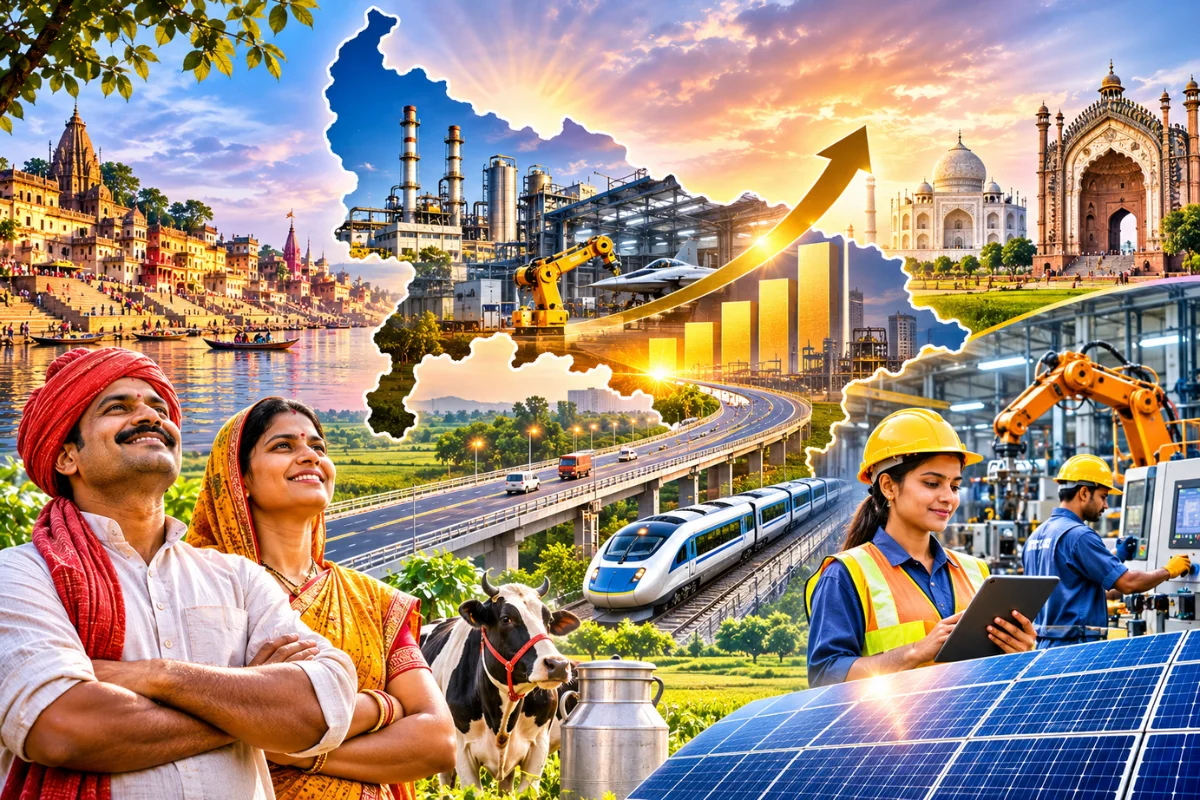
AI Generated Image
The $1 Trillion Uttar Pradesh: A Development Journey from the BIMARU Stigma to an Industrial Revolution
Uttar Pradesh’s development journey marks a shift from a reputation for economic disadvantage towards an ambition built around manufacturing, infrastructure, rural enterprise and skilled employment. The state’s transformation agenda includes a US$1 trillion economy target, with its State Transformation Commission presenting 2030 as the vision year—not an achievement already secured. Understanding this journey means looking beyond investment announcements to the factories, services and livelihoods that turn ambition into everyday progress.
What Does Uttar Pradesh’s $1 Trillion Ambition Mean?
The ambition is to expand the annual value of goods and services produced within Uttar Pradesh to US$1 trillion. It is an economy-wide goal, not a government spending allocation or a total of investment commitments. The State Transformation Commission connects this ambition with evidence-based policy, performance monitoring and coordination across departments.
For readers following Uttar Pradesh’s development, the distinction matters. A proposed factory represents potential investment; an operating factory contributes to production and employment. Likewise, a larger economy should be assessed alongside household prosperity, rather than treated as proof that every district or family has benefited equally.
A useful reading of the target therefore asks three questions: What is being produced? Who is earning more? And can that progress continue without weakening essential public services or environmental safeguards?
Moving Beyond the BIMARU Label
BIMARU grouped Bihar, Madhya Pradesh, Rajasthan and Uttar Pradesh under a shorthand associated with development challenges. Demographer Ashish Bose, who coined the term, explained that the grouping drew attention to population size, geographical proximity and socioeconomic conditions. It was a diagnosis of disadvantage, not a permanent limit on these states’ potential.
The most useful way to move beyond that stigma is not to replace it with another sweeping label. Instead, progress should be judged through better employment, stronger local businesses, dependable infrastructure and wider access to opportunity.
Calling the transition an ‘industrial revolution’ should therefore describe a direction of change, not imply that transformation is complete. The stronger test is whether new industrial activity creates lasting links with local workers, suppliers and communities.
Infrastructure That Connects Production With Markets
Uttar Pradesh’s infrastructure strategy brings together expressways, rail freight connections, logistics facilities and industrial corridors. Invest UP identifies the Agra–Lucknow and Purvanchal expressways within the state’s connectivity network, alongside opportunities linked to freight corridors and multimodal logistics. These assets form part of the framework intended to connect production centres with wider markets.
Their practical value depends on what happens beyond the main carriageway. A food processor needs reliable access from farms to its collection centre. A component manufacturer needs predictable freight movement, usable industrial land and dependable utilities—not simply a nearby expressway.
For businesses assessing a location, the sensible checklist includes:
- Last-mile access: Can trucks reach the actual site without recurring bottlenecks?
- Utility readiness: Are power, water and waste-management arrangements suitable for production?
- Supplier connections: Can local enterprises meet purchasing and delivery requirements?
- Workforce access: Can employees travel safely and affordably to the workplace?
These checks help distinguish infrastructure visibility from infrastructure usefulness.
Industrial Growth Needs Operating Businesses
The Uttar Pradesh Defence Industrial Corridor provides a concrete example of the manufacturing push. Its six nodes cover Aligarh, Agra, Jhansi, Chitrakoot, Kanpur and Lucknow. In a March 2026 release, Invest UP reported nine operational units while separately identifying investment proposals and land allotments—an important distinction between planned activity and functioning production.
The next question is how much surrounding enterprise these facilities can support. Policymakers and industry associations should examine opportunities for smaller firms to supply components, packaging, maintenance and other services. Supplier development deserves attention alongside efforts to attract large anchor investors.
Traditional enterprises also belong in this story. Uttar Pradesh’s One District One Product programme includes support such as training, equipment, financial assistance and technical guidance for district-specific producers. It offers another route for connecting existing capabilities with stronger businesses, rather than treating industrial development as an entirely new beginning.
UP Urban Development Must Support Daily Life
UP urban development is not only about prominent buildings or major transport projects. Uttar Pradesh’s Urban Development Department identifies drinking water, roads, drainage, sanitation, waste disposal, sewerage, lighting and public spaces among the responsibilities of urban local bodies. Its programme framework includes AMRUT, Swachh Bharat Mission and Smart City Mission.
For the development agenda, these basics deserve the same scrutiny as flagship investments. A sensible assessment should ask whether workers can live near employment, whether neighbourhoods remain accessible during heavy rain and whether growing settlements receive functioning services.
Municipal planning should also anticipate growth rather than respond after pressure builds. Before expanding an industrial area, planners should examine housing, transport, drainage and service-maintenance requirements together. The recommendation is straightforward: assess the surrounding settlement as carefully as the investment site.
How Can Rural Households Share in Industrial Growth?
Rural households can participate through stronger producer organisations, viable small enterprises, skills and connections to buyers. The Rural Development Department, Uttar Pradesh, provides an institutional base for this through the Uttar Pradesh State Rural Livelihood Mission. Its framework includes self-help groups and federations at village and cluster levels.
The priority should be to connect the organisation with commercial viability. Before supporting a village enterprise, assess demand, production costs, quality requirements and payment arrangements. Forming a group or purchasing equipment should be the beginning of business development—not the final measure of success.
For example, a proposed food-processing group should identify potential buyers before choosing machinery. It should also understand packaging needs, storage arrangements and the working capital required between purchasing inputs and receiving payment. These are practical planning questions, not guarantees of profitability.
That approach keeps rural development connected to markets while leaving room for enterprises suited to local resources and household circumstances.
Dairy Development Links Farms With Value-Added Production
Dairy development in Uttar Pradesh connects agricultural livelihoods with processing and consumer markets. The Dairy Development Department, Uttar Pradesh, presents the state’s Dairy Development and Milk Products Promotion Policy 2022 as a framework covering eligible cooperatives, farmer producer organisations, milk producer companies and private entrepreneurs. Invest UP also identifies an investor-support function within the department.
The development opportunity should be evaluated across the chain, not only through herd expansion. Collection, testing, chilling, processing and marketing all deserve attention when assessing whether a proposed dairy business can operate reliably.
For a farmer considering expansion, the first step should be to establish the buyer’s collection schedule, quality-testing process and payment terms. For a processor, supply consistency and product demand should come before equipment selection. Dairy policy can provide a framework, but each enterprise still needs a workable operating plan.
Renewable Energy and Skills Strengthen the Foundations
The Uttar Pradesh New and Renewable Energy Development Agency, or UPNEDA, is the nodal agency identified in the state’s Solar Energy Policy 2022. Its official portal also provides access to bioenergy policy resources and project-related portals. Renewable energy therefore forms a distinct part of the state’s development framework.
Project decisions should nevertheless begin with site-specific assessments. A business considering rooftop solar should examine roof suitability, electricity consumption, connection requirements and maintenance responsibilities. A bioenergy proposal should test feedstock availability and collection arrangements before assuming that agricultural residues automatically make a project viable.
People need equally careful investment. The Uttar Pradesh Skill Development Mission describes its purpose as coordinating employment-oriented, placement-linked vocational training, including access for disadvantaged groups and women. Its published training requirements also address on-the-job training and post-placement support.
For learners, a useful course assessment goes beyond the certificate: ask about practical training, employer connections, likely job locations and support after placement. For programme managers, sustained employment should matter more than enrolment alone.
Measure the Journey Through Outcomes
A credible development scorecard should separate resources committed from benefits delivered. The State Transformation Commission’s stated emphasis on outcome-based governance provides a relevant framework for that approach.
Readers can apply five practical tests:
- Investment conversion: Distinguish proposals, construction and commercial production.
- Employment quality: Examine earnings, safety, retention and advancement—not just hiring totals.
- Regional participation: Check whether smaller towns and rural producers gain meaningful access.
- Service reliability: Assess functioning water, transport and sanitation systems after construction.
- Enterprise durability: Follow whether supported businesses retain customers and remain viable.
The takeaway is simple: Uttar Pradesh’s trillion-dollar ambition is best understood as a development challenge, not a finish line already crossed. Its strongest expression will be productive businesses, capable workers, viable rural enterprises and places where daily life improves. That is the standard against which the journey should be judged.
Also Read: Bharat’s Zero-Tolerance Approach To Cross-Border Proxy Wars
To read more such news, download Bharat Express news apps