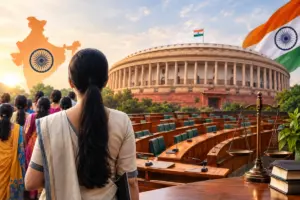




AI Generated Image
By Dr Shalini Ali
I have sat through enough seminars on women’s empowerment to know how they usually end. Someone quotes a statistic, someone else quotes a verse, the hall applauds, and the women in the back rows go home to villages where men still decide where the handpump goes. So forgive me if I sound impatient.
The Nari Shakti Vandan Adhiniyam was passed in September 2023 with almost no dissent. Three years on, not a single woman has entered the Lok Sabha because of it. The law exists. The seats do not.
The reason lies in one clause. Article 334A, inserted by the 106th Amendment, says the reservation begins only after a delimitation exercise based on the first Census taken after the Act came into force.
Put in plain language: wait for the Census, wait for its figures, wait for a Delimitation Commission, and then wait while it redraws 543 Lok Sabha and roughly 4,000 Assembly constituencies.
People who have worked through the timetable put the realistic start date at 2033 or 2034. A girl born the year the Act was passed would be in Class 5 by then.
That is why I support the Delimitation Bill and the Constitution (131st Amendment) Bill, and why I believe they should come back to Parliament now. Reports this week suggest the Centre is considering a special session before the end of October. I hope it goes ahead.
What Happened in April
On 16 April 2026, the government introduced three bills together: the 131st Amendment, the Delimitation Bill, 2026, and the Union Territories Laws (Amendment) Bill. The idea was simple enough.
Allow delimitation on the latest available Census figures instead of waiting for the next one, expand the Lok Sabha to as many as 850 seats, and reserve about 273 of them for women in time for the 2029 general election.
The next day, the amendment received 298 votes in favour and 230 against. That is a clear majority, but not the two-thirds a constitutional amendment needs. The other two bills were withdrawn.
Every member has the right to vote as they see fit. I only want to set out, as plainly as I can, why the case for these bills is stronger than the case against them.
1. The Numbers Have Stopped Moving on Their Own
We are often told women will rise naturally as parties mature. The record says otherwise. Women accounted for about 5 per cent of the first Lok Sabha. It took nearly seven decades to reach the peak of 14.4 per cent, or 78 women, in 2019. In 2024, we slipped back to 74, which is 13.6 per cent. Of nearly 800 women who contested, fewer than one in ten won.
Representation at the state level is even lower. The Association for Democratic Reforms counted 390 women among 4,123 MLAs, about 9 per cent. Meanwhile, the global average for women in national parliaments is close to 27 per cent. We are not catching up with the world. In the last election, we actually went backwards.
When a line stays flat for seventy years, it is not waiting for more encouragement. It needs a structural push.
2. We Have Already Run the Experiment, and It Worked
India does not have to look abroad to see what reservation does. We tried it at home. The 73rd and 74th Amendments of 1992–93 reserved one-third of panchayat and municipal seats for women.
According to figures the Centre gave in April 2026, women now make up 49.7 per cent of elected panchayat representatives, about 12.14 lakh out of 24.41 lakh. Bihar went to 50 per cent in 2006, and many states followed. Nothing collapsed.
The change was not only cosmetic. Economists Raghabendra Chattopadhyay and Esther Duflo studied randomly reserved panchayats in West Bengal and Rajasthan and published their findings in Econometrica in 2004.
Where a woman headed the council, spending moved towards what women in the village had been asking for, and drinking water was at the top of that list. A woman pradhan knows exactly how far the walk to the well is.
Yes, the “sarpanch pati” problem is real. In the early years, husbands often ran things from behind the chair. But a generation later, many of those women make their own decisions, and their daughters grew up seeing a woman’s name on the office board. That shift in what a village considers normal is worth a great deal.
3. Expansion Means Nobody Has to Be Pushed Out
One quiet reason this reform stalled for 27 years, from the Deve Gowda government’s bill in 1996 until 2023, is that it threatened sitting male MPs. Reserve 181 seats inside a fixed House of 543 and you are asking 181 men to give up their constituencies. Very few politicians vote for their own retirement.
The Delimitation Bill gets around this by enlarging the House. Women gain seats without anyone losing theirs. A zero-sum fight becomes a positive-sum reform. That is not a trick. It is the only design that has ever had a realistic chance of passing.
4. Delimitation Is Overdue in Its Own Right
Leave women out of the picture for a moment and the freeze on seats is still hard to defend. Seat allocation has rested on the 1971 Census since 1976, and the freeze was extended again in 2001.
The Home Minister told the Lok Sabha in April that 127 constituencies now have more than 20 lakh voters each. No MP can meet, hear or properly answer to two million people. One person, one vote, one value is a constitutional principle, and for half a century we have let it erode.
So linking the two reforms is not opportunism. Both were postponed for the same reason, political discomfort, and the same exercise can settle both.
5. Rotation Keeps the System Fair
Some worry that reserved seats will turn into permanent fiefdoms. The bills provide for rotation, so the particular constituencies reserved for women change after each delimitation cycle. That spreads opportunity across regions, keeps any group of voters from feeling permanently boxed in, and stops parties from parking token candidates in the same safe seats forever.
6. The SC and ST Sub-Quota Reaches the Women Most Often Left Out
The reservation is vertical. Within the one-third, seats are set aside for women from Scheduled Castes and Scheduled Tribes. Dalit and Adivasi women have been among the least represented people in our legislatures. This provision makes sure the reform is not just a ladder for women from families that already hold power.
7. Other Countries Show What a Firm Date Achieves
Rwanda wrote a 30 per cent quota into its constitution in 2003. Today, women hold more than 60 per cent of the seats in its lower house, the highest share anywhere. Mexico and Senegal have used parity laws to make similar jumps within a single election cycle. What these countries share is not culture. It is a fixed, enforceable start date. A reservation without a date is a promise, not a policy.
Answering the Honest Objections
I do not wave away the concerns raised in April. Three of them come up most often, and each deserves a straight answer.
The Southern States Will Lose Their Voice
This is the most serious objection, and I take it seriously. Kerala, Tamil Nadu, Karnataka and Andhra Pradesh brought their birth rates down decades before the north did. They fear that a population-based redraw will punish them for doing the right thing.
But the answer lies in the design, not in delay. Because the House is being expanded, no state needs to lose a single seat it holds today. Parliament can go further and write a floor into the bill itself, for instance, a guaranteed minimum percentage increase for every state, so that no state’s share falls below where it stands now.
Several parties, including the NCP (SP), have already said they could support the bill on terms like these. That is a negotiation worth having. It is not a reason to keep women waiting.
There is also a fairness point that cuts the other way. When a constituency in one state has more than 20 lakh voters and one in another has a fraction of that, a voter in the larger seat counts for less. Keeping the 1971 freeze forever does not protect federalism. It simply locks in a different unfairness.
There Is No Separate Quota for OBC Women
I understand why this demand is made, and I share the goal behind it. But it helps to be precise about what the Constitution allows today. Article 330 reserves Lok Sabha seats for Scheduled Castes and Scheduled Tribes only. There is no OBC reservation in Parliament even for men. A sub-quota for OBC women would therefore need a separate constitutional change, and it would need reliable caste data to set the numbers.
That data is now on its way. Census 2027 will ask every household about caste, the first time since 1931, with population enumeration across most of India due in February 2027. The sensible course is to pass the women’s quota now and commit, in the text or by resolution, to a time-bound review of OBC representation once those figures are published. Nothing stops parties from giving tickets to OBC women in the meantime.
The panchayats show how this can work in stages. The 73rd Amendment allowed states to add backward-class reservation on top of the women’s quota, and at least 17 states have done so. OBC women have been entering local government through that combined route for years.
Why Not Decouple It and Apply the Quota to the Existing 543 Seats?
This is the critics’ strongest argument, and I have some sympathy for it. If the aim is speed, why wait for any redraw at all?
The trouble is that we have already tested this route. Reserving a third of a fixed House means 181 sitting members must give up their seats. That is precisely why every bill from 1996 to 2010 died. Decoupling sounds faster on paper, but in practice it revives the very resistance that kept women out for a generation.
There is a practical problem too. Someone has to decide which 181 constituencies are reserved, and then rotate them fairly. If the government of the day picks them without an independent body, every choice will be called partisan and challenged in court.
A Delimitation Commission exists to make those calls at arm’s length. The bills before Parliament aim to bring the start date forward to 2029. That is not a delay dressed up as reform. It is the fastest version of this reform that can actually pass and survive.
Settle the Details Inside the Bill
All three concerns are matters to resolve through amendments on the floor of the House. None of them is a reason to vote the bill down.
What I cannot accept is the argument that because the design is imperfect, women should wait another decade. We waited from 1996 to 2023 for the law. We should not wait from 2023 to 2034 for its effect.
The Politics of Delay
There is a pattern here. Every party says it supports women’s reservation. Every manifesto mentions it. Yet each time it reaches the floor, a new condition appears. In 2010, the Rajya Sabha passed it and the Lok Sabha never voted. In 2023, it passed with a trigger that pushed it a decade out. In 2026, the fast-track fell short by fewer votes than the number of women already sitting in the House.
I would put one question to every member who voted no in April: if not this bill, then which one, and when? If the answer is a better version of the same reform, bring the amendments to the floor. If the answer is “later”, then please say so directly to the women in your constituency.
What I Am Asking For
Bring back the 131st Amendment and the Delimitation Bill in the coming special or winter session.
Build consensus by writing protection for smaller-growth states into the text, not by postponing the vote.
Fix 2029 as the first general election held under the quota, with no further conditions.
Commit to a time-bound parliamentary review of the OBC question.
A Date, Not Another Promise
Women make up nearly half of India’s electorate, and in recent general elections they have turned out to vote at rates equal to or higher than men. They have earned their place in the House as a matter of arithmetic, not charity. The law already says so. Parliament now has to give it a date.
I will be watching the next session closely. So will millions of women who have heard this promise before.
Dr Shalini Ali is a political analyst, author and co-founder of Powher Trust, New Delhi.
To read more such news, download Bharat Express news apps