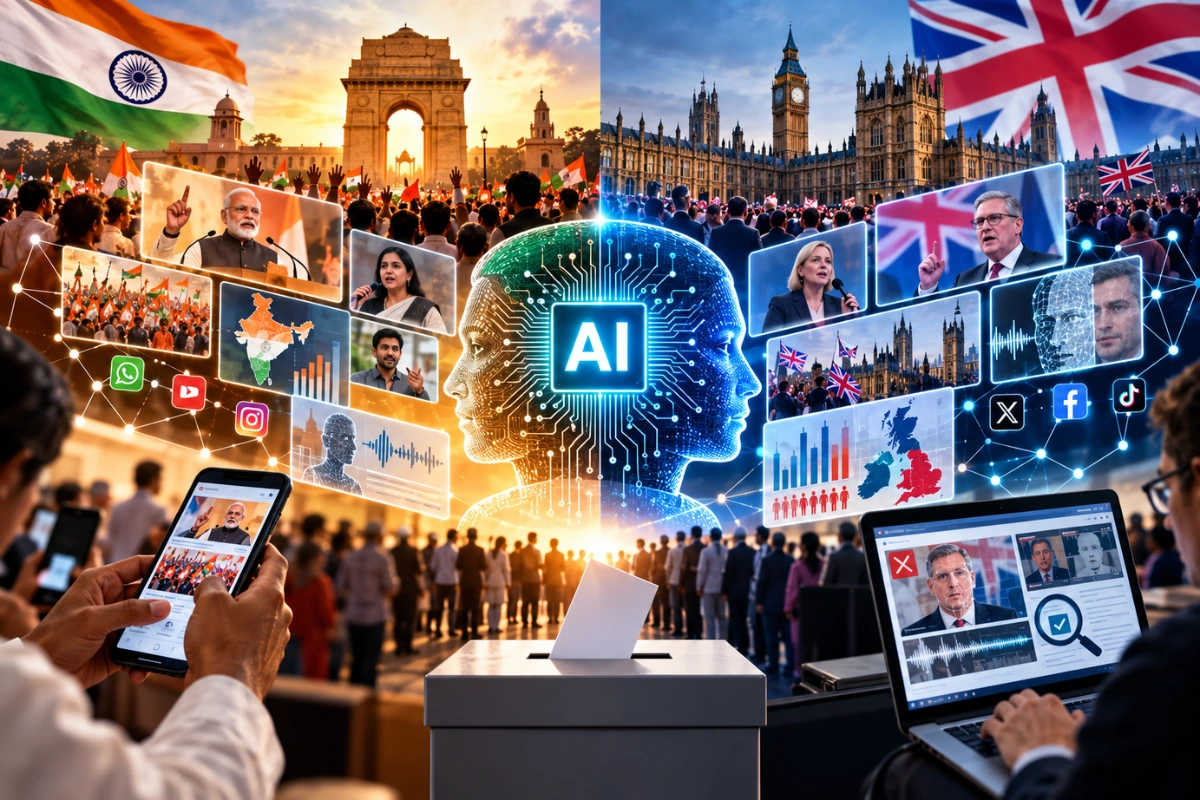
AI Generated Image
Artificial intelligence is no longer a side issue in democratic politics. It now shapes how campaigns find voters, how citizens receive information, how journalists verify claims, and how regulators respond to manipulation. Comparing India and the UK shows the same core challenge in two very different electoral environments: how to use election technology without weakening trust in the vote.
What Is the Role of AI in Elections?
The role of AI in elections is to process large amounts of political, behavioural, and public information faster than human teams can. Campaigns can use AI to segment audiences, draft messages, translate content, monitor sentiment, and support voter outreach. Election officials, media organisations, and civil society groups can also use AI to detect misleading content, track coordinated manipulation, and explain voting procedures more efficiently.
The risk is that the same tools can also produce convincing falsehoods at scale. Generative AI can create synthetic speeches, cloned voices, fake images, misleading videos, automated comments, and chatbot answers that sound authoritative even when they are wrong. That is why the debate around AI in elections is not simply about innovation; it is about accountability, transparency, and public confidence.
AI as a Campaign Tool, Not Just a Technology Story
Modern campaigns are information operations. Parties must understand local concerns, test messages, respond quickly to criticism, and communicate across languages and platforms. AI helps by turning scattered data into patterns that campaign teams can act on.
In practical terms, campaign AI may support:
- Message drafting: creating speeches, social posts, captions, emails, and localised campaign material.
- Voter segmentation: identifying groups by issue interest, geography, language, age, or digital behaviour.
- Translation and localisation: adapting campaign communication for multilingual audiences.
- Sentiment monitoring: tracking how voters react to candidates, policies, scandals, or events.
- Volunteer support: using chatbots or dashboards to answer common campaign questions.
- Prediction and planning: using election prediction models to estimate turnout patterns or competitive seats.
These uses are not automatically harmful. A well-designed tool can help smaller teams communicate more clearly and make public information easier to access. The danger begins when speed replaces verification, when targeting becomes manipulative, or when synthetic media hides who is speaking.
India’s AI Election Environment Is Vast, Multilingual, and Mobile-First
India presents one of the most complex environments for AI in elections. Its electorate is enormous, politically diverse, and linguistically varied. Campaign content moves through national media, regional television, WhatsApp groups, YouTube channels, Instagram reels, local influencers, and party-run digital networks.
This scale makes AI attractive. A campaign can create region-specific slogans, translate speeches, produce short videos, and respond to opposition narratives almost instantly. In a country with many languages and local identities, AI-assisted localisation can be a powerful campaign advantage.
But India’s scale also magnifies harm. A fake audio clip in a local language, a manipulated video of a public figure, or a fabricated communal message can travel quickly before journalists or officials have time to correct it. During the 2024 general election period, the Election Commission of India warned parties against misusing AI tools to create deepfakes that distort information or spread misinformation, and directed parties to remove such content within three hours after it was brought to their notice.
India’s challenge is therefore not only technical. It is also institutional. The country needs fast response systems, clear political party obligations, platform cooperation, media literacy, and safeguards that do not become tools for overbroad censorship.
The UK’s AI Election Debate Is More Regulation-Led
The UK faces many of the same threats, but in a different setting. Its electorate is smaller, its party system is structured differently, and its regulatory discussion has focused strongly on campaign transparency, digital imprints, platform rules, and coordinated responses by public bodies.
The UK Electoral Commission explains generative AI as technology that can create new text, photo, audio, or video content from prompts. It also says that where it sees false information about voting or election processes, it will seek to correct or respond to that information.
The UK has also paid attention to political advertising transparency. The digital imprints regime introduced through the Elections Act 2022 was described by the UK government as a way to increase transparency in digital political advertising, including AI-generated material.
More recently, the Electoral Commission launched a pilot to detect political deepfakes and counter AI misinformation. It reported that during the 2024 UK general election, more than half of surveyed voters said they saw misleading information about parties or candidates, while around a quarter reported seeing or hearing a deepfake.
How Do India and the UK Differ in Their Approach?
India’s approach is shaped by electoral scale, linguistic diversity, high-volume social sharing, and the need for rapid takedown of harmful content. The UK’s approach is shaped more by transparency rules, regulator coordination, and public correction of misleading claims about electoral processes. Both systems recognise that AI can affect trust, but they manage the problem through different administrative and political traditions.
A useful comparison looks like this:
| Area | India | UK |
|---|---|---|
| Main pressure point | Scale, language diversity, viral misinformation | Transparency, political advertising, deepfake detection |
| Common AI risks | Deepfakes, local-language rumours, manipulated speeches, mass forwarding | Synthetic campaign content, misleading voter information, deceptive political ads |
| Regulatory style | Election advisories, IT rules, platform escalation, takedown expectations | Electoral guidance, digital imprints, regulator coordination, detection pilots |
| Campaign opportunity | Localised outreach across regions and languages | Targeted communication, compliance-aware digital campaigning |
| Key democratic challenge | Preventing fast viral harm without suppressing legitimate speech | Maintaining trust and transparency in a dense digital media environment |
The contrast is important. India needs systems that can operate at extraordinary scale and speed. The UK needs systems that make political communication traceable and trustworthy, especially when synthetic media becomes hard for ordinary voters to identify.
Election Prediction Models Need Careful Interpretation
Election prediction models are among the most discussed uses of AI. They can combine polling, demographic data, past results, turnout trends, economic signals, and campaign indicators to estimate possible outcomes. For analysts, parties, and journalists, such models can make elections easier to understand.
Prediction, however, is not certainty. Models depend on the quality of the data, the assumptions built into the system, and the stability of voter behaviour. If polling is weak, turnout changes unexpectedly, or late events shift opinion, even sophisticated models can be wrong.
The practical rule is simple: election prediction models should inform discussion, not replace judgment. They are best used to show probability, uncertainty, and scenarios. They become harmful when campaigns or media outlets present them as guaranteed results, discouraging participation or creating false narratives about legitimacy.
AI Chatbots Create a New Layer of Voter Information Risk
AI chatbots are increasingly part of the election information environment. Voters may ask them where to vote, what ID they need, whether they are eligible, what a candidate said, or who is leading. If the chatbot is accurate and properly limited, it can guide users towards official sources. If it is outdated or speculative, it can mislead people at the exact moment they need reliable information.
The global debate around AI chatbots in Trump elections shows why this matters beyond one country. In the United States, reporting and research around the 2024 election cycle highlighted concerns that chatbots could provide incorrect or inconsistent answers about voting rules, candidates, and political events. For example, the Centre for Democracy and Technology described AI chatbots as a new and largely untested vector for election-related information and misinformation, especially for voters with disabilities.
India and the UK can learn from that concern. Election-related chatbots should avoid guessing. They should redirect voters to official election authorities for registration, polling place, postal voting, ID requirements, and deadlines.
Responsible AI Use Requires Shared Safeguards
The healthiest approach is not to ban every use of AI in politics. That would be unrealistic and may even reduce useful innovation. The better approach is to require disclosure, limit deception, strengthen verification, and make campaigns accountable for what they publish.
A practical safeguard checklist includes:
- Clear labelling of synthetic media when AI materially changes audio, video, or images.
- Human review before publication for campaign messages, ads, translations, and automated replies.
- Official-source redirection for voter registration, polling, ID, and deadline questions.
- Rapid correction channels between election bodies, platforms, parties, and fact-checkers.
- Public archives for political ads so voters can see who paid for messages and whom they targeted.
- Model uncertainty disclosure when media or campaigns discuss predictions.
- Media literacy campaigns that teach voters to pause before sharing emotional or suspicious content.
These safeguards are especially important because AI reduces the cost of producing persuasive content. A misleading rumour that once took time and money to create can now be produced quickly, localised, and distributed across platforms.
The Future of Election Technology Depends on Trust
AI will continue to influence elections in India, the UK, and every major democracy. Campaigns will use it to communicate faster. Regulators will use it to detect risk. Journalists will use it to verify content. Voters will encounter it through search, social media, chatbots, political ads, and news feeds.
The central question is whether election technology makes democracy clearer or more confusing. Used responsibly, AI can improve access to information, help administrators respond to misinformation, and make campaigns more efficient. Used carelessly, it can blur the line between persuasion and deception.
India and the UK offer two lessons together. India shows why scale, language, and virality matter. The UK shows why transparency, regulator coordination, and detection systems matter. The best future for the role of AI in elections will combine both: innovation that helps voters understand politics, and safeguards strong enough to protect the legitimacy of the vote.
To read more such news, download Bharat Express news apps