



AI Generated Image
Chandrashekhar Azad’s rise in western Uttar Pradesh is the story of a youth movement built around dignity, education, constitutional rights, and visible street-level assertion. The modern Chandrashekhar Azad associated with the Bhim Army and Aazad Samaj Party turned local anger over caste injustice into organised youth activism, using the Constitution as both a symbol and a political language. His journey also shows how the memory of India’s freedom fighters and the unfinished promises of Indian independence continue to shape new forms of democratic mobilisation.
Which Chandrashekhar Azad Are We Talking About?
This article is about the contemporary leader Chandrashekhar Azad, also widely known through his association with the Bhim Army, not the revolutionary freedom fighter Chandra Shekhar Azad of the Indian independence era. The similarity of names matters because both sit inside India’s wider imagination of resistance, but their historical contexts are different: one belonged to the anti-colonial nationalist movement, while the other works within post-independence constitutional politics. The modern Chandrashekhar Azad youth movement is rooted in western UP’s social realities, especially the assertion of Dalit, Bahujan, and marginalised youth.
Azad is a law graduate from the Chutmalpur area of Saharanpur district and became known as a co-founder of the Bhim Army, an organisation associated with Dalit rights and education. Reports have traced the group’s rise to western Uttar Pradesh, where it challenged caste oppression and built a reputation as a force that could mobilise quickly when local communities felt ignored.
The Constitution Became a Movement Language
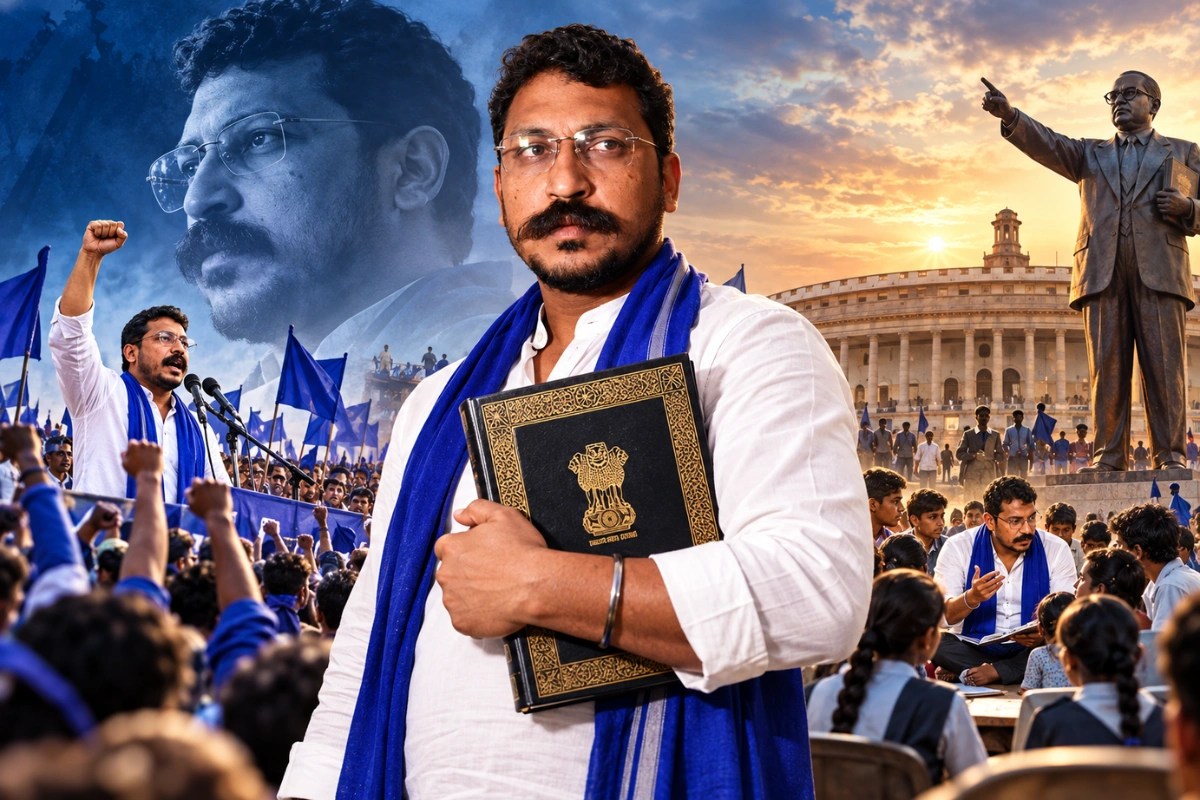
For Azad, carrying the Constitution was not just political theatre; it helped translate anger into a claim of citizenship. In a landscape where young people often experience politics as distant, symbolic use of the Constitution made the message direct: rights are not charity, dignity is not negotiable, and democracy must be felt in everyday life. That framing allowed youth activism to move beyond protest slogans and into a larger argument about justice, representation, and accountability.
The power of this image was visible during moments such as Azad’s planned march to Ayodhya with the Constitution in hand, which was reported as a response to fears of communal tension. The act positioned constitutionalism as an alternative to both caste humiliation and religious polarisation.
This is also where Azad’s politics differs from conventional party messaging. Instead of beginning with manifestos or elite negotiation, the movement often began with public presence: young people arriving at a village, a police station, a protest site, or a campus-like gathering space. The Constitution gave that presence a recognisable moral grammar.
Western UP Gave the Movement Its Ground
Western Uttar Pradesh was not merely the backdrop; it shaped the movement’s tone. Saharanpur and surrounding districts have a long history of caste, community, agrarian, and electoral contestation. In that setting, a youth revolution could not survive as abstract ideology. It had to respond to local conflicts, humiliation, education gaps, unemployment, policing, and everyday questions of respect.
The Bhim Army’s early work was closely linked to fighting caste oppression in and around Saharanpur, including Gharkoli village, where conflicts over Dalit assertion became part of the organisation’s public identity. Commentators have described the group as a new phase of Dalit assertion in western UP, especially after it gained visibility between local caste disputes and larger political protests.
That regional rooting helped the Chandrashekhar Azad Youth Movement grow in three ways:
- Local recognition: Young people saw leaders and volunteers who came from familiar social worlds, not distant power centres.
- Rapid mobilisation: The movement could respond quickly to incidents that communities viewed as injustice or intimidation.
- Cultural confidence: Dalit and Bahujan assertion became public, visual, and unapologetic rather than hidden inside closed meetings.
- Political training: Street action, legal language, and public speaking created a new class of youth organisers.
This mix turned western UP into a laboratory for a new style of democratic mobilisation: emotional, confrontational, constitutional, and youth-led.
Education Was the Organising Base
Movements last longer when they build institutions, however modest those institutions may be. The Bhim Army’s emphasis on education gave Azad’s politics a practical foundation. Instead of treating caste injustice only as a matter of protest, the organisation linked dignity to schooling, literacy, and confidence among children from marginalised communities.
Reports have noted the Bhim Army’s work around free education initiatives and its aim of supporting marginalised sections, including Dalits and other Bahujan communities. This educational focus connects Azad’s politics to the Ambedkarite belief that social change needs learning, organisation, and agitation—not anger alone.
That matters for youth because education creates a bridge between immediate outrage and long-term capacity. A young volunteer who teaches children, helps a family navigate official systems, or explains constitutional rights is doing more than campaigning. They are learning how power works and how communities can negotiate with it.
How Did Azad Turn Youth Activism Into Political Power?
Azad turned youth activism into political power by combining symbolic clarity, grassroots networks, social media visibility, and a willingness to confront established parties. The movement did not depend only on election campaigns; it first built recognition through rights-based intervention, street mobilisation, and Ambedkarite identity. Electoral politics came later as an attempt to convert social energy into institutional representation.
The formation of the Aazad Samaj Party in 2020 marked a shift from movement politics towards party politics, with Azad presenting it as an effort rooted in Ambedkarite and Bahujan values. In the 2024 Lok Sabha election, the Election Commission’s Gazette listed Chandrashekhar as elected from Nagina (SC) in Uttar Pradesh on an Aazad Samaj Party (Kanshi Ram) ticket, giving the movement a parliamentary foothold.
The conversion from movement to electoral force is never simple. A street movement can be flexible, emotional, and fast; a party must make alliances, choose candidates, manage expectations, and face scrutiny. Azad’s challenge has been to keep the urgency of youth activism alive while operating inside formal politics.
The Movement’s Message Blended Assertion and Citizenship
The most distinctive feature of Azad’s appeal is the way it combines pride with legality. Many youth movements either reject the system entirely or become absorbed by it too quickly. Azad’s politics has often tried to stand in between: confront authority, but do so in the language of constitutional rights.
That blend is why references to freedom fighters, the nationalist movement, and Indian independence still matter in this conversation. The anti-colonial struggle promised political freedom, but post-independence movements often ask whether that freedom has reached everyone equally. Azad’s supporters frame dignity, safety, education, and representation as part of that unfinished democratic promise.
The language is not only about Dalit assertion, though that remains central. It also speaks to students, unemployed youth, minorities, women, and rural communities who feel excluded from decision-making. Whether one supports or criticises Azad’s politics, the larger point is clear: constitutional vocabulary has become a tool of mass youth mobilisation.
What Makes the Chandrashekhar Azad Youth Movement Different?
The Chandrashekhar Azad Youth Movement stands out because it combines Ambedkarite symbolism, local intervention, educational work, and electoral ambition. It is not simply a protest group, not only a caste organisation, and not yet a conventional party machine in the old sense. Its strength comes from turning everyday experiences of injustice into a public claim for dignity.
Several elements make this model notable:
- A visible leader with a recognisable symbol: Azad’s image with the Constitution helped create a simple visual message. In crowded political spaces, that clarity matters.
- A youth-first organising style: The movement gave young people roles as volunteers, speakers, defenders, teachers, and digital amplifiers. Participation became active rather than ceremonial.
- A focus on immediate response: Many supporters were drawn to the idea that someone would show up when injustice happened. That presence built trust.
- A bridge between movement and election: By entering electoral politics, Azad tested whether street legitimacy could become legislative representation.
- A moral connection to historical resistance: The movement borrows from India’s tradition of protest while grounding itself in constitutional democracy rather than armed rebellion.
The Lessons for Youth Politics in India
Azad’s rise offers broader lessons for anyone studying youth revolution and democratic politics in India. First, young people respond when politics speaks to lived experience. Abstract promises matter less than whether a movement appears during moments of fear, exclusion, or humiliation.
Second, symbols work when they connect to action. The Constitution in hand became powerful because it was tied to education, mobilisation, and public claims of justice. Without that connection, symbolism becomes decoration.
Third, local movements can reshape national conversations. A formation rooted in Saharanpur and western UP became part of debates on caste, citizenship, protest, and opposition politics. That shows how regional youth activism can travel when its message is clear.
Finally, every movement faces the test of organisation. Charisma can attract attention, but institutions, ethical discipline, leadership development, and accountability decide whether a movement endures.
A Continuing Story of Constitutional Assertion
Chandrashekhar Azad’s journey from western UP activism to parliamentary politics reflects a new chapter in India’s democratic churn. His movement draws emotional power from caste assertion, historical memory from freedom fighters and the nationalist movement, and practical language from the Constitution.
The deeper story is not only about one leader. It is about young citizens asking whether Indian independence can be made more equal in everyday life. That question keeps the movement relevant—and keeps the Constitution in hand as both symbol and demand.
Also Read: The On-Ground Administrator: How Brajesh Pathak Built UP’s Modern Healthcare Shield
To read more such news, download Bharat Express news apps