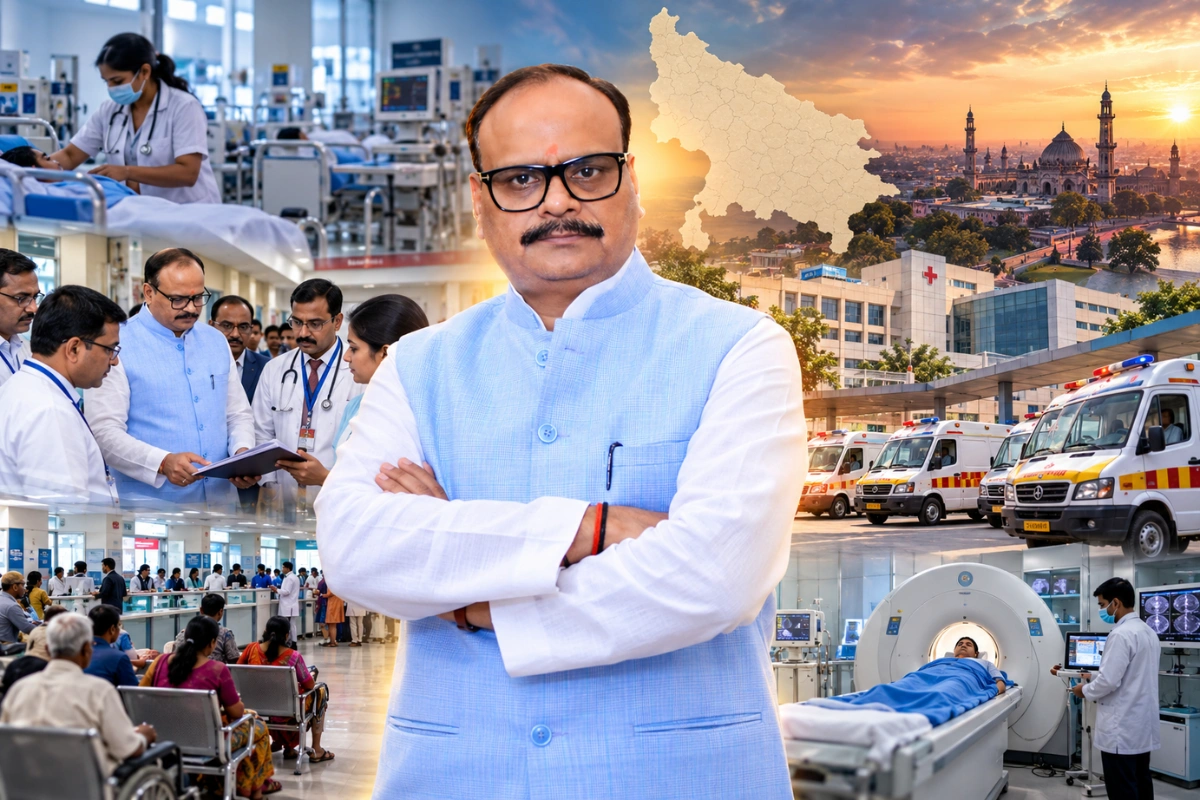
AI Generated Image
Uttar Pradesh’s health department has entered a sharper phase of administrative oversight, with Deputy Chief Minister Brajesh Pathak placing hospital inspections, staffing, infrastructure upgrades and private-sector accountability at the centre of the state’s public-health agenda. The latest moves suggest that the government’s healthcare policy changes are being shaped less as a single announcement and more as a rolling governance drive across public hospitals, medical colleges and regulated private facilities.
What Has Changed in UP’s Healthcare Push?
The clearest change is the shift from scheme-led expansion to tighter day-to-day supervision. Pathak, who holds the Medical Health and Family Welfare portfolio in Uttar Pradesh, has repeatedly linked better patient care with visible administrative control: functioning equipment, available doctors, responsive ambulances, and hospitals that meet basic standards before making big claims. The state health directorate continues to list Pathak as the Minister in charge, reflecting his central role in the department’s current direction.
That approach has given the phrase Brajesh Pathak healthcare reforms a practical meaning in state politics: inspections, warnings, service reviews and budget-backed expansion. In recent months, reports from Lucknow and other divisions have highlighted directions to improve government hospital infrastructure, strengthen CT scan and dialysis services, check ambulance readiness, and ensure health ATMs are functional in districts.
A Budget-Backed Health Shield
The administrative push is being supported by larger public spending. Uttar Pradesh’s 2026-27 budget analysis shows health receiving 6.3% of total state expenditure, with allocations including urban and rural allopathic health services. The state budget portal also lists the 2026-27 budget documents, underscoring that health spending is now being positioned within a broader development and welfare framework rather than treated as an isolated departmental matter.
For patients, spending will matter only if implementation delivers results: district hospitals need specialists, diagnostic machines need to run reliably, emergency services need to arrive on time, and rural facilities need to handle common conditions before families have to travel to larger cities. This is where Pathak’s on-ground style matters. Budget provisions create capacity; inspections and reviews determine whether that capacity reaches the ward, the outpatient counter and the ambulance bay.
The policy direction also appears to be moving towards a mixed model. The state has indicated interest in bringing private investment into healthcare infrastructure, while also tightening expectations from existing private providers. That dual strategy—expansion plus enforcement—is becoming a defining feature of Uttar Pradesh’s current healthcare policy changes.
Enforcement Has Become a Headline Issue
One of the most visible signals came from action against private hospitals. In February 2026, Pathak told the Assembly that complaints had led to the cancellation of 178 private hospital licences, while hearings had restored 59. Authorities had also issued notices to 1,542 hospitals to make improvements. The numbers were striking because they suggested that regulation had moved beyond paperwork and occasional raids.
Directions on misleading ‘trauma centre’ signage reinforced the message to the private sector. Pathak reportedly asked that private hospitals not meeting required standards remove such signage, while discussions also covered plans for 100-bed cancer hospitals in all 75 districts and broader early disease-detection campaigns.
Together, these steps frame healthcare reform as a patient-safety issue. A hospital’s signboard, licence and service claim are not merely business details; they shape where families go in emergencies. Sustained enforcement may reduce the gap between what facilities advertise and what they can actually deliver.
Key Reform Signals Now Visible
- Hospital infrastructure reviews: Officials have been directed to upgrade facilities, check equipment and improve basic services in government hospitals.
- Diagnostic and emergency focus: CT scans, dialysis services, ambulances and health ATMs have emerged as recurring review points.
- Private hospital accountability: Licence cancellations, notices and scrutiny of trauma-centre claims signal a stricter regulatory posture.
- Staffing flexibility: Recent announcements indicate government doctors in Uttar Pradesh may continue through reappointment until age 70, a move presented as a way to strengthen public healthcare services.
- District-level expansion: Proposed cancer-care expansion and early detection campaigns point to an attempt to move specialist care closer to patients.
The Staffing Test Remains Central
Infrastructure can be built faster than a health workforce can be trained and retained. That is why the reappointment route for government doctors is politically and administratively significant. If experienced doctors remain available for longer, district and sub-district facilities can manage demand better, particularly where specialist vacancies affect service delivery.
Still, reappointment is not a complete substitute for new recruitment, training, fair deployment and retention in difficult postings. Uttar Pradesh’s scale makes this challenge unusually complex. A reform that works in Lucknow or Noida must also work in smaller districts, rural blocks and crowded outpatient departments.
The government’s emphasis on reviews suggests it understands this gap between policy and delivery. But the coming test will be consistency: inspections must deliver permanent improvements, follow-up must address underperforming facilities, and patients must experience shorter delays, cleaner facilities and more dependable treatment.
Why the On-Ground Model Matters
The model centres on administrative visibility under Pathak. Surprise visits, public directions and review meetings create pressure on local officials, especially in a sector where weak supervision can quickly turn into patient distress. This is why his supporters project him as an ‘on-ground administrator’ rather than only a policymaker.
The method has clear advantages. It can speed up response, expose gaps and make district-level officers more accountable. It also gives patients a visible political authority to associate with health-system complaints.
But the model carries a risk: if reforms become too dependent on high-level intervention, improvements may fade when attention shifts elsewhere. The more durable shield would be institutional—routine audits, transparent complaint handling, predictable staffing, functional equipment maintenance and clear public standards for both government and private facilities.
What Comes Next
The next stage of Brajesh Pathak’s healthcare reforms will depend on delivery rather than announcements. The state has already signalled its priorities: stronger government hospitals, better emergency readiness, more reliable diagnostics, stricter private-hospital regulation and wider access to specialised care.
For Uttar Pradesh residents, the practical question is simple: will these reforms make quality care easier to reach before a medical emergency becomes a financial and logistical crisis? If the budget support, enforcement drive and on-ground supervision continue together, UP’s healthcare shield could become more than a political phrase. It could become a working system that patients encounter at the registration desk, in the diagnostic room, inside ambulances and across district hospitals.
Also Read: The Fortress Of Kunda: Inside Raghuraj Pratap Singh’s Decades-Long Political Monopoly
To read more such news, download Bharat Express news apps