

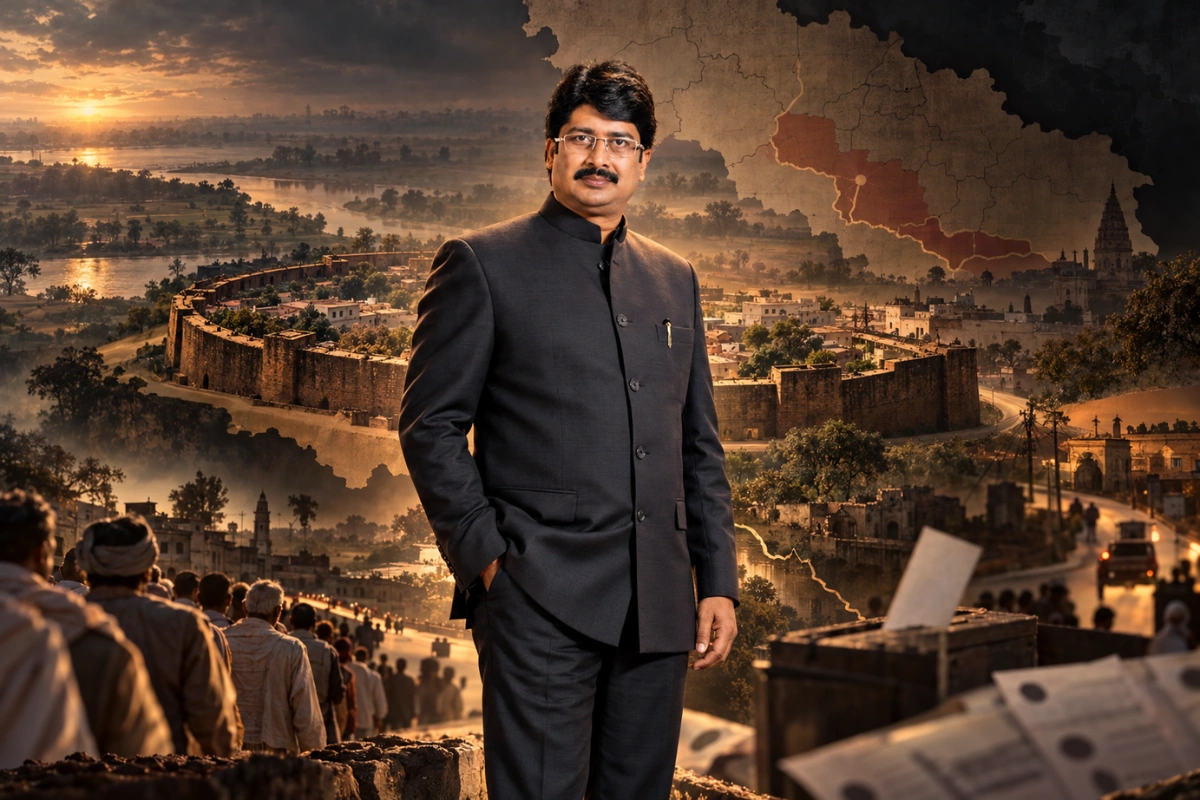
AI Generated Image
A Lucknow court’s latest order in the 2013 Zia-ul-Haq murder case has again pushed Kunda MLA Raghuraj Pratap Singh, widely known as Raja Bhaiya, into the political spotlight. The development comes as Singh remains one of Uttar Pradesh’s rare long-term constituency strongmen: elected from Kunda seven consecutive times since 1993, first as an Independent and later under his own Jansatta Dal Loktantrik banner. His hold on the Pratapgarh seat has become a case study in Kunda political monopoly, local loyalty, caste networks, personality-driven campaigning, and the limits of party machinery in rural Uttar Pradesh.
What Happened Now?
A special CBI court in Lucknow accepted the Central Bureau of Investigation’s closure report in the 2013 murder case of Deputy Superintendent of Police Zia-ul-Haq, who died in Balipur village, Pratapgarh, after violence broke out following the murder of village pradhan Nanhe Yadav. The Indian Express reported that the agency again found insufficient evidence to proceed against Singh and four others, while The Times of India reported that the court passed the order after examining material from the fresh investigation and hearing the parties. The order, dated September 19, 2026, gives Singh significant legal relief in a case that has followed his public image for more than a decade.
The case matters politically because Singh’s dominance in Kunda has never been only about election arithmetic. His supporters frame him as an accessible local patron who gets things done; critics describe the same structure as exercising political control through fear, dependency, and a feudal style of influence. With the 2027 Uttar Pradesh Assembly election cycle approaching, the court development has renewed attention on how Singh’s local fortress has survived changing state governments, party waves, criminal allegations, and repeated attempts by rivals to break his grip.
Kunda Remains the Core of Singh’s Political Power
Kunda, an Assembly constituency in Pratapgarh district and part of the Kaushambi Lok Sabha constituency, has been Singh’s base since his first victory in 1993. He retained the seat in 1996, 2002, 2007, 2012, 2017 and 2022, making him a seven-term MLA from the same constituency. That continuity is striking in Uttar Pradesh, where caste coalitions, ruling-party swings and anti-incumbency routinely reshape local contests.
His electoral numbers show why opponents call it a political monopoly rather than ordinary incumbency. In 2017, he contested as an Independent and won 1,36,597 votes, about 68% of the vote, defeating the BJP’s Janki Sharan by more than 1.03 lakh votes. In 2022, contesting on a Jansatta Dal Loktantrik ticket, he defeated Samajwadi Party candidate Gulshan Yadav by 30,315 votes, polling 99,612 votes and just over half the constituency vote.
| Election Year | Singh’s Party Label | Result in Kunda | What It Signals |
|---|---|---|---|
| 1993 | Independent | First Assembly victory | Start of local dominance |
| 2017 | Independent | Won by over 1.03 lakh votes | Peak personal vote consolidation |
| 2022 | Jansatta Dal Loktantrik | Won by 30,315 votes | Monopoly narrowed but survived |
The 2022 result is especially important. It showed that Singh’s vote share could be challenged when a major party put up a serious candidate and framed the contest as a direct fight. Yet it also confirmed that his organisation could survive without the BJP or SP symbol, which is the defining feature of his monopoly politics: the local brand remains stronger than the party label.
A Personal Party Built Around a Constituency Base
Singh launched Jansatta Dal Loktantrik in 2018, after 25 years in politics. The party’s formation turned a long-standing personal network into a formal political vehicle, but it did not fundamentally change the source of his power. The Kunda model still depends on direct contact, patronage, local intermediaries, caste-community influence, and the perception that Singh’s camp can affect administrative outcomes.
This is why his political dominance differs from the normal advantage enjoyed by a sitting MLA. Many incumbents depend on a ruling party’s welfare delivery, campaign funding or leadership wave. Singh’s base has moved across state-level alignments while keeping him at the centre. He has held Ministerial positions in governments led by different political formations, and his ability to maintain working relations across rival camps has helped him remain relevant beyond Kunda.
That flexibility also creates unease for larger parties. The BJP and SP may compete for statewide power, but in and around Pratapgarh they have often had to calculate Singh’s likely move, his silence, or the mood of his supporters. In 2024, local reporting around the Lok Sabha election noted that his influence was watched closely in the Kunda and Babaganj Assembly segments, both part of the Kaushambi parliamentary seat.
The 2024 Lok Sabha Signal Widened the Story
The 2024 general election offered a reminder that Singh’s influence is not confined to his own Assembly ballot. Reports from the campaign said Jansatta Dal Loktantrik did not field candidates and that Singh publicly left supporters free to vote as they wished. After the results, Hindi news reports argued that his neutrality, and the subsequent movement of some supporters towards SP candidates, hurt the BJP’s calculations in Pratapgarh and Kaushambi.
That does not prove a simple transfer of votes. Lok Sabha results are shaped by national issues, caste alliances, candidate selection, turnout and anti-incumbency. But the political reading in eastern Uttar Pradesh was clear: in close or layered contests, Singh’s organisation can still matter. A local strongman does not need to contest every election to influence bargaining; sometimes a meeting, a refusal, or a ‘vote as you wish’ signal becomes part of the campaign story.
This is the harder-to-measure side of political control. It is not only about votes cast for Singh himself. It is about whether local workers, village notables, caste leaders and booth-level operators believe his preference matters. As long as that belief remains alive, rival parties must treat Kunda as a special case rather than a normal constituency.
Allegations, Acquittals and Image Management
Singh has also faced serious controversy throughout his career. In 2003, during Mayawati’s tenure as Chief Minister, the Uttar Pradesh government invoked the Prevention of Terrorism Act against him and associates after raids and allegations tied to weapons and conspiracy claims; contemporary reports noted that the move triggered a political storm, with rivals accusing the government of misuse. Later, the political and legal trajectory of those cases became part of Singh’s wider narrative of persecution versus accountability, depending on who is telling the story.
The Zia-ul-Haq case carried even greater public weight because it involved the killing of a police officer in Singh’s own political region. Supporters will use the latest closure-report order to argue that the allegations did not stand up legally. Critics, however, will likely continue pointing to the broader climate of power in Kunda, where political commentary has often linked electoral loyalty with fear. A court order can close proceedings in a specific case; it does not automatically settle the political debate around monopoly politics.
That distinction is crucial for readers following Uttar Pradesh politics. Legal relief is not the same as political rehabilitation, but it can strengthen a leader’s ability to campaign without a pending case dominating every discussion. For Singh, the September 2026 order may help reset the public conversation towards performance, loyalty and local influence as the next Assembly election approaches.
Why the Kunda Model Still Matters
Kunda’s politics exposes a persistent feature of Indian democracy: formal competition can coexist with entrenched local dominance. Voters have options on paper, parties nominate candidates, and campaigns contest elections. Yet one leader can remain overwhelmingly favoured when social hierarchy, personal access, dispute resolution, identity, and the fear of backing a losing side all converge.
For supporters, this looks like stability. They see a leader who is available, recognisable and powerful enough to command attention from officials and parties. For opponents, it looks like political monopoly: a system where democratic choice exists but the cost of challenging the dominant camp can feel high. Both readings explain why Singh’s hold over Kunda has lasted longer than many statewide alliances.
The 2022 margin showed cracks compared with his 2017 landslide, but not a collapse. The 2024 Lok Sabha signals suggested his network still matters beyond one Assembly seat. The 2026 court relief removes one major legal cloud, at least for now. Together, those developments make Kunda a constituency to watch ahead of 2027—not because anyone can predetermine the result, but because breaking a decades-long political monopoly requires more than a party symbol and campaign slogan.
Also Read: Tapping Progress: How Swatantra Dev Singh Brought Water Security To Bundelkhand
To read more such news, download Bharat Express news apps