



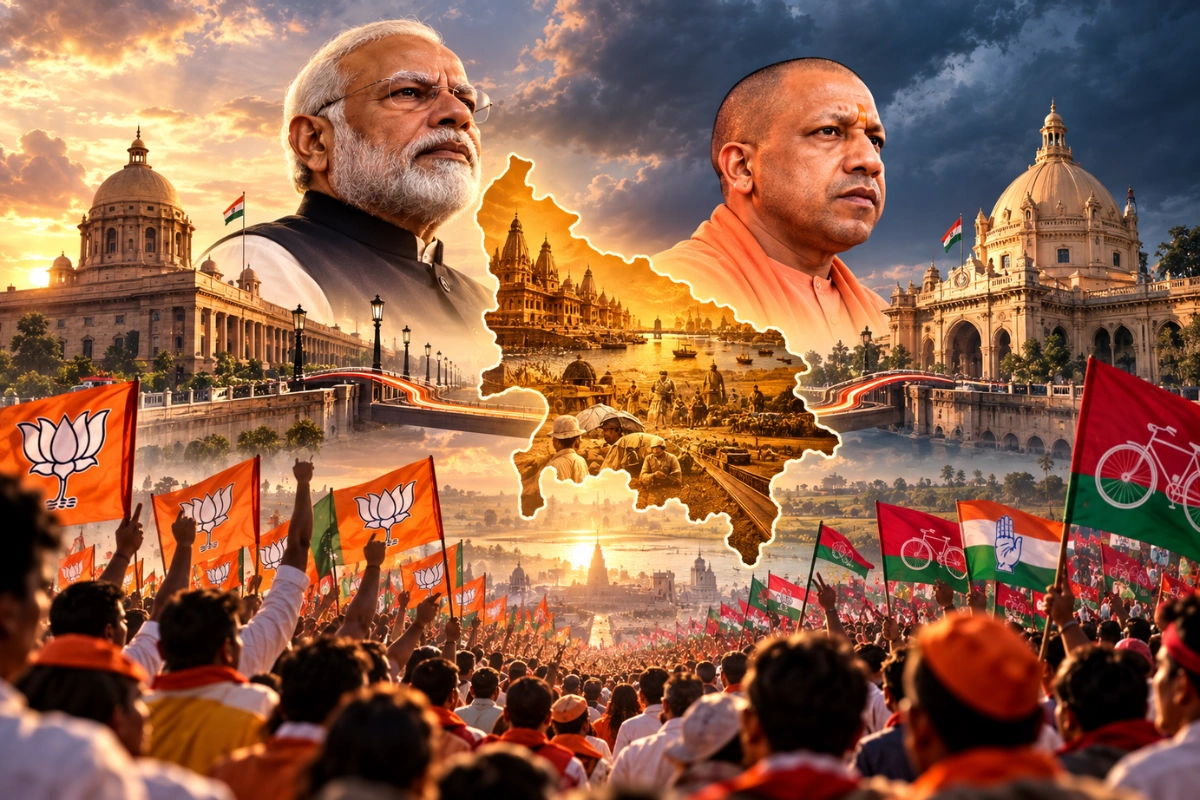
AI Generated Image
Uttar Pradesh is again at the centre of India’s political map as the BJP prepares for the 2027 Assembly election after a sharp setback in the 2024 Lok Sabha contest. The story is not only about one state; it is about the Delhi-Lucknow political axis built around Narendra Modi’s national leadership, the BJP’s organisational machine, and the governing weight of Lucknow under Chief Minister Yogi Adityanath. That axis helped turn Uttar Pradesh into the BJP’s most valuable electoral base, but recent results show it now faces a more demanding test.
Why Does the Delhi-Lucknow Political Axis Still Matter?
The Delhi-Lucknow political axis matters because Uttar Pradesh sends 80 members to the Lok Sabha, more than any other Indian state, and its Assembly has 403 seats, making it the largest state battleground in the country. When the BJP dominates Uttar Pradesh, it strengthens its national arithmetic in Delhi; when it slips, the effect is felt far beyond Lucknow. That is why the state’s 2027 Assembly election is already being treated as a major political marker ahead of the next national contest.
Modi’s relationship with Uttar Pradesh reshaped the state’s political imagination after 2014. By choosing Varanasi as his parliamentary constituency and making Uttar Pradesh central to the BJP’s national campaign, he tied the symbolism of Delhi’s power to the electoral weight of the Hindi heartland. The BJP won 71 of Uttar Pradesh’s 80 Lok Sabha seats in 2014 and 62 in 2019, results that helped anchor its parliamentary majorities.
From Breakthrough to Governing Model
The BJP built its rise in Uttar Pradesh through more than parliamentary momentum. The 2017 Assembly election gave the party a sweeping mandate, with the BJP winning 312 seats in the 403-member House. In 2022, the party retained power with 255 seats, a smaller but still decisive majority that confirmed the durability of its state-level coalition.
This sequence changed Uttar Pradesh politics in three ways. First, it weakened the assumption that caste-led regional parties would always set the terms of competition. Second, it placed welfare delivery, law-and-order messaging, religious symbolism, and central leadership in one campaign frame. Third, it created a two-capital model: Delhi supplied the national brand and strategic direction, while Lucknow projected administrative control and regional authority.
For supporters, that model represented stability and scale. For critics and rivals, it created a highly centralised style of politics in which local grievances could be overshadowed by national narratives. The 2024 result showed both the power and the limits of that approach.
The 2024 Setback Changed the Conversation
The June 2024 Lok Sabha results interrupted the BJP’s Uttar Pradesh story. The Samajwadi Party emerged as the largest party in the state with 37 seats, while the BJP won 33 and the Congress won six. The INDIA bloc’s performance marked a major opposition revival in a state where the BJP had previously set the pace in national elections.
The result did not remove the BJP from power in Lucknow or Delhi, but it altered the political mood. Reports after the election pointed to concerns over local disconnect, candidate selection, caste equations, jobs, and rural discontent as factors in the BJP’s losses. These issues now sit at the heart of the party’s attempt to repair its ground network before the 2027 Assembly vote.
The setback also gave the opposition a clearer route. Akhilesh Yadav’s Samajwadi Party, backed by its 2024 performance and alliance arithmetic with the Congress, can argue that the BJP is no longer unbeatable in its strongest northern state. For the BJP, the task is not simply to repeat old slogans, but to rebuild booth-level confidence among voters who shifted away.
Key Shifts Now Shaping Uttar Pradesh Politics
- Booth-Level Recovery Is Becoming Central: Recent reporting says the BJP is focusing on thousands of booths that it won in the 2022 Assembly election but lost in the 2024 Lok Sabha voting pattern. That suggests the party sees its challenge as granular, not merely rhetorical.
- The Modi-Yogi Combination Remains Important: Analysts continue to view both Modi’s national appeal and Adityanath’s state leadership as vote-mobilising factors in Uttar Pradesh, especially as the BJP works to protect its core support base.
- Caste and Social Coalition Politics Are Back in Focus: The opposition’s 2024 gains revived attention on OBC, Dalit, minority, and youth voting patterns, forcing the BJP to reassess how its broad Hindu consolidation strategy works at the constituency level.
- Urban Strength May Not Be Enough: Reports indicate that the BJP remained comparatively resilient in major urban centres, but the 2027 contest will require deeper recovery in rural and semi-urban regions.
What Happens Next
The run-up to 2027 is likely to test whether the Delhi-Lucknow political axis can adapt to a more competitive Uttar Pradesh. The BJP’s advantage remains substantial: it controls the state government, has a deep organisation, and continues to draw on Modi’s national stature. But the opposition now has evidence that voters can defeat the BJP seat by seat, especially when local dissatisfaction combines with caste arithmetic and alliance discipline.
The larger question is whether Uttar Pradesh voters have permanently rewritten the state’s political destiny or merely realigned it temporarily. Modi’s rise undoubtedly changed the state’s role in national politics by making it the BJP’s principal route to Delhi. Yet 2024 showed that the same state can also become the site of resistance when voters decide that national appeal is not enough.
For now, Uttar Pradesh remains the country’s most watched political theatre. The coming contest will reveal whether the BJP can renew the model that linked Delhi’s authority with Lucknow’s command, or whether the opposition can turn the 2024 breakthrough into a wider state-level reversal.
Also Read: Chirag’s Crucible: The Son’s War To Claim His Father’s Dalit Legacy
To read more such news, download Bharat Express news apps