AI Generated Image
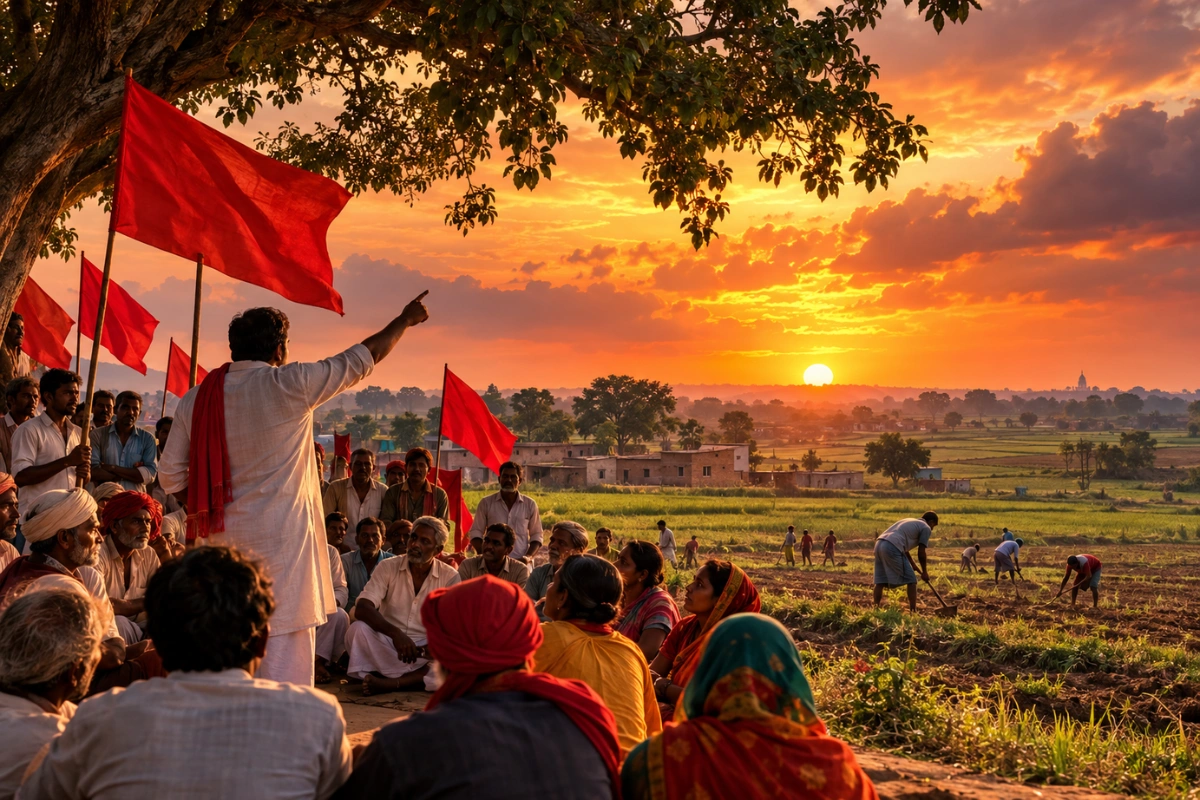
Bihar’s Left is not simply an election-time force; it is a village-level language of land, wages, dignity, and caste power. Even when seat numbers rise or fall, Left politics continues to shape how rural Bihar politics talks about the landless, Dalits, agricultural workers, and the poor among backward communities.
Why Does the Left Still Matter in Rural Bihar?
The Left still matters because it speaks to conflicts that remain local, material, and everyday: who owns land, who gets work, who faces eviction, and who can speak in the village. In the 2020 Assembly election, CPI(ML) Liberation won 12 seats, while CPI and CPI(M) won two each; in 2025, the Left suffered a sharp setback, with CPI(ML) reduced to two seats and CPI(M) to one, according to available post-election analyses. That fall in seats does not erase its role as an organiser of rural grievance, especially where mainstream Bihar political parties often negotiate caste blocs from above.
The Land Question Behind the Slogan
In Bihar, ‘landless’ is not just an economic label. It often overlaps with caste hierarchy, dependence on dominant landholders, insecure housing, and weak bargaining power in farm labour. This is why Left campaigns repeatedly return to homestead land, land redistribution, eviction protection, and minimum wages rather than only broad promises of development.
CPI(ML)’s recent Bihar campaign material continued to foreground land for landless and homeless families, along with rights for workers, farmers, Dalits, women, minorities, and youth. Whether voters reward that platform electorally depends on alliances, candidates, and local equations, but the vocabulary itself remains central to rural mobilisation.
How the Left Built Influence Beyond Seats
The Left’s rural strength has historically come from organisation rather than spectacle. Cadres, unions, student fronts, women’s groups, and village-level campaigns can keep a party present even when it does not dominate the Assembly.
Key sources of influence include:
- Local Dispute Politics: Wage conflicts, land possession, police cases, and caste violence often require organised backing.
- A Clear Class-Caste Message: The Left links poverty to social power, not just to lack of income.
- Alliance Leverage: Even smaller parties can affect opposition strategy where their cadres are disciplined.
- Issue Memory: Families remember who stood with them during eviction threats, violence, or labour struggles.
What Should Readers Watch in Bihar Politics Now?
To understand the future of rural Bihar politics, watch where social anger goes after elections, not only who forms the government. The NDA’s large 2025 majority shows the electoral strength of welfare delivery, leadership networks, caste coalitions, and organisational reach, while the Left’s reduced seat tally shows its limits under a difficult alliance and constituency map.
Still, the Left’s relevance will depend on three tests: whether it can rebuild booth-level trust, whether it can connect land and labour issues to youth employment, and whether it can make alliances without losing its distinct rural voice. In Bihar, the loudest politics is not always the largest party; sometimes it is the force that keeps uncomfortable village questions alive.
Also Read: Red Soil Of Bhojpur: How An Underground Revolution Transformed Into Electoral Firepower
To read more such news, download Bharat Express news apps