



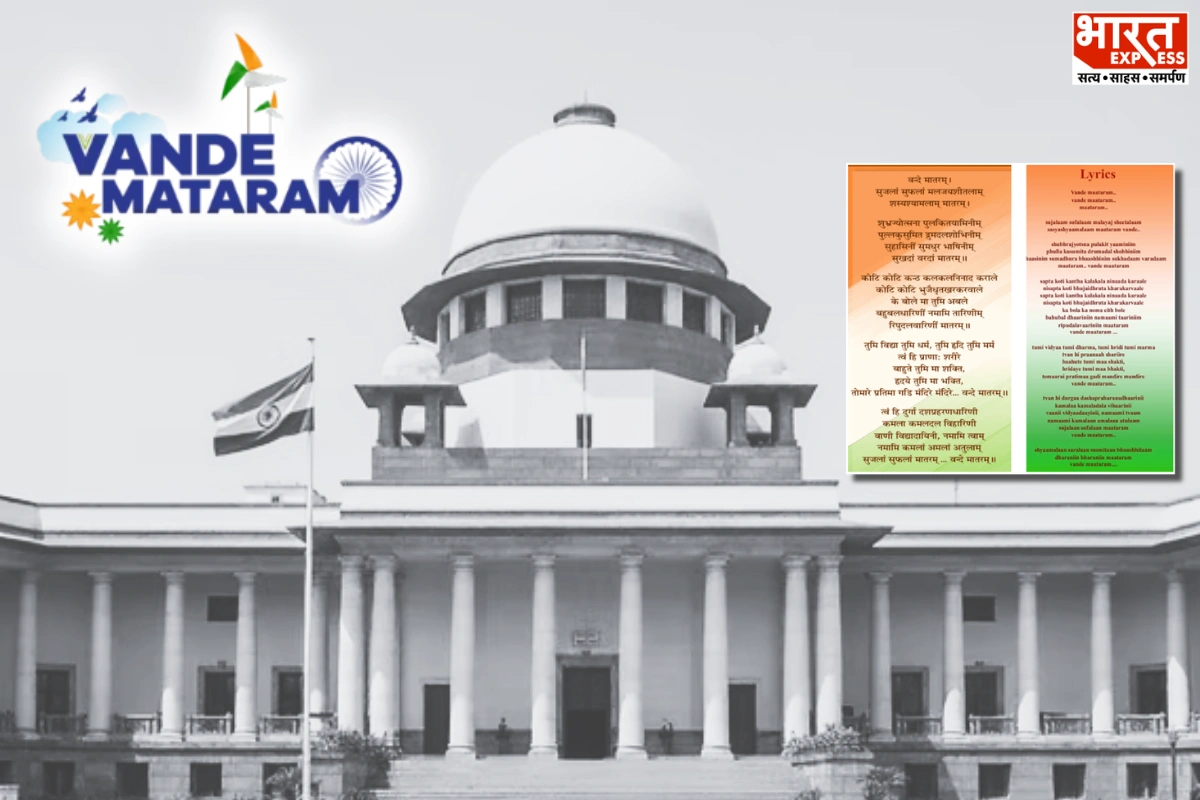
The Supreme Court on Tuesday agreed to examine whether not singing the national song Vande Mataram can constitute a punishable offence.
The bench, headed by Chief Justice of India Surya Kant and comprising Justices Joymalya Bagchi and V Mohana, declined to consider at this stage whether the National Song should contain two stanzas or all six.
The court referred to its landmark Bijoe Emmanuel ruling. It noted that the legal principle protecting people from punishment for not singing the National Anthem continues to remain applicable.
The bench asked the Centre to submit its response to the Public Interest Litigation. However, it did not issue notice to the government at this stage.
The court said the penal provisions could be examined against the fundamental rights guaranteed under Articles 25 and 26 of the Constitution.
Carnatic vocalist T M Krishna filed the petition challenging the law that mandates singing all six stanzas of Vande Mataram.
Krishna argued that the final four stanzas expressly invoke Hindu deities. He contended that compulsory singing could conflict with India’s secular character, according to a PTI report.
The plea challenges the amendment bringing Vande Mataram under the Prevention of Insults to the National Honour Act. It alleges that the provision is arbitrary, violates personal liberty and promotes what it describes as a ‘majoritarian religious message’.
The petitioner has questioned both the expansion of the National Song from two to six stanzas and the provision seeking punishment for non-singing.
Solicitor General Tushar Mehta, representing the Centre, opposed the challenge. He argued that people with a ‘naxalite mindset’ should not question the National Song while ignoring its role in India’s freedom struggle.
Also Read: Supreme Court Orders Fresh Probe Into 2012 Karnataka Teen Rape-Murder Case
To read more such news, download Bharat Express news apps