

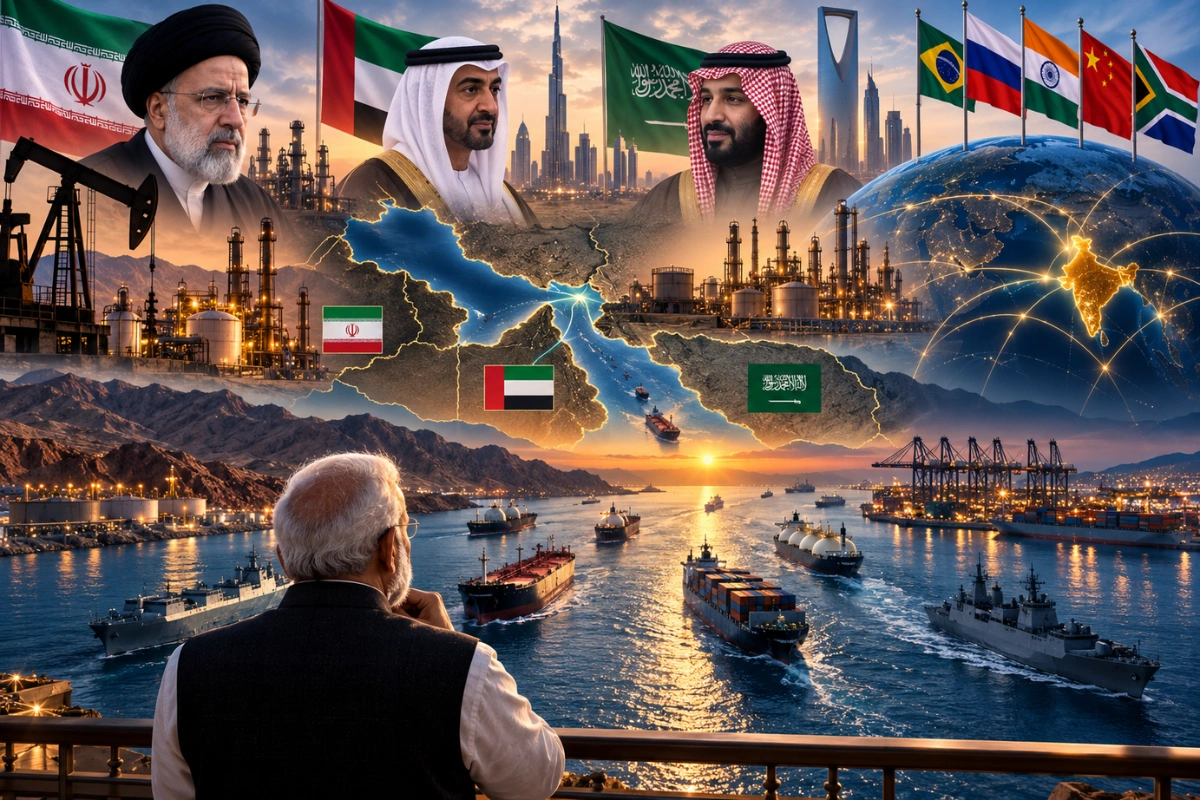
AI Generated Image
Middle East escalation matters to India because the Strait of Hormuz is not only an energy corridor; it is also a pressure point for freight costs, insurance, currency exposure, working capital, and trade confidence. Iran, the UAE, and Saudi Arabia now sit alongside India within the expanded BRICS framework, but their roles around the Gulf are very different: Iran borders the chokepoint, the UAE is a commercial and re-export hub, and Saudi Arabia is a major energy supplier with some route flexibility. For Indian companies, the practical task is not to predict every shock, but to build trade risk management systems that protect supply, pricing, contracts, and cash flow when the Middle Eastern economy becomes volatile.
Why Does the Strait of Hormuz Matter So Much to India?
The Strait of Hormuz matters because it concentrates a huge share of global energy movement into a narrow maritime passage between Iran and Oman, linking the Persian Gulf with the Arabian Sea and onward to India’s west coast. In 2024 and the first quarter of 2025, flows through Hormuz represented more than one-quarter of global seaborne oil trade and about one-fifth of global oil and petroleum product consumption, while roughly one-fifth of global LNG trade also moved through the strait, mainly from Qatar.
For India, the risk is amplified by import dependence. India’s crude oil import dependency stood at 88.6% in April–January FY26, and 46.9% of its crude oil imports during that period came from the Middle East, according to India’s Department of Economic Affairs, citing PPAC data. Even where a specific cargo does not sail through Hormuz, the prices of oil, LNG, marine fuel, and war-risk insurance are influenced by the perceived safety of the route.
That is why Middle East trade security is not a niche concern for oil companies alone. A disruption can affect refiners, fertiliser importers, airlines, ports, logistics providers, metal manufacturers, exporters using Gulf transhipment hubs, and consumer-facing sectors exposed to fuel inflation. It can also influence the rupee through India’s import bill, making the Strait of Hormuz a macroeconomic issue tied directly to economic stability.
The BRICS Angle Changes the Diplomatic Map
As of September 2026, India’s official account of BRICS lists 11 members: Brazil, China, Egypt, Ethiopia, India, Indonesia, Iran, Russia, Saudi Arabia, South Africa, and the UAE. The same Indian government note says the expanded BRICS membership represents 49.5% of the global population, 40% of global GDP, and 26% of global trade.
This is important because the Middle East is no longer merely an external crisis zone for BRICS. Iran, Saudi Arabia, and the UAE are part of the same grouping as India, China, and Russia. That gives India additional diplomatic channels, but it also makes consensus harder. A forum that includes both Iran and the UAE cannot automatically take a unified position on a Gulf crisis, especially when members have different security partnerships, energy interests, and threat perceptions.
The limits of the BRICS framework became visible when BRICS Foreign Ministers met in India in May 2026 and failed to issue a joint statement because of differences over the Middle East conflict, with divisions especially visible between Iran and the UAE. For India, that is the core lesson: BRICS can be useful for dialogue, trade agreements, development finance, and South-South coordination, but it is not a substitute for bilateral diplomacy, maritime security, and commercial risk controls.
How Iran, the UAE, and Saudi Arabia Shape India’s Trade Security
Iran, the UAE, and Saudi Arabia affect India’s trade security through geography, energy supply, port networks, financing, insurance, and diplomacy. Each country adds a different type of leverage and vulnerability to India’s external trade system.
Iran Is the Geographic Risk Anchor
Iran sits on the northern side of the Strait of Hormuz and can influence regional risk perceptions even when trade continues to move. Any escalation involving Iran can increase insurance premiums, cause shipowners to avoid certain routes, complicate crew deployment, or trigger advisories for vessels transiting the Gulf. For Indian trade risk management, Iran is therefore not only a country-specific exposure but also a route-level exposure.
India also has strategic interests in connectivity with Iran, including Chabahar Port. India’s Ministry of External Affairs noted that the long-term main contract for equipping and operating the Shahid Beheshti Terminal of Chabahar Port was signed on 13 May 2024 between India Ports Global Limited and Iran’s Port and Maritime Organisation. Chabahar matters because it gives India a route towards Afghanistan and Central Asia that is not dependent on Pakistan. However, the same geography also places the project within a sensitive geopolitical environment.
For businesses, the Iran factor should be understood through three channels: sanctions compliance, route safety, and documentary risk. Even companies that do not trade directly with Iran may be affected if insurers, banks, or carriers tighten due diligence for regional shipments. In practical terms, a stable compliance file, clear end-use documentation, and alternative routing plans become part of trade protection.
The UAE Is India’s Commercial Shock Absorber
The UAE is one of India’s most important trade partners and a key hub for re-exports, logistics, bullion, energy products, services, and finance. The India-UAE Comprehensive Economic Partnership Agreement came into force on 1 May 2022, and Indian government reporting says bilateral trade crossed US$100.06 billion in FY 2024–25, recording 19.6% growth.
This relationship gives India a valuable buffer. Dubai, Abu Dhabi, and other UAE nodes support warehousing, redistribution, shipping services, financial intermediation, and business continuity for Indian firms serving Africa, Europe, and the wider Middle East. When Gulf routes face risk, UAE-based logistics and trading networks often become the first place companies look for revised schedules, substitute suppliers, inventory consolidation, and payment coordination.
The UAE relationship also helps reduce settlement friction. In July 2023, the Reserve Bank of India and the Central Bank of the UAE signed memoranda of understanding to promote the use of the Indian rupee and UAE dirham for cross-border transactions and to link payment and messaging systems. Local-currency settlement will not remove geopolitical risk, but it can reduce some foreign-exchange and settlement risks in bilateral trade when dollar liquidity or correspondent banking becomes more expensive.
Saudi Arabia Is Both a Supplier and a Stabilising Partner
Saudi Arabia matters to India because of energy, investment, petrochemicals, fertilisers, infrastructure finance, and its broader role in the Gulf. The Embassy of India in Riyadh says Saudi Arabia is India’s fifth-largest trading partner and that India imported 33.14 million metric tonnes of crude oil from Saudi Arabia in FY 2024–25, equal to 13.58% of India’s total crude imports that year.
Saudi Arabia’s infrastructure also gives it partial flexibility. EIA analysis notes that disruptions around the Bab al-Mandeb Strait in 2024 led Saudi Aramco to shift some seaborne crude flows from Hormuz by using the East-West pipeline to Red Sea ports. This does not make Saudi supply immune to regional escalation, because Red Sea routes have their own risks. However, it does mean Saudi Arabia has options that some Gulf producers do not.
For India, Saudi Arabia’s role is therefore dual. It is a major supplier whose exports help maintain India’s refinery system, and it is a diplomatic partner whose choices can affect regional energy confidence. In any crisis, Indian policymakers and companies will watch Saudi production policy, export logistics, freight routes, and pricing formulas closely.
The Transmission Channels from Escalation to Indian Business
A Gulf escalation rarely affects India through a single dramatic event. More often, it moves through layered commercial channels that raise uncertainty and costs even before physical supply is interrupted.
Key transmission channels include:
- Energy Prices: Higher perceived risk around Hormuz can lift crude oil, LNG, petroleum products, and bunker fuel prices. This can raise costs for refiners, transporters, airlines, chemical producers, and manufacturers using energy-intensive processes.
- War-Risk Insurance and Freight Rates: Insurers may add premiums for vessels entering high-risk waters. Shipowners may also demand higher freight rates, avoid the route, or require amended contracts to cover delays and security exposure.
- Port and Schedule Congestion: Even without a full closure, vessel bunching, inspections, naval advisories, or route changes can delay cargo. Indian importers relying on just-in-time inventory are especially exposed.
- Currency and Working-Capital Pressure: A higher oil import bill can pressure the rupee and increase hedging needs. Importers may need larger credit lines if cargo costs rise while delivery times lengthen.
- Contract Disputes: Delays can trigger disagreements over force majeure, demurrage, detention, price escalation clauses, and delivery obligations. Contracts that were acceptable under normal conditions can become fragile during geopolitical stress.
- Compliance and Sanctions Screening: Escalation involving Iran can make banks, insurers, and logistics providers more cautious. Shipments may face additional documentation checks even when they are lawful.
This is why Middle East trade security is best understood as a full operating discipline rather than a geopolitical headline. Businesses need procurement, finance, logistics, legal, and leadership teams to work from the same risk picture.
India’s Public Preparedness Combines Energy, Ports, and Maritime Security
India’s response to Gulf risk has been built across several layers. On the energy side, the government has emphasised diversification, stock availability, and route monitoring. In March 2026, India’s Press Information Bureau said the country’s crude oil supply remained secure, port operations were stable, and 70% of India’s crude imports were then routed outside the Strait of Hormuz.
On maritime security, India has experience from Operation Sankalp. The Indian Navy launched the operation in June 2019 after attacks on merchant ships in the Gulf of Oman, with the stated purpose of ensuring the safe passage of Indian-flagged vessels transiting the Strait of Hormuz. In 2024, the Ministry of Defence said the Navy had expanded maritime security operations across the Gulf of Aden, Arabian Sea, and waters off Somalia under Operation Sankalp after conflict-related threats spread into the maritime domain.
Crew welfare is another part of trade protection. India’s maritime administration has issued advisories and built reporting systems for vessels in high-risk waters, including the Persian Gulf, Strait of Hormuz, Gulf of Oman, Gulf of Aden, and Red Sea. For trade managers, this is a reminder that security is not only about cargo value; it is also about seafarers, vessel tracking, communication protocols, and emergency response.
What Should Indian Companies Do When Hormuz Risk Rises?
Indian companies should treat Hormuz risk as a scenario-planning trigger: review exposure, protect contracts, diversify logistics, increase visibility, and secure financing before disruption becomes urgent. The goal is not to eliminate risk, because no importer or exporter can control regional conflict. Instead, the goal is to prevent a route shock from becoming a cash-flow crisis, a customer failure, or a compliance breach.
A practical response checklist includes:
- Map Direct and Indirect Exposure: Identify shipments, suppliers, customers, banks, insurers, and carriers connected to the Persian Gulf, Gulf of Oman, Red Sea, or UAE transhipment routes.
- Separate Energy Exposure from Trade-Lane Exposure: A company may not import oil but may still face higher freight, packaging, power, diesel, or chemical input costs.
- Review Incoterms and Risk Transfer Points: Understand who carries cost and risk at each stage. CIF, FOB, CFR, DAP, and DDP structures can produce very different results when freight and insurance costs spike.
- Audit Force Majeure and Hardship Clauses: Contracts should define what happens when ports close, vessels are delayed, insurance becomes unavailable, sanctions rules change, or a carrier refuses a route.
- Build Alternative Supplier Options: Dual sourcing is not always cheap, but even a limited backup supplier can provide leverage and continuity.
- Pre-Negotiate Logistics Contingencies: Ask forwarders and carriers what rerouting, storage, and priority booking options exist before a crisis.
- Increase Safety Stock Selectively: Focus on high-margin, long-lead, or production-critical inputs rather than building expensive inventory across the board.
- Strengthen Documentation: Keep certificates of origin, sanctions screening records, end-use declarations, insurance certificates, and vessel details organised.
- Use Hedging Carefully: Currency and commodity hedges should match real exposure. Speculative over-hedging can create new risks.
- Create a Decision Calendar: Define when leadership will review exposure: daily during active escalation, weekly during elevated risk, and monthly under normal conditions.
Trade Agreements Are Useful but Not Enough
Trade agreements can support resilience by reducing tariffs, improving market access, encouraging investment, and making commercial relationships more predictable. The India-UAE CEPA is the clearest example in the Gulf, giving Indian exporters and importers a formal framework in a major regional hub. India and the Gulf Cooperation Council also signed terms of reference for an India-GCC Free Trade Agreement in 2026, signalling a broader attempt to deepen economic ties with the Gulf region.
However, trade agreements cannot guarantee safe passage through a maritime chokepoint. A tariff concession does not prevent a tanker delay. A certificate of origin does not lower war-risk premiums by itself. A free trade agreement does not remove the need for naval presence, insurance capacity, payment resilience, or emergency logistics.
The right approach is to treat trade agreements as one layer of trade security. They are most valuable when paired with private-sector risk controls, government-to-government communication, customs modernisation, local-currency settlement, and diversified sourcing. For India, deeper Gulf trade agreements can improve long-term economic stability, but they must be supported by operational readiness.
A Useful Risk Framework for India-Linked Trade
Companies can simplify trade risk management by classifying exposure into four levels.
Level 1: Price Exposure
The company is affected mainly through oil, gas, freight, or currency costs. This is common for manufacturers, retailers, transporters, and exporters using fuel-intensive supply chains. The response should focus on pricing clauses, hedging, budget buffers, and customer communication.
Level 2: Route Exposure
The company has cargo moving through the Persian Gulf, Strait of Hormuz, Gulf of Oman, Red Sea, or UAE hubs. The response should focus on vessel tracking, alternative routes, insurance, forwarder coordination, and delivery commitments.
Level 3: Counterparty Exposure
The company depends on buyers, sellers, banks, insurers, or logistics providers based in affected countries. The response should focus on credit risk, payment terms, sanctions screening, and backup counterparties.
Level 4: Strategic Exposure
The company’s business model depends on Gulf energy, Gulf markets, or Gulf re-export networks. The response should include board-level scenario planning, geographic diversification, long-term supply contracts, and investment in resilience.
This framework helps leaders avoid vague geopolitical discussions. A small exporter may have Level 2 exposure through a Dubai transhipment route, even if it has no energy imports. A large manufacturer may have Level 1 and Level 3 exposure because its input costs and supplier payments are both sensitive to Gulf risk.
The Macroeconomic Stakes for India
India’s economic stability depends partly on keeping energy shocks manageable. When crude prices rise sharply, India can face imported inflation, higher current-account pressure, increased subsidy or tax-policy trade-offs, and tighter margins for transport-heavy sectors. The Department of Economic Affairs noted that a 10% increase in crude oil prices above baseline assumptions, assuming full pass-through, could raise inflation by 30 basis points, citing the Reserve Bank of India’s October 2025 Monetary Policy Report.
The broader Middle Eastern economy also affects India through remittances, construction demand, services exports, aviation, food exports, and investment flows. Millions of Indian workers and professionals are connected to Gulf economies, and Indian companies use the region as a platform for Africa, Europe, and global trade. Therefore, a Gulf shock is not just an oil story; it is also a trade, labour, finance, and confidence story.
India has improved resilience by diversifying crude sources, maintaining diplomatic relations across opposing camps, strengthening maritime presence, and deepening trade frameworks with Gulf partners. However, diversification reduces vulnerability; it does not erase interdependence. The Gulf will remain central to India’s trade security because geography, energy demand, and commercial networks make it central.
Strategic Takeaways for Policymakers and Business Leaders
For policymakers, the priority is to keep multiple channels open at once: BRICS dialogue, bilateral ties with Iran, the UAE, and Saudi Arabia, naval readiness, energy diversification, and trade facilitation. India’s advantage lies in its ability to speak to competing sides while protecting its own commercial and maritime interests. That balanced posture becomes more valuable when a crisis tests both diplomacy and supply chains.
For business leaders, the priority is to move from reactive crisis handling to structured preparation. A company that waits for a closure, advisory, or price spike will pay more for freight, insurance, credit, and replacement supply. A company that has already mapped exposure, reviewed contracts, and prepared alternatives can respond faster and protect customer trust.
The Strait of Hormuz will remain one of the world’s most important trade security chokepoints. BRICS membership gives Iran, the UAE, Saudi Arabia, and India a shared diplomatic space, but it does not align their interests automatically. India’s best path is pragmatic: use trade agreements where they help, invest in maritime and energy resilience, and make trade protection a permanent part of commercial planning rather than an emergency exercise.
Also Read: Non-Alignment 2.0: Why India Will Never Let BRICS Become An Anti-Western Club
To read more such news, download Bharat Express news apps