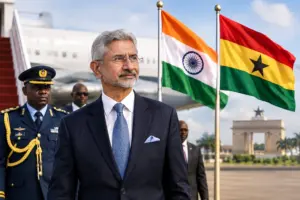




Bangladesh has recognised India’s initiative to move bilateral relations forward following External Affairs Minister S Jaishankar’s brief visit to Dhaka to attend former Prime Minister Khaleda Zia’s funeral.
Meanwhile, India’s Defence Minister Rajnath Singh paid respects to the late leader at the Bangladesh High Commission in New Delhi.
Observers viewed the gesture as significant amid strained ties.
“The brief visit of India’s foreign minister S Jaishankar to Dhaka over the past two days, along with Defence Minister Rajnath Singh’s visit to the Bangladesh mission, is significant,” Prothom Alo analysis said.
“Since the popular uprising of 5 August 2024, which led to the fall of the Awami League government and Sheikh Hasina’s flight to India, relations between the two countries have deteriorated,” it added.
Earlier, Bangladesh High Commissioner to India Riaz Hamidullah spoke on social media about Jaishankar’s visit. He said it could help open a new chapter in bilateral relations. He added that the ties would be based on pragmatism and mutual interdependence.
Referring to the visit, he highlighted the External Affairs Minister’s meeting with BNP Acting Chairman Tarique Rahman, during which Prime Minister Narendra Modi’s condolence letter was handed over.
As 🇮🇳Hon External Affairs Minister HE Dr @DrSJaishankar left Dhaka following a whirlwind 4-hr visit, #Bangladesh & #India would look forward to script a new chapter in 🇧🇩🇮🇳 ties, in shared interests driven by pragmatism and mutual interdependence, as indeed briefly discussed with… pic.twitter.com/S5HrUApijS
— Riaz Hamidullah (@hamidullah_riaz) December 31, 2025
Subsequently, Hamidullah also acknowledged Rajnath Singh’s visit to the Bangladesh mission. He described it as a mark of respect and a signal of India’s commitment to diplomatic security.
Honoured to welcome HE @rajnathsingh, Hon 🇮🇳Defense Minister at @bdhc_delhi as he conveyed condolences of #India and paid homage to former 🇧🇩 Prime Minister | @bdbnp78 Chairperson (late) #BegumKhaledaZia, in Delhi.@MEAIndia @BDMOFA @BJP4India #Bangladesh pic.twitter.com/UaykG224TT
— Riaz Hamidullah (@hamidullah_riaz) January 1, 2026
However, the Prothom Alo analysis largely overlooked the escalating violence within Bangladesh, particularly attacks targeting Hindu and other minority communities.
Instead, the focus remained on protests in India, highlighting alleged atrocities, while domestic failures to address hate crimes received little attention.
Violence across Bangladesh has intensified sharply, with Hindu citizens increasingly facing targeted killings and mob lynchings.
At least 12 Hindus reportedly lost their lives last month as mobs and extrajudicial attackers carried out the killings. The incidents heightened fear among minority groups.
Such incidents undermine social cohesion and threaten the country’s democratic transition, especially ahead of the February 12 elections.
Although authorities often present each killing as an isolated case, the broader pattern points to political instability and religious radicalism. Weak institutions continue to leave minorities exposed.
Concluding its analysis, Prothom Alo highlighted uncertainty within Bangladesh’s interim leadership regarding the future of bilateral ties.
To read more such news, download Bharat Express news apps