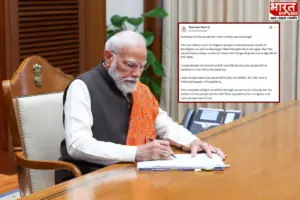




Prime Minister Narendra Modi’s visit to Jordan has paved the way for a deeper and more comprehensive partnership between India and the West Asian nation.
During the visit, India and Jordan signed five key Memoranda of Understanding (MoUs) in the areas of renewable energy, water resource management, cultural exchange, digital solutions and a twinning arrangement between Petra and Ellora.

The visit also marked the 75th anniversary of the establishment of diplomatic relations between the two countries, adding symbolic significance to the agreements.
Wide-Ranging Bilateral Discussions
PM Modi held extensive discussions with King Abdullah II of Jordan on strengthening cooperation across a broad range of sectors.
These included trade and investment, defence and security, renewable energy, fertilisers and agriculture, innovation, IT and digital technologies, critical minerals, infrastructure, health and pharmaceuticals, education and capacity building, tourism, heritage, culture and people-to-people ties.
The Prime Minister proposed that both countries should aim to enhance bilateral trade to USD 5 billion over the next five years. He also called for collaboration between Jordan’s digital payment system and India’s Unified Payments Interface (UPI), highlighting the potential for digital connectivity to support inclusive growth.
Trade and Fertiliser Cooperation
India is Jordan’s third-largest trading partner, while Jordan remains a crucial supplier of phosphates and potash fertilisers to India.
Companies from both sides are engaged in discussions to expand investment in Jordan to meet India’s growing demand for phosphatic fertilisers.
A flagship example of this cooperation is the Jordan India Fertiliser Company (JIFCO), a joint venture between Indian Farmers Fertiliser Cooperative (IFFCO) and Jordan Phosphate Mines Company (JPMC).
Originally valued at USD 860 million, the venture produces phosphoric acid for export to India and remains a vital component of India’s fertiliser supply chain.
Manufacturing and Technology Links
Over 15 garment manufacturing companies owned by Non-Resident Indians operate in Jordan’s Qualified Industrial Zones, with a cumulative investment of around USD 500 million. These firms manufacture garments in Jordan and export finished products under the Jordan–USA Free Trade Agreement framework, reflecting deep commercial integration.
Technology cooperation has also gained momentum through the Indian–Jordan Centre of Excellence in Information Technology at Al-Hussein Technical University.
Fully funded by India, the centre houses advanced infrastructure, including the PARAM Shavak supercomputer, and supports training in emerging areas such as cyber security, machine learning, web development and big data analytics.
Around 17,500 Indian nationals currently live and work in Jordan, primarily in textiles, construction, manufacturing and healthcare, forming a vital bridge between the two countries.
The MoUs and discussions during PM Modi’s visit underline a shared commitment to expanding economic engagement, technological cooperation and cultural ties, firmly cementing India–Jordan relations for the future.
Also Read: PM Modi Calls For Doubling India-Jordan Trade To $5 Billion In Five Years
To read more such news, download Bharat Express news apps