



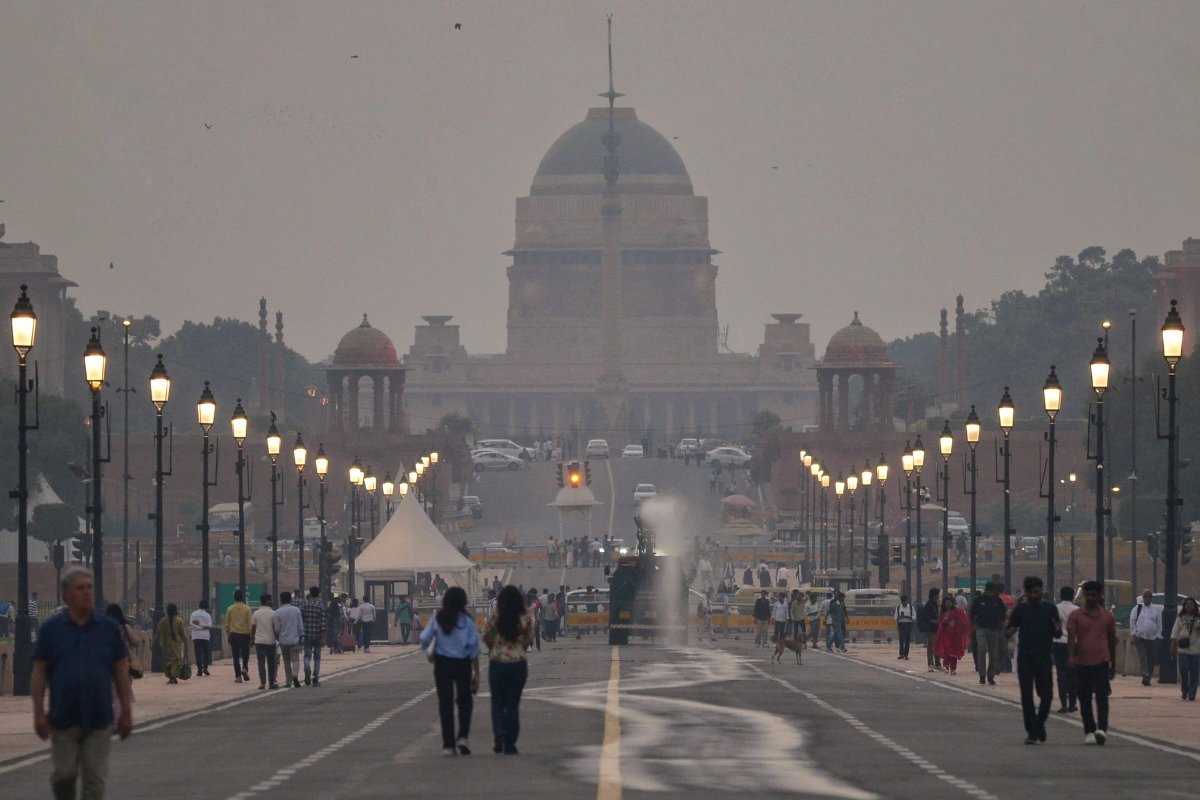
Delhi continued to reel under heavy pollution on Monday, with a thin yet persistent layer of toxic haze blanketing the Capital.
The Air Quality Index (AQI) reached 396 — firmly in the ‘very poor’ category — offering only limited relief from Saturday’s ‘very severe’ readings, which had crossed 500 at several hotspots.
The dense smog reduced visibility across multiple areas, prompting fresh health advisories from authorities.
Neighbouring cities reported similarly alarming figures: Faridabad recorded an AQI of 358, Gurugram 370, Ghaziabad 355, Greater Noida 342, and Noida 372.
While most Delhi localities remained between 300 and 400, several pockets slipped into the ‘severe’ category, surpassing the 400 mark.
Officials cautioned that pollution levels could worsen further if calm wind conditions persist.
Weather Conditions Fueling the Crisis
Meteorologists attributed the rising pollution to a combination of stagnant winds, falling temperatures, and increased moisture levels.
These factors, along with the winter inversion phenomenon — where cold air gets trapped beneath a warmer layer — prevent pollutants from dispersing, causing particulate matter to accumulate near the surface.
Environmental experts emphasised that PM2.5 particles, known for penetrating deep into the lungs, remain the most hazardous component of the current pollution mix.
Vehicular emissions, construction activity, industrial discharges, and local biomass burning continue to be major contributors during this season.
Healthcare specialists urged residents to restrict outdoor activity, particularly children, elderly people, asthma sufferers, and those with cardiovascular conditions.
Prolonged exposure to the prevailing air quality may trigger respiratory distress, eye irritation, reduced lung function, and an increased risk of cardiac complications.
GRAP Measures and Possible Restrictions
With AQI edging closer to the ‘severe’ category, Delhi remains under the enforcement of the Graded Response Action Plan (GRAP).
Authorities may introduce stricter measures if pollution levels continue to climb, including construction bans, curbs on polluting vehicles, and suspension of select industrial operations.
Experts argue that Delhi’s recurring winter pollution cannot be tackled through temporary measures alone.
They call for structural reforms such as stringent checks on vehicle emissions, accelerated expansion of public transport, robust dust control at construction sites, and coordinated regional strategies to prevent cross-border pollution.
As Delhi confronts yet another severe pollution episode, residents brace for potentially harsher weeks ahead — a stark reminder that the Capital’s annual smog crisis has become a persistent public health emergency demanding urgent, long-term solutions.
Also Read: Delhi-NCR Gasping For Breath As AQI Spikes; Stricter Controls Enforced
To read more such news, download Bharat Express news apps