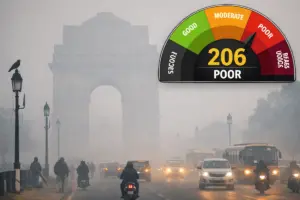




Delhi woke up on Sunday under a choking blanket of hazardous smog as air pollution spiralled deeper into the ‘severe’ category, triggering alarm across political, administrative, and public health circles. Toxic air gripped the national capital, slashed visibility, and reinforced the growing perception that India’s pollution crisis has slipped into a chronic governance challenge.
According to the Central Pollution Control Board, Delhi’s average Air Quality Index surged to an alarming 461 at 7 AM, deteriorating further from Saturday’s already critical level of 431. All 40 air quality monitoring stations across the city reported ‘severe’ readings, signalling a uniform collapse in air quality rather than isolated pollution pockets.
Several areas hovered dangerously close to the maximum measurable limit. Rohini emerged as the most polluted zone with an AQI of 499, followed closely by Bawana at 498. Vivek Vihar touched 495, while Ashok Vihar and Wazirpur reported 493 each. Narela stood at 492, and Anand Vihar recorded 491, highlighting how industrial belts, residential areas, and traffic corridors all suffered equally.
Central and old Delhi fared no better. ITO registered 485, Mundaka 486, Punjabi Bagh 478, Nehru Nagar 476, and both Chandni Chowk and Okhla recorded 470. The data painted a grim picture of city-wide exposure, leaving millions breathing air officially classified as hazardous to health.
Capital Faces Pollution Emergency
The crisis extended well beyond Delhi’s borders. Cities across the National Capital Region also reeled under extreme pollution. Noida recorded a severe AQI of 470, Ghaziabad followed with 460, while Gurugram slipped into the ‘very poor’ category at 348. Faridabad reported an AQI of 220, still firmly within the ‘poor’ bracket.
Dense smog, mixed with fog, engulfed the region from early morning, sharply reducing visibility and disrupting movement. Several neighbourhoods reported near-zero visibility, forcing commuters to slow traffic and raising road safety concerns.
At Indira Gandhi International Airport, authorities activated low-visibility procedures as a precautionary measure. While flights continued to operate, pilots navigated under strict protocols amid fluctuating conditions. The India Meteorological Department warned that visibility could drop to 100 metres during early morning hours before marginally improving later in the day.
Stagnant winds, cold weather, vehicle emissions, industrial output, and seasonal biomass burning combined to worsen the crisis. Health experts warned that prolonged exposure could trigger respiratory distress, cardiac complications, and long-term lung damage.
Politically, the worsening smog has intensified scrutiny of pollution control policies, emergency response mechanisms, and inter-state coordination. With winter tightening its grip, Delhi’s air crisis once again underscores the urgent need for sustained structural reforms rather than temporary firefighting.
Also Read: Smog Blankets Delhi-NCR As Air Pollution Worsens Sharply
To read more such news, download Bharat Express news apps