



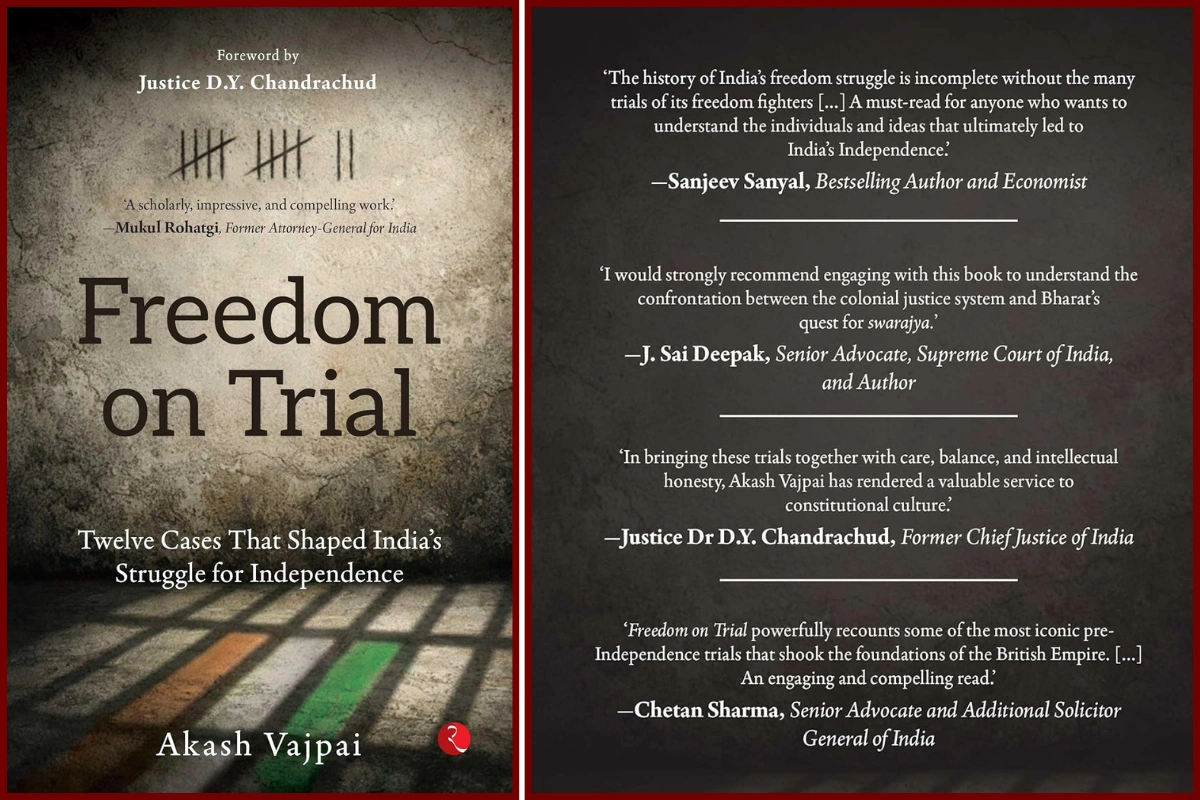
Freedom on Trial: Twelve Cases That Shaped India’s Struggle for Independence by Akash Vajpai is a significant contribution to the historiography of India’s freedom movement.
Published by Rupa Publications, the book shifts the focus from familiar narratives of street protests, marches and revolutionary actions to the often-overlooked battlefield of colonial courtrooms.
With a foreword by Justice DY Chandrachud and praise from legal luminaries such as former Attorney-General Mukul Rohatgi, the book presents a compelling account of how the fight for swaraj was waged not only through mass mobilisation but also through legal resistance against a biased imperial justice system.
Vajpai, an Advocate-on-Record practising before the Supreme Court of India, brings a lawyer’s precision and a historian’s curiosity to the subject.
The book reconstructs twelve landmark trials spanning nearly a century, from the court-martial of Mangal Pandey after the Revolt of 1857 to the Indian National Army (INA) trials at the Red Fort in 1945–46.
Among the cases examined are those involving Bal Gangadhar Tilak, Vinayak Damodar Savarkar, Aurobindo Ghose in the Alipore Conspiracy Case, Ram Prasad Bismil and Ashfaqulla Khan in the Kakori case, Bhagat Singh and his associates in the Lahore Conspiracy Case, Madan Lal Dhingra, Udham Singh, Basanta Kumar Biswas, Sachindra Nath Sanyal and Mahatma Gandhi’s sedition trial of 1922, alongside the INA proceedings involving officers such as Shah Nawaz Khan, PK Sahgal and Gurbaksh Singh Dhillon.
Law and Political Resistance
What distinguishes the work is its dual focus on legal procedure and political drama.
Vajpai shows how the colonial state repeatedly manipulated the law by appointing compliant magistrates, amending statutes mid-trial to deny appeals, conducting secretive hearings and ensuring predetermined outcomes.
Yet the accused and their defenders frequently turned these forums into platforms of resistance.
Bhagat Singh’s defiant stance, Gandhi’s moral authority in the dock and the nationwide surge of support during the INA trials illustrate how courtroom injustices awakened nationalist consciousness and exposed the moral bankruptcy of imperial rule.
The evolution of legal defence itself mirrors the growth of the freedom struggle.
Early cases often saw limited organised support, while later ones, particularly the INA trials, attracted the active involvement of national leaders, including Jawaharlal Nehru, who had learnt from earlier reluctance to fully back Bhagat Singh.
Vajpai’s narrative strength lies in reconstructing these episodes with vivid detail while avoiding excessive legal jargon, making the book accessible to general readers as well as lawyers and students of history.
The human stories—of young revolutionaries facing the gallows with composure, lawyers challenging an empire’s legal machinery, and public opinion crystallising around these trials—remain central.
Freedom on Trial brings neglected legal battles back into the independence narrative and shows how colonial constraints helped shape the ideas of rights and justice in modern India.
To read more such news, download Bharat Express news apps