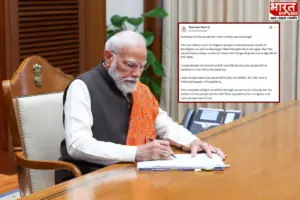




File Photo
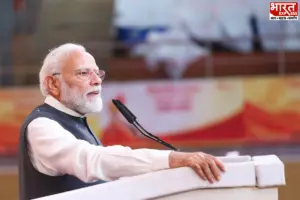
Prime Minister Narendra Modi paid respects to Dr Syama Prasad Mookerjee on his death anniversary and remembered him as a visionary leader who devoted his life to the country’s progress.
Through a post on X, the Prime Minister praised Dr Mookerjee’s dedication to public service, describing him as a patriot, scholar, and statesman whose principles continue to guide and inspire people across generations. He also stated that the nation remains committed to advancing the values for which Mookerjee stood throughout his life.
On his Balidan Diwas, I pay homage to Dr. Syama Prasad Mookerjee, a distinguished patriot, scholar and statesman who dedicated his life to India’s development. His unwavering conviction, courage in public life and commitment to national interest continue to inspire generations.…
— Narendra Modi (@narendramodi) June 23, 2026
Dr Mookerjee earned recognition as one of the leading intellectual figures of his time. In 1934, he assumed office as the youngest Vice-Chancellor of Calcutta University and worked to strengthen educational institutions and expand access to higher learning.
Born on 6 July 1901 in Calcutta, Dr Syama Prasad Mookerjee belonged to a distinguished family known for its contributions to education and the legal profession. His academic accomplishments established the foundation for a career that would later influence national politics.
Dr Mookerjee began his political career after securing election to the Bengal Legislative Council in 1929.
After Independence, Dr Syama Prasad Mookerjee joined then Prime Minister Jawaharlal Nehru’s government as the country’s first Minister for Industry and Supply. In that role, he promoted industrial expansion, encouraged indigenous enterprise, and advocated policies aimed at strengthening economic self-sufficiency.
Dr Mookerjee stepped down from the Union Cabinet in 1950 following differences with the government over issues such as Kashmir, relations with Pakistan, and the interpretation of secularism.
A year later, Dr Syama Prasad Mookerjee established the Bharatiya Jana Sangh, creating a political platform centred on cultural nationalism, national cohesion, and self-reliant development.
Under his leadership, the party emerged as a significant voice in opposition politics and helped shape discussions on governance, identity, and national priorities in post-Independence India.
To read more such news, download Bharat Express news apps