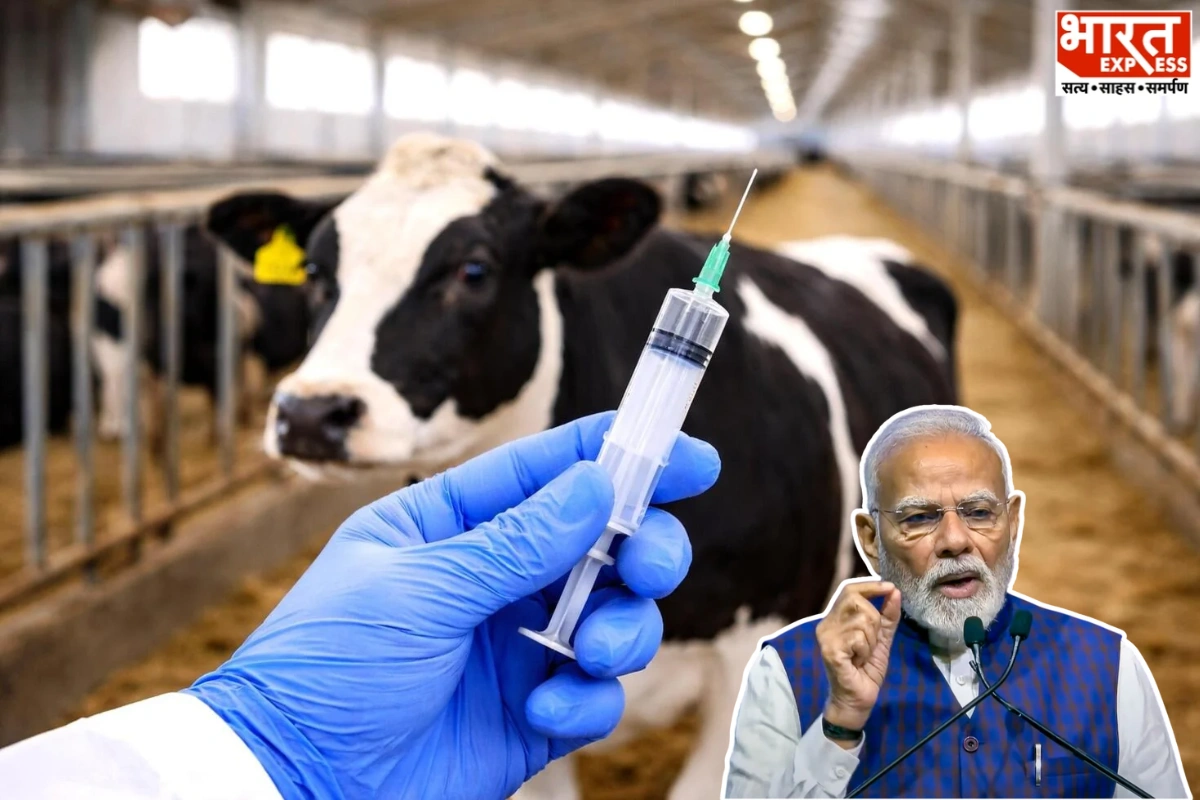
Prime Minister Narendra Modi on Friday highlighted the role of indigenous vaccines in protecting livestock and poultry from infectious diseases. He said these efforts over the past 12 years had strengthened animal healthcare and reduced disease-related losses. They had improved farmers’ incomes and livelihoods.
PM Modi said the government had taken several important steps to promote farmers’ prosperity and empower rural India. He further added that indigenous vaccine development reflected India’s growing capabilities in veterinary healthcare. It supported the goal of building a self-reliant agricultural ecosystem.
The Prime Minister referred to an article by Union Agriculture Minister Shivraj Singh Chouhan.
The article explains how homegrown vaccines protect livestock and poultry from infectious diseases. These efforts improve animal health and help farmers avoid financial losses.
Shivraj Singh Chouhan was scheduled to dedicate India’s first indigenous vaccine against the highly pathogenic H5N1 strain of avian influenza, commonly known as bird flu, to the nation.
The Bhopal-based ICAR-National Institute of High Security Animal Diseases (ICAR-NIHSAD) developed the vaccine. It, however, aims to strengthen disease control in India’s poultry sector.
Bird flu outbreaks often force authorities to cull infected poultry and impose trade restrictions. These measures, however, disrupt markets, affect poultry prices and cause heavy losses to farmers.
India reported its first bird flu case in 2006. Since then, the country has recorded more than 500 outbreaks involving the H5N1 and H5N8 subtypes.
Official estimates suggest a major outbreak could reduce India’s GDP growth by 1.5 per cent. It could, however, put more than 20 per cent of the country’s poultry population at risk.
The 2006 outbreak caused estimated direct and indirect losses of Rs 2,200 crore to Rs 3,000 crore.
A separate outbreak in Manipur caused losses equivalent to 0.5 per cent of the state’s GDP.
Bird flu poses serious public health risks. The World Health Organisation reported 1,003 human H5N1 cases and 479 deaths across 25 countries, including India, since 2003
Also Read: Giriraj Singh Highlights PM Modi’s Development Push In Bihar
To read more such news, download Bharat Express news apps