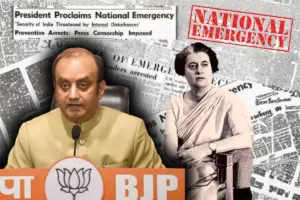




More than five decades have passed since the midnight of June 25, 1975, when then Prime Minister Indira Gandhi proclaimed a national Emergency under Article 352 of the Indian Constitution.
What followed was 21 months of authoritarian rule marked by the suspension of fundamental rights, mass arrests of opposition leaders, forced sterilisations, press censorship, and the erosion of judicial independence.
The Emergency remains one of the darkest chapters in independent India’s democratic journey.
The recently published book 50 Years of the Indian Emergency: Lessons for Democracy, edited by Peter Ronald de Souza and Harsh Sethi (Orient BlackSwan, Landmarks series), arrives as a sobering scholarly intervention to revisit that period and extract enduring lessons for Indian democracy.
The book’s cover itself is striking — a dignified portrait of an elderly woman encircled by a ring of stylised human figures, some raising their hands in protest, symbolising both collective resistance and the fragility of democratic norms.
Through a collection of essays by leading academics, journalists, and public intellectuals, the volume examines the Emergency not merely as a historical event but as a diagnostic lens to understand contemporary challenges to constitutionalism.
Examining Institutional Failures
The editors have curated contributions that explore multiple dimensions.
Several chapters analyse the institutional failures that enabled the Emergency — the Executive’s overreach, the judiciary’s initial deference (most notoriously in the ADM Jabalpur case), and the bureaucracy’s willing compliance.
Others revisit the human cost: the stories of political prisoners, the slum demolitions in Delhi, and the coercive family planning drive that scarred millions.
Importantly, the book avoids reducing the period to a simple morality tale of one leader’s ambition. It situates the Emergency within deeper structural issues — the tensions between development and democracy, the centralisation of power, and the fragility of institutional safeguards when majoritarian impulses or political exigencies take precedence.
A particularly valuable aspect of the volume is its forward-looking orientation.
The contributors draw explicit parallels between the 1975-77 experience and present-day concerns: the use of laws against dissent, the shrinking space for civil society, media self-censorship, and the politicisation of institutions.
The book argues that while India returned to democracy in 1977 with a powerful electoral verdict against authoritarianism, many of the underlying vulnerabilities persist.
The lesson is clear — democratic backsliding does not always arrive with tanks in the streets; it can creep in through incremental erosion of norms, laws, and constitutional spirit.
Why the Book Matters
Peter Ronald de Souza and Harsh Sethi deserve credit for assembling a balanced yet unflinching assessment. The volume does not indulge in partisan rhetoric but insists on intellectual honesty. It reminds readers that the survival of Indian democracy after the Emergency was not inevitable; it was the result of public resistance, judicial correction in later years, and the resilience of the Constitution itself.
In an era of polarised politics and competing narratives about India’s past and future, 50 Years of the Indian Emergency serves as a vital reminder that vigilance is the price of liberty.
As India crosses the 51-year mark, the book urges citizens, institutions and leaders to internalise the lessons of 1975: that unchecked power breeds corruption, that governments can suspend rights again if people fail to remain vigilant, and that citizens must actively defend democracy rather than simply assume it will endure.
This scholarly work is essential reading for anyone invested in the health of Indian democracy. It is both a memorial to those who suffered and a call to strengthen the republic’s foundations for the decades ahead.
To read more such news, download Bharat Express news apps