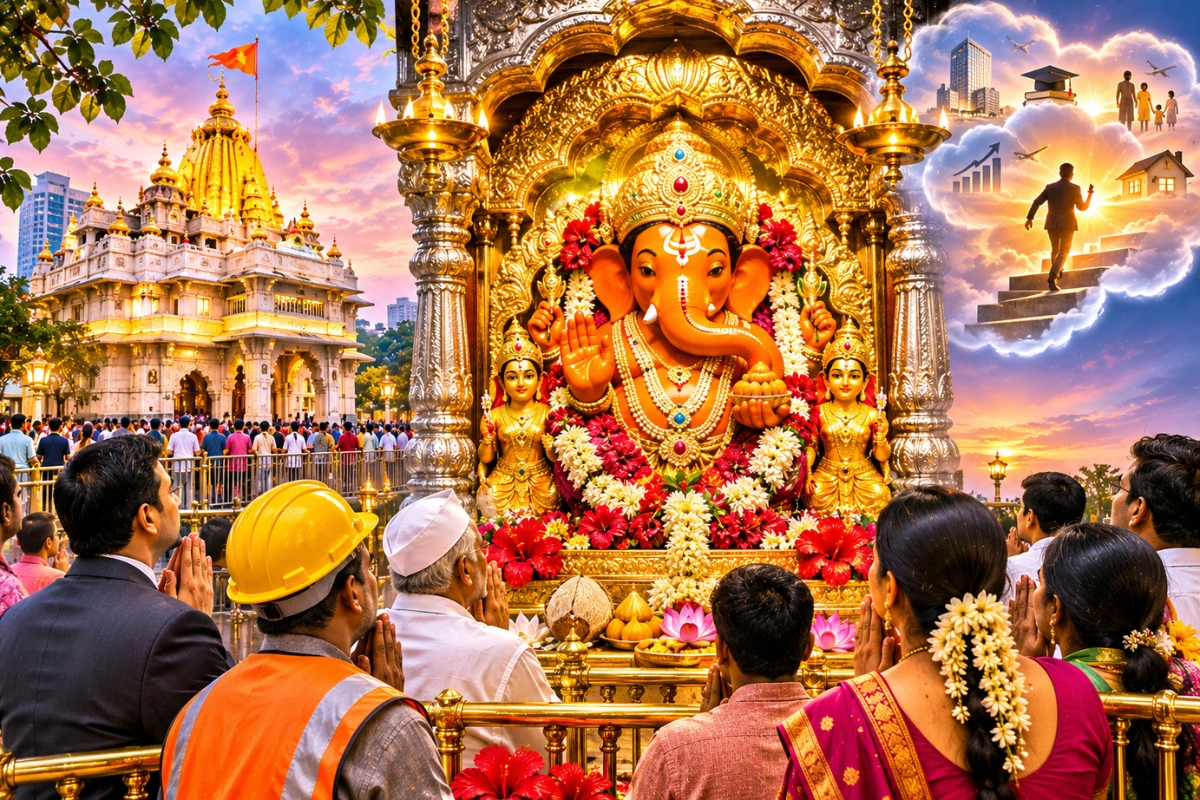
AI Generated Image
The Warden of Dreams: Where Billionaires and Labourers Bow Before the Right-Trunked Ganesha
Shree Siddhivinayak Temple (Mumbai, Maharashtra)
Shree Siddhivinayak Temple in Prabhadevi, Mumbai, is a Ganesha shrine distinguished by its unusual right-curving trunk and its enduring association with prayers for new beginnings. Established in 1801, it offers a setting for understanding devotion, ambition, and the hopes people place before the remover of obstacles. This exploration connects its history and symbolism with thoughtful approaches to meditation and personal aspirations.
The Warden of Dreams: Where Billionaires and Labourers Bow Before the Right-Trunked Ganesha
Here, ‘dreams’ can mean more than images encountered during sleep. They can also represent the business someone hopes to build, the education a parent wants for a child, or the steady employment that could transform a household. The phrase invites us to consider what happens when ambition pauses long enough to become prayer.
Why Call Ganesha the Warden of Dreams?
‘Warden of Dreams Ganesha’ is best understood here as a poetic description, not an established scriptural title. It presents Ganesha as a guardian of aspirations: someone before whom a wish can be examined, offered, and connected with responsibility. The temple trust describes Ganesha as Vighnaharta, the remover of obstacles, traditionally worshipped before starting a new project or venture.
That distinction matters. A guardian does not have to function as a dispenser of everything requested. Read reflectively, the image asks whether a dream deserves our effort, whether its pursuit will harm others, and whether we are prepared for the discipline it requires.
For someone seeking Ganesha’s blessings, the prayer might therefore become more specific: not simply ‘Let me succeed’, but ‘Help me begin honestly, recognise obstacles clearly, and respond without losing my integrity’.
Legend and Civilisational Significance
The temple was established in 1801, with its first consecration recorded on 19 November 1801. Its beginnings were modest: a small structure housing the black-stone deity rather than the substantial shrine familiar today. That documented beginning anchors its devotional history in a concrete place and time.
Accounts of its founding associate the shrine with builder Laxman Vithu Patil and patron Deubai Patil, a childless woman remembered for wishing that other women might receive the blessing of children. This tradition gives the founding story a compassionate centre: personal longing becomes a reason to create a place of hope for others. It should be understood as devotional history, not evidence that any particular prayer guarantees an outcome.
The shrine houses the rare right-trunked form requested here as Dahinavarti Ganesha, more commonly described as Dakshinavarti or right-curving Ganesha. The trust confirms that this trunk direction is unusual compared with the more commonly seen leftward curve.
Some devotional descriptions portray this form as fierce in granting quick boons while demanding absolute purity of thought. These are expressions of religious belief, not measurable promises. Reporting on the temple also records the association between right-trunked Ganesha and especially disciplined worship. Read ethically, the emphasis on purity invites sincerity rather than fear or the expectation of instant rewards.
Its civilisational significance can be understood through the relationship between desire and duty. A sacred place preserves more than architecture: it keeps alive questions about worthy beginnings, gratitude, and what people owe one another while pursuing prosperity.
The Living Reality of Devotion in Prabhadevi
The temple’s living reality encompasses celebrities, corporate leaders, and ordinary working people, including daily-wage labourers. India’s Ministry of Tourism describes visitors from almost all sections of society, while documented visits by business figures show how widely its appeal extends. Tim Cook, for example, attended morning worship during his May 2016 visit to India.
Mumbai’s district administration describes lakhs of devotees visiting on Tuesdays and other auspicious occasions. This supports the familiar description of lakhs gathering every Tuesday in Prabhadevi, although it should not be treated as an audited attendance figure for every individual week. Behind the scale are personal petitions: a livelihood, a family concern, or courage before a consequential beginning.
The evocative image of movie stars walking barefoot at 3:00 am belongs to this pre-dawn devotional landscape, but the precise hour should not be presented as a universal celebrity routine. A documented example is the Bachchan family’s barefoot pilgrimage on 27 May 2008, reported as starting at around 2:00 am. The verified practice is the early-hours walk, not one fixed departure time.
Seeking blessings before launching a campaign, film, or business fits the broader tradition of invoking Ganesha before new undertakings. The temple trust explicitly connects worship with beginning projects and ventures. This is a devotional practice, not a claim that every visitor follows the same ritual or receives the same result.
Spiritual equality need not mean identical circumstances. Wealth, access, and working conditions remain unequal outside the shrine. The more meaningful reflection is that uncertainty belongs to everyone, regardless of status.
Ganesha Symbolism as a Prompt for Reflection
Ganesha symbolism becomes more useful when observation comes before interpretation. The Siddhivinayak idol is carved from a single black stone, with four hands holding a lotus, an axe, prayer beads, and a modak. Riddhi and Siddhi stand beside the deity and are associated by the trust with success, riches, and prosperity.
Rather than treating every feature as a rigid code, consider these personal reflection prompts:
- The lotus: What would it mean to pursue your goal without abandoning your values?
- The axe: Which avoidable habit or distraction could you stop feeding?
- The prayer beads: What small practice could you repeat consistently instead of waiting for motivation?
- The modak: How could you receive success with gratitude rather than entitlement?
These prompts are suggested interpretations, not quotations from a sacred text. Their purpose is to bring attention back to conduct. A symbol becomes practically valuable when it changes how you listen, work, decide, or treat another person.
Can Spiritual Dreams Offer Meaningful Dream Guidance?
Spiritual dreams can be approached as personally meaningful experiences without assuming they predict events or carry compulsory divine instructions. For this article, dream interpretation means reflective exploration: considering what an image brings to mind and how it relates to your waking concerns. Dream guidance need not become a command to make a major life decision.
If Ganesha appears in a dream, begin with the experience itself rather than a ready-made verdict. Did you feel welcomed, challenged, peaceful, or uncertain? What beginning or difficulty was already occupying your attention?
Try keeping a simple record:
- Describe the scene. Write what you remember before adding an explanation.
- Name the emotion. Separate the dream’s imagery from how it felt.
- Connect it cautiously. Note possible links with current hopes, responsibilities, or conflicts.
- Choose a grounded response. Reflect, pray, or take one sensible action without treating the dream as proof.
You might choose to read an obstructed path as a prompt to review your preparation. That remains a chosen interpretation, not evidence that failure or success has been foretold. Leave room for uncertainty and resist anyone offering guaranteed predictions.
A Simple Ganesha Meditation for Everyday Practice
Use this suggested Ganesha meditation as a quiet reflection, not as a substitute for formal worship or instruction within your tradition. No elaborate visualisation is necessary. The emphasis is on attention, intention, and an achievable next step.
- Settle comfortably. Allow your breathing to remain natural and your posture unforced.
- Bring one aspiration to mind. Choose something specific rather than thinking about your entire future.
- Offer a plain intention. For example: ‘May I begin with honesty and respond with patience’.
- Examine your part. Identify what requires preparation, courage, an apology, or sustained work.
- Close with action. Decide what you will do next, however modest.
If you follow an established devotional practice, let that tradition guide your prayers and ritual details. You do not need to manufacture a vision or unusual experience. A useful ending may simply be a clearer intention and a task you are willing to undertake.
Carrying the Prayer Beyond the Shrine
For a visit, consult the temple trust’s official schedule rather than assuming an account of early-hours worship applies to every day. The trust publishes separate arrangements for ordinary days, Tuesdays, and special observances. Planning around these differences is part of respecting a functioning place of worship.
The lasting takeaway is not that devotion purchases success. Let Siddhivinayak’s association with new beginnings invite a better question: what kind of person will you become while pursuing your dream? Bring the hope, but bring the willingness to act responsibly as well.
Also Read: Raghupati: Civilizational Faith’s 500-Year Triumph
To read more such news, download Bharat Express news apps