



AI Generated Image
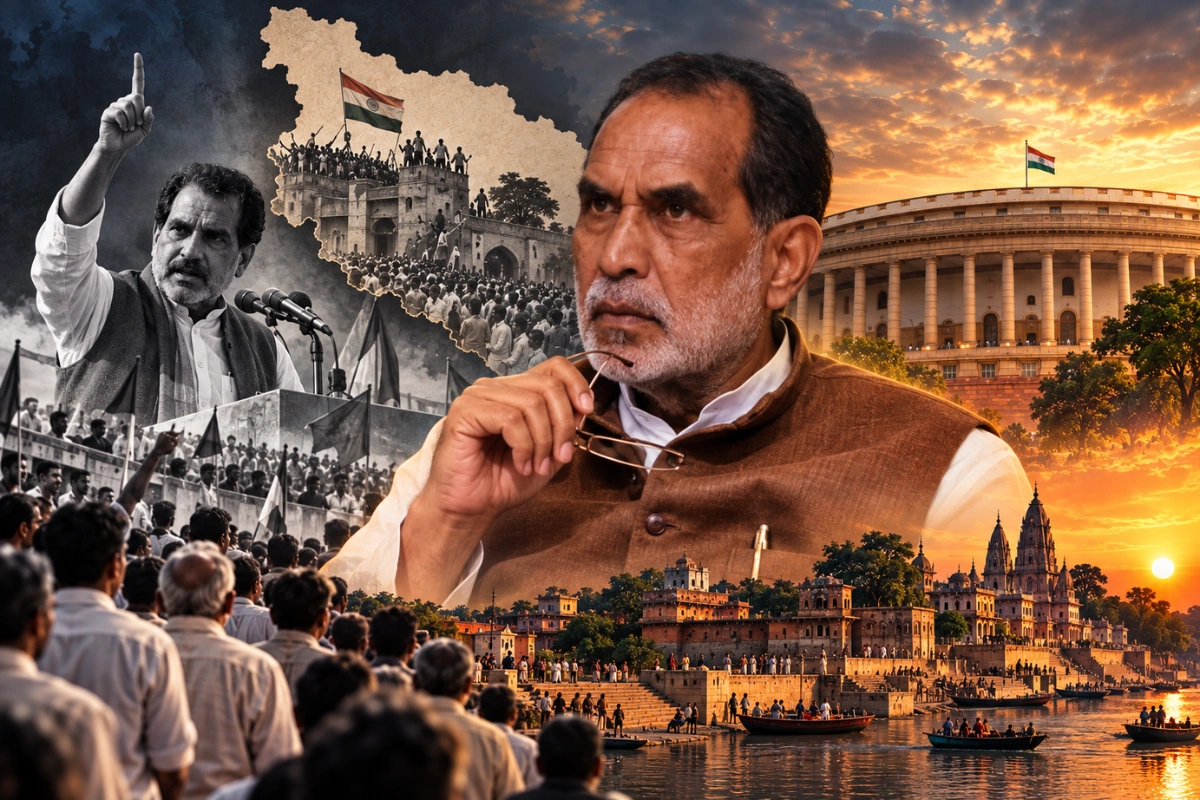
In Indian political memory, the ‘Young Turk’ associated with Ballia is Chandra Shekhar: a socialist, dissenter, parliamentarian, and former Prime Minister whose politics drew strength from eastern Uttar Pradesh’s rebellious public culture. The phrase also carries a much older global history, rooted in the Young Turk movement of the Ottoman Empire, so understanding Ballia’s version means separating metaphor from origin. This guide explains how a local tradition of defiance, the 1942 Ballia uprising, and Chandra Shekhar’s anti-establishment style helped shape a lasting political vocabulary in Uttar Pradesh.
What Does ‘Young Turk’ Mean in the Ballia and Uttar Pradesh Context?
In the Ballia and Uttar Pradesh context, ‘Young Turk’ refers to a fearless, reform-minded political rebel rather than a direct connection to Turkish nationalism or modern Turkey. Chandra Shekhar came to be described as a Young Turk because he challenged entrenched power, spoke for social change, and cultivated a politics of ideological conviction over easy alignment. The Prime Minister’s Office biography notes that he earned the label for ‘conviction, courage and integrity’ in opposing vested interests.
That distinction matters. In everyday Indian usage, ‘Young Turk’ became a shorthand for a bold insider who refuses to behave like a loyal courtier. It suggests youthfulness of spirit more than age, dissent more than disruption for its own sake, and political revolution through democratic argument rather than armed seizure of power.
Ballia gave the phrase a special charge because the district already carried the reputation of a rebellious place. Before Chandra Shekhar became a national figure, Ballia had been remembered for its role in the Quit India movement, when local mobilisation briefly overwhelmed colonial authority. In that setting, the ‘Young Turk’ label did not feel imported; it attached itself naturally to a region proud of speaking sharply to power.
The Original Young Turks Were a Different and Darker History
The original Young Turks were an early 20th-century Ottoman political movement, not an Indian socialist formation. They emerged as reformist nationalist leaders who opposed Sultan Abdul Hamid II’s absolutism and helped restore constitutional politics in 1908. Their most powerful organisation, the Committee of Union and Progress, later moved towards a more centralised and exclusive nationalism, especially during the violent collapse of the Ottoman imperial order.
This is where the term’s global history becomes complicated. The Young Turks initially presented themselves as constitutional modernisers who wanted a liberal, secular political order. But between 1909 and 1913, the Committee of Union and Progress increasingly embraced a more strident nationalist vision, imagining the empire’s future less as multi-ethnic Ottomanism and more as culturally Turkish.
The legacy is darker still because the wartime CUP leadership is closely associated with the Armenian genocide. The United States Holocaust Memorial Museum explains that Ottoman authorities arrested Armenian leaders in Constantinople on April 24, 1915, expanded deportations beginning in May 1915, and that most scholars regard the mass murder of Armenians as genocide. It also states that CUP leadership intentionally targeted the Armenian population of Anatolia.
So when Indian politics uses ‘Young Turk’, it is using a phrase that travelled far from its original historical setting. The Indian meaning does not endorse the Ottoman movement’s actions, nor does it suggest ideological continuity with Turkish nationalism. It functions as a political metaphor: a restless reformer within the system.
Why the Distinction Matters
Without this distinction, the phrase can become historically careless. ‘Young Turk’ in Ottoman history evokes modernisation, nationalism, authoritarian consolidation, and mass violence. ‘Young Turk’ in Indian parliamentary language generally evokes dissent, impatience with hierarchy, and moral challenge to entrenched interests.
A responsible guide must hold both meanings at once. The Indian metaphor is real, but the Ottoman history should not be erased. That is especially important when SEO discussions place terms like Young Turk legacy, Armenian genocide, modern Turkey, and political revolution beside Ballia and Uttar Pradesh.
Ballia’s Rebel Memory Came Before Chandra Shekhar
Ballia’s political identity did not begin with one leader. The district’s official history records that people in Ballia actively carried forward the Quit India movement after August 9, 1942, and that students, local leaders, and residents joined a wave of mobilisation after Congress leaders were arrested. By August 20, 1942, Ballia had declared ‘Independence’, and a popular government was formed with Chittu Pandey as its first head.
That moment became central to Ballia’s self-image. The district was not merely participating in a national movement; it was acting out a local version of sovereignty. Panchayats were formed, volunteers took up civic roles, and the colonial administration briefly lost effective control in several parts of the district.
The uprising was quickly suppressed. Military forces entered Ballia during the night of August 22–23, 1942, and the popular government was overthrown. The district account describes arrests, beatings, torture, looting, and harsh repression after British authority returned.
This memory matters because it created a political culture in which resistance was not abstract. Ballia’s reputation as ‘revolutionary’ was built through a concrete local episode: people had seen authority challenged, punishment inflicted, and sacrifice remembered. When later leaders spoke of justice, dignity, and democratic dissent, those words landed on soil already marked by rebellion.
The Symbolic Power of ‘Baghi Ballia’
The phrase ‘Baghi Ballia’, or rebel Ballia, works because it condenses history into identity. It tells voters, activists, and leaders that rebellion is not an imported style but a local inheritance. In Uttar Pradesh politics, where caste, region, ideology, religion, and personality often intersect, such symbols give public life emotional depth.
This does not mean every Ballia politician is rebellious or every act of defiance is noble. It means that Ballia’s political culture has a ready-made language for honouring dissent. Rise of Chandra Shekhar made that language nationally visible.
Chandra Shekhar Turned Rebellion Into a Democratic Idiom
Chandra Shekhar’s importance lies not only in the offices he held but in the way he practised politics. He entered Parliament early, became associated with socialist concerns, and developed a reputation for speaking against economic concentration and political arrogance. His official biography records that he was elected to the Rajya Sabha from Uttar Pradesh in 1962, joined the Indian National Congress in 1965, and came into conflict with centres of power after attacking the growth of monopoly houses with state patronage.
That is the key to his Young Turk image. He was not simply anti-Congress or anti-establishment in a narrow partisan sense. He was a dissenter from within, someone who believed politics had to confront privilege even when privilege sat inside one’s own party.
During the Emergency declared on June 25, 1975, Chandra Shekhar was arrested despite being part of important Congress bodies. The PMO biography notes that he was among the few individuals in the then ruling party who were imprisoned during the Emergency and that his Hindi prison diary was later published as Meri Jail Diary.
His later Bharat Yatra deepened this image. From January 6, 1983, to June 25, 1983, he walked from Kanyakumari to Rajghat, covering about 4,260 kilometres, to reconnect with people and understand their problems. That act turned politics into physical listening: not a rally from a stage, but a long encounter with villages, towns, and citizens.
Ideology Over Personality
One of the most useful ways to understand Chandra Shekhar is to see him as a politician who distrusted personality cults, even though he had a powerful personality himself. His official biography says he stood against the ‘politics of personalities’ and favoured the ‘politics of ideology and social change’.
That distinction explains why his legacy remains larger than his brief period as Prime Minister. He represented a way of doing politics: sharp argument, ideological seriousness, social concern, and a willingness to lose comfort for conviction. In a state as politically dense as Uttar Pradesh, that style left a vocabulary for later leaders, activists, and commentators.
How Did Ballia’s Fire Enter Uttar Pradesh’s Political DNA?
Ballia’s fire entered Uttar Pradesh’s political DNA by turning rebellion, socialist language, and grassroots legitimacy into durable political values. The district’s freedom struggle gave eastern UP a heroic memory of defying rulers; Chandra Shekhar converted that memory into a parliamentary style that valued dissent, ideological argument, and direct contact with ordinary people. Together, they helped make anti-elite politics feel both local and democratic.
‘Political DNA’ is, of course, a metaphor. It does not mean one district mechanically determines the politics of India’s most populous state. It means that certain instincts keep reappearing: suspicion of distant authority, respect for leaders who speak plainly, admiration for sacrifice, and an expectation that politics should travel beyond capital cities.
Uttar Pradesh has often produced leaders who present themselves as challengers of entrenched order. Some draw from caste justice, some from religious mobilisation, some from farmer politics, some from socialist traditions, and some from regional pride. Ballia’s contribution to this wider culture is the moral romance of rebellion: the idea that a leader must be willing to confront power, not merely manage it.
The Ballia Pattern in Public Life
A useful way to understand the pattern is to break it into recurring traits:
- Defiance as legitimacy: In Ballia’s political memory, a leader gains credibility by standing up to authority, especially when that authority appears unjust or arrogant.
- Grassroots contact as proof: Chandra Shekhar’s long walk symbolised a belief that political knowledge should come from direct public contact, not only from offices and party rooms.
- Social justice as moral language: The Young Turk style in India often connects rebellion with concern for the downtrodden, rural society, and those excluded from power.
- Oratory as political action: In Uttar Pradesh, speeches are not decorative. They are tools for mobilisation, persuasion, and identity formation.
- Memory as mobilisation: References to 1942, freedom fighters, and ‘Baghi Ballia’ give contemporary politics a usable past.
These traits do not belong to one party alone. They form part of a wider political culture in which leaders must show nerve, proximity, and symbolic rootedness.
The Young Turk Legacy Is Both Local and National
The Young Turk legacy attached to Chandra Shekhar works on two levels. Locally, it gives Ballia a national figure who seems to embody the district’s rebellious image. Nationally, it offers an example of how dissent can come from inside institutions rather than outside them.
This is why his career is useful for understanding Indian democracy. Democracies need parties, but parties can become rigid. Democracies need leaders, but leaders can become insulated. Similarly, democracies need ideology, but ideology can become a slogan. The Young Turk figure stands at the point where these tensions become visible.
Chandra Shekhar was not remembered only because he opposed things. He was remembered because his opposition was tied to a larger claim: that politics must be answerable to the poor, the marginalised, and the morally alert citizen. Whether one agrees with every position he took is secondary to understanding the role he played in Indian political imagination.
A Bridge Between Street and Parliament
Ballia’s history gives pride of place to popular action. Parliament gives pride of place to debate, procedure, and law. Chandra Shekhar’s political personality connected the two.
He could speak the language of socialist mobilisation, but he also spent decades in parliamentary life. He could criticise power, yet he eventually held the highest executive office. Similarly, he could invoke mass concerns, yet he insisted on ideological seriousness. That combination is rare, and it explains why his memory still has value beyond nostalgia.
The Difference Between Rebellion and Responsibility
A guide to this legacy must also recognise a tension: rebellion is politically attractive, but responsibility is politically difficult. Ballia’s 1942 uprising was born in extraordinary colonial conditions. Chandra Shekhar’s dissent developed inside a constitutional democracy. These are not the same situation, and treating them as identical would flatten history.
In colonial India, rebellion challenged foreign rule. In democratic India, dissent must challenge power while preserving constitutional methods. This is one reason Chandra Shekhar’s model matters: his rebellion was usually expressed through speech, organisation, writing, imprisonment, padyatra, and parliamentary struggle.
That is a crucial lesson for Uttar Pradesh politics. The romance of revolt can energise citizens, but democratic politics also demands patience, negotiation, coalition-building, and respect for institutions. A leader who only rebels may become theatrical. A leader who never rebels may become irrelevant.
The Best Version of the Legacy
The strongest version of the Young Turk inheritance is not permanent anger. It is principled restlessness. It asks leaders to remain uncomfortable with injustice, but also disciplined enough to convert discomfort into public work.
That difference separates democratic dissent from mere disruption. It also separates Ballia’s constructive political memory from shallow attempts to borrow its rebel image without earning it.
What Can Today’s Leaders Learn From the Young Turk Legacy?
Today’s leaders can learn that political courage is most persuasive when it is tied to social purpose, public contact, and personal risk. The Young Turk legacy is not just about speaking loudly against the powerful; it is about proving that dissent serves people beyond oneself. For Uttar Pradesh, the lesson is that rooted politics still matters: voters often recognise the difference between staged rebellion and lived conviction.
Several practical lessons stand out.
1. Build Credibility Before Confrontation
Chandra Shekhar’s dissent had force because it was backed by ideological preparation and public work. Confrontation without credibility can look like ambition. Confrontation with a record of service can look like courage.
For modern leaders, this means speeches are not enough. They need consistent positions, relationships with communities, and a willingness to be accountable when conditions change. Political revolution in a democracy is rarely one dramatic event; it is often a long process of shifting public expectations.
2. Stay Close to People, Not Just Platforms
The Bharat Yatra remains a powerful symbol because it placed the leader physically among citizens. Today, technology allows constant messaging, but messaging is not the same as listening. Doorstep contact, constituency work, local meetings, and patient hearing still build political trust.
This is especially important in Uttar Pradesh, where local identities and everyday grievances can be highly specific. A leader who knows only television language may miss the village-level emotional map. Ballia’s political tradition rewards those who can speak nationally without losing local texture.
3. Make Ideology Usable
Ideology becomes meaningful when people can connect it to land, labour, dignity, jobs, education, representation, and justice. Chandra Shekhar’s politics drew from socialist traditions, but its appeal rested on a broader moral claim: public life should not be captured by the privileged few.
Modern leaders do not have to copy his exact ideology. But they can learn from the seriousness with which he treated ideas. In an age of fast slogans, ideological clarity can itself become a form of rebellion.
4. Remember That Dissent Has Costs
Ballia’s 1942 memory includes repression. Chandra Shekhar’s career includes imprisonment during the Emergency. The point is not to glorify suffering, but to recognise that credible dissent often involves sacrifice.
A politics that wants the prestige of rebellion without any cost becomes performance. A politics that accepts responsibility, risk, and scrutiny can become legacy.
A Responsible Reading of the Global Young Turk Comparison
Because the phrase ‘Young Turk’ has multiple histories, writers and political communicators should use it carefully. In India, it may describe bold reformers or anti-establishment leaders. Globally, it also points back to the Ottoman movement, the rise of Turkish nationalism, the making of modern Turkey, and the catastrophic violence associated with the Armenian genocide.
That does not mean the phrase must be abandoned in every Indian context. It does mean it should not be used lazily. When the term appears in a serious historical or political article, readers deserve clarity about which meaning is intended.
A balanced explanation should include three points:
| Context | What ‘Young Turk’ Suggests | What to Remember |
|---|---|---|
| Ottoman history | Reformist movement, constitutionalism, nationalism, CUP rule | The movement’s trajectory included authoritarianism and the Armenian genocide. |
| Indian parliamentary usage | Bold dissenters challenging entrenched power | The phrase is metaphorical, not ideological continuity with Ottoman politics. |
| Ballia and Chandra Shekhar | Socialist courage, anti-elite politics, grassroots legitimacy | The local meaning draws more from Ballia’s rebel culture and democratic dissent. |
This careful reading improves the article rather than weakening it. It allows Ballia’s story to stand on its own while acknowledging the heavier burden carried by the phrase elsewhere.
Ballia’s Continuing Lesson for Uttar Pradesh Politics
Ballia’s continuing lesson is that political identity is built from memory, not only from manifestos. The district’s 1942 uprising gave it a story of courage. Chandra Shekhar gave that story a national democratic figure. Together, they shaped an expectation that politics should challenge arrogance, travel among people, and speak in the language of social dignity.
This does not make Ballia unique in every respect. Many regions of Uttar Pradesh have their own heroes, movements, and political traditions. But Ballia’s blend of freedom-struggle memory and Young Turk symbolism gives it a distinctive place in the state’s imagination.
The deeper lesson is about the moral economy of politics. Voters may disagree on party, caste, religion, leadership, and policy. Yet across these divisions, they often respond to leaders who appear fearless and grounded. That is the emotional space Ballia occupies.
The Danger of Simplifying the Legacy
Every powerful political memory can be misused. ‘Rebel’ can become an excuse for indiscipline. ‘Social justice’ can become a slogan without delivery. ‘People’s politics’ can become theatre if it does not produce institutions, policy, and accountability.
A mature reading of Ballia’s fire avoids both extremes. It neither worships rebellion blindly nor reduces it to romantic folklore. It asks what forms of courage still serve democracy.
Key Takeaways
- The ‘Young Turk’ associated with Ballia is primarily Chandra Shekhar, whose politics combined socialist conviction, dissent, parliamentary seriousness, and grassroots contact.
- The original Young Turks belonged to the Ottoman Empire’s early 20th-century politics; their history includes Turkish nationalism, the Committee of Union and Progress, and the Armenian genocide, so the Indian usage should be clearly distinguished.
- Ballia’s rebel identity was shaped by the Quit India movement, especially the brief declaration of independence and popular government under Chittu Pandey in August 1942.
- Chandra Shekhar’s Young Turk image grew from his opposition to vested interests, imprisonment during the Emergency, and commitment to ideology and social change.
- Uttar Pradesh’s political DNA is not literally determined by Ballia, but Ballia contributes a durable language of defiance, sacrifice, and anti-elite legitimacy.
- The best lesson from this legacy is not rebellion for spectacle. It is principled dissent joined to democratic responsibility.
Ballia’s fire still matters because it reminds Uttar Pradesh that politics is not only the management of power. It is also memory, courage, argument, and the stubborn belief that ordinary people can judge rulers. That is why the Young Turk legacy remains more than a nickname: it is a standard against which public life can still be measured.
Also Read: The Constitution In Hand: How Chandrashekhar Azad Built A Youth Movement In Western UP
To read more such news, download Bharat Express news apps