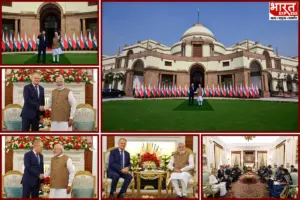




President Vladimir Putin’s visit to India marked far more than a routine bilateral summit. It emerged as a calculated geopolitical statement, reaffirming India’s strategic autonomy while repositioning India-Russia relations for a world defined by energy insecurity, economic fragmentation, and great-power rivalry.
Putin’s first India visit since the Ukraine conflict began underlined continuity, confidence, and convergence at a moment when global fault lines are sharply drawn.
The summit decisively shifted focus from the traditionally dominant defence narrative to a broader economic and commercial partnership. Both sides signalled that trade, energy security, technology, and mobility will drive the next phase of engagement.
Prime Minister Narendra Modi’s assertion that elevating economic cooperation with Russia remains a shared priority carried unmistakable diplomatic weight, particularly amid renewed pressure from Western capitals urging India to scale back Russian oil imports.
Strategic Autonomy Takes Centre Stage
New Delhi used the summit to assert policy independence without confrontation. PM Modi described the India-Russia relationship as a ‘guiding star’ that has remained steady for over eight decades, anchored in mutual respect and strategic trust. The message was clear: India will not recalibrate long-standing partnerships under external pressure.
Economic diplomacy dominated the agenda. Putin highlighted a series of agreements aimed at deepening cooperation in trade, investment, and technology.
Both leaders launched an ambitious Economic Cooperation Programme to expand bilateral trade from the current $68 billion to $100 billion by 2030, with India expressing confidence in achieving the target ahead of schedule.
The emphasis on correcting trade imbalances and removing regulatory bottlenecks signalled a pragmatic shift toward sustainable commercial growth.
Energy security emerged as a central pillar. Despite Western sanctions on Russian energy firms, Putin reaffirmed Russia’s commitment as a reliable supplier of oil, gas, and coal to India’s fast-growing economy.
PM Modi reciprocated by underlining the importance of energy cooperation while announcing continued collaboration in civil nuclear energy to advance clean energy goals.
The message reinforced India’s balanced approach: diversifying energy sources while securing affordability and stability.
The Ukraine conflict surfaced cautiously but meaningfully. PM Modi reiterated India’s support for all efforts toward a negotiated settlement, stressing that India stands firmly on the side of peace rather than neutrality.
Putin acknowledged these efforts and noted ongoing engagements with partners, including the United States, in exploring pathways to resolution.
Notably, the joint statement avoided direct references to Ukraine, instead calling for humanitarian relief and sustainable peace in Gaza, reflecting calibrated diplomatic positioning.
Economics, Energy & Security Converge
Security cooperation and counter-terrorism formed another area of convergence. Both leaders reaffirmed zero tolerance for terrorism and pledged coordinated action against UN-designated terror groups.
Prime Minister Modi drew parallels between attacks in Jammu and Kashmir and Moscow, highlighting shared vulnerabilities.
The joint statement underscored a unified stance against terror financing, safe havens, and ideological justifications for violence, reinforcing counter-terrorism as a shared global concern.
The summit also delivered tangible outcomes in mobility and labour cooperation. India and Russia agreed on frameworks to facilitate skilled Indian workers in Russia, addressing Moscow’s rising labour demand in sectors such as IT, construction, and engineering.
India announced reciprocal 30-day employment-tourist visas for Russian nationals, signalling people-centric diplomacy alongside strategic engagement.
External Affairs Minister S Jaishankar framed the visit as a reaffirmation of India’s sovereign decision-making. He described the outcomes as a reimagining of the partnership, noting that economic ties had lagged behind defence cooperation for decades.
Jaishankar firmly rejected the notion that any country could claim a veto over India’s foreign relationships, underscoring New Delhi’s freedom to engage simultaneously with Russia, the United States, and other major powers.
Putin’s visit ultimately strengthened both sides. India secured energy stability, expanded trade pathways, and reinforced its strategic autonomy.
Russia consolidated a key partnership in Asia amid Western isolation. Together, they demonstrated that multipolar diplomacy thrives on balance, not binaries.
In a rapidly polarising world, the India-Russia summit sent a clear signal: pragmatic partnerships, mutual respect, and national interest remain the defining currencies of global diplomacy.
Also Read: PM Modi-Trump Reset Signals High-Voltage Push To India-US Strategic Power Play
To read more such news, download Bharat Express news apps