



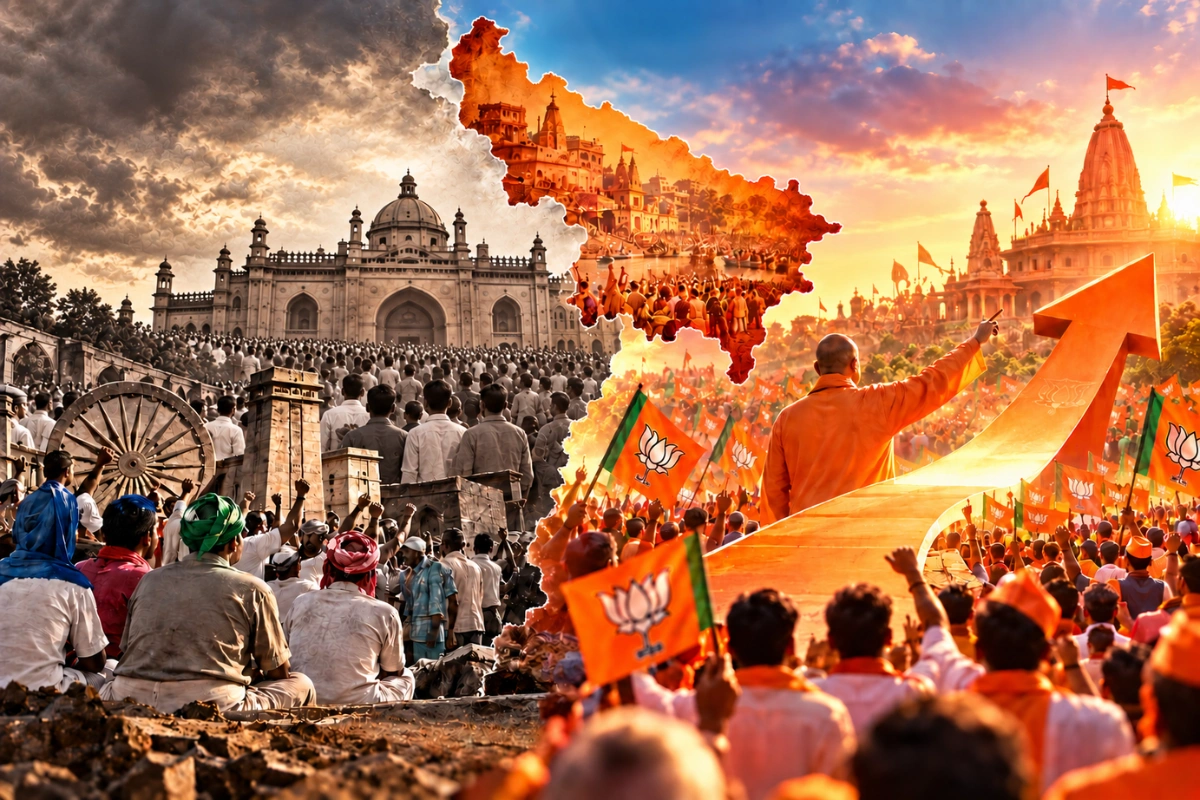
AI Generated Image
Uttar Pradesh’s political transformation is one of the most important stories in modern Indian democracy. The state moved from a Mandal-era landscape shaped by caste justice, OBC assertion, and Dalit mobilisation to a Kamandal-era order where Hindu identity, welfare delivery, leadership projection, and booth-level organisation helped the saffron party build a wider coalition. This shift did not erase caste; it reorganised caste within a larger Hindutva frame.
What Changed in Uttar Pradesh Politics?
UP changed when caste-based mobilisation stopped being the only grammar of power and became one layer inside a broader Hindu political imagination. The BJP’s rise was not simply a sudden saffron revolution; it was a long political project that connected Ram Mandir symbolism, non-Yadav OBC outreach, non-Jatav Dalit engagement, welfare messaging, and a disciplined organisation. In 2017, the BJP won a large Assembly majority in Uttar Pradesh, and in 2022 it again emerged as the party with the highest number of seats, according to Election Commission data.
For anyone searching ‘saffron politics UP’, the key lesson is this: Hindutva did not replace Mandal politics in a clean break. It absorbed parts of it, challenged parts of it, and built a new vocabulary around dignity, security, nationalism, religion, welfare, and representation.
The Mandal Moment Made Caste the Centre of Power
The Mandal era gave political language to communities that had long been socially and electorally marginalised. Parties such as the Samajwadi Party and Bahujan Samaj Party rose by converting social identity into political negotiation. Yadavs, other OBCs, Jatavs, and other Dalit groups were no longer passive vote banks; they became assertive political actors.
This period weakened the old Congress-style umbrella coalition in UP. It also made government formation dependent on caste alliances, symbolic representation, and the promise of social justice. But over time, Mandal politics developed its own limits. Some communities felt that dominant groups within OBC and Dalit politics had captured most benefits, while smaller caste groups looked for alternative political homes.
That opening became central to the saffron movement. The BJP recognised that a purely upper-caste image could not dominate UP. It had to speak to communities that Mandal had empowered but not always satisfied.
The Kamandal Strategy Expanded the Hindu Umbrella
Kamandal politics used religious identity as a unifying frame, but its success in UP came from combining symbolism with social engineering. The Ram Mandir movement gave saffron politics emotional depth, yet the later electoral rise depended on far more than temple politics alone. It required candidate selection, local alliances, caste arithmetic, welfare narratives, and an energetic party machine.
The BJP’s strategy worked because it did not ask voters to forget caste. Instead, it asked many caste groups to see themselves as part of a larger Hindu bloc. Academic discussions of Dalit and OBC mobilisation in UP note the BJP’s effort to reach communities that lacked strong political representation, including sections among non-Yadav OBCs and non-Jatav Dalits.
This is where the phrase ‘fascinating Hindutva saffron politics and Dalit mobilisation’ becomes more than a keyword. It describes a real contradiction: a politics rooted in Hindu consolidation also seeking support from communities historically oppressed within Hindu society.
How Did the Saffron Party Turn Social Gaps into Electoral Strength?
The saffron party turned social gaps into strength by identifying voters who felt underrepresented in older caste coalitions. It offered them visibility, local leadership positions, welfare access, and a larger ideological identity. This did not end caste inequality, but it gave many communities a reason to reconsider old loyalties.
Several factors mattered:
- Non-Yadav OBC outreach: The BJP focused on groups that did not always identify with SP-led Yadav dominance.
- Non-Jatav Dalit mobilisation: It reached Dalit communities that felt outside the BSP’s core Jatav base.
- Welfare as political communication: Benefits were framed not just as schemes, but as evidence of state presence.
- Law-and-order messaging: The party used security and governance narratives to appeal across caste lines.
- Religious symbolism: Temples, festivals, and Hindu identity helped create a shared emotional register.
- Booth-level organisation: Local workers converted broad ideology into voter contact.
This combination made saffron politics up close look different from saffron politics in theory. On the ground, it was not only about ideology; it was about who got heard, who got tickets, who received benefits, and who felt protected.
The Saffron Revolution Was Also a Communication Revolution
The BJP’s growth in UP was helped by its ability to simplify complex politics into memorable messages. Mandal parties often spoke in the language of social justice, reservation, and caste dignity. The BJP added another language: Hindu pride, nationalism, welfare delivery, and decisive leadership.
This mattered because voters rarely choose only on one identity. A voter may be OBC, Hindu, poor, young, aspirational, local, and nationalistic at the same time. The BJP’s communication strategy tried to speak to all those identities together. That is why the rise of saffron power reflections on Indian politics often begins in UP: the state became the testing ground for combining caste arithmetic with civilisational messaging.
Still, this ‘saffron revolution’ should not be understood as total or permanent. UP remains politically competitive, and caste grievances continue to shape voting behaviour. The very communities brought into the saffron fold can also demand greater representation, material benefits, and respect.
Why Mandal Has Not Disappeared
Mandal politics survives because caste remains a lived reality in Uttar Pradesh. Marriage, land, local power, education, policing, and employment are still deeply shaped by caste location. No ideological wave can simply dissolve those structures.
What has changed is the way caste is expressed electorally. Earlier, caste assertion often meant voting for a party explicitly built around caste justice. Today, caste interests may be negotiated inside a Hindutva-led coalition, through candidate selection, welfare access, or local leadership.
This creates an unstable balance. The BJP must keep its Hindu umbrella broad while satisfying many caste groups with different expectations. Opposition parties, meanwhile, try to revive Mandal energy through caste census demands, social justice language, and alliances among OBC, Dalit, Muslim, and other voters.
Saffron Is a Symbol, Not a Single Meaning
Saffron carries different meanings in Indian politics: sacrifice, spirituality, Hindu identity, nationalism, and party power. Critics see it as majoritarian consolidation; supporters see it as cultural resurgence. That is why phrases such as ‘colour of my politics is not saffron Kamal Haasan’ became politically memorable. Kamal Haasan’s statement that his politics was not saffron showed how the colour itself had become shorthand for a larger ideological position.
In UP, however, saffron is not merely symbolic. It marks a restructuring of political imagination. A colour became a campaign identity, then a governance narrative, then a social coalition.
The Lasting Lesson from UP
Uttar Pradesh shows that Indian politics is rarely a simple battle between caste and religion. Mandal and Kamandal compete, overlap, and borrow from each other. The BJP’s dominance came from understanding this overlap better than its rivals for a crucial period.
The future will depend on whether saffron politics can continue to manage caste aspirations, economic pressures, youth expectations, and demands for dignity. UP’s saffron awakening is therefore not just a story of one party’s rise. It is a reminder that political power in India belongs to those who can translate identity into organisation, emotion into votes, and social fragmentation into a believable coalition.
Also Read: The New BJP Team’s Piecemeal Reset
To read more such news, download Bharat Express news apps