



AI Generated Image
India used the 18th BRICS Summit in New Delhi to place Prime Minister Narendra Modi, Russian President Vladimir Putin and Chinese President Xi Jinping inside the same diplomatic frame while avoiding the appearance of a hard anti-Western bloc. The Sept. 12–13 meeting highlighted New Delhi’s central challenge: balancing rivals, preserving old partnerships and keeping room for manoeuvre in a shifting balance of power.
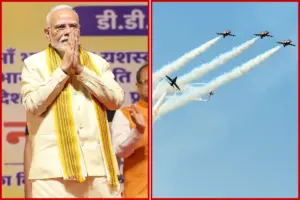
The summit delivered a carefully managed display of engagement among leaders whose interests overlap in some areas and collide in others. PM Modi met Xi on the sidelines as India and China continued a cautious thaw, and he also held talks with Putin focused on political, economic, defence, energy, space and people-to-people cooperation.
New Delhi Puts Strategic Autonomy on Display
India’s hosting role gave PM Modi a visible platform to practise strategic autonomy rather than simply describe it. BRICS now brings together an expanded set of emerging and developing economies, but its internal competitive rivalry is impossible to miss: India and China remain strategic competitors, Russia is increasingly dependent on non-Western partners, and several members have sharply different relationships with Washington.
The India-China track was the most delicate part of the choreography. According to the Indian Prime Minister’s office, PM Modi and Xi welcomed progress since their previous meeting in Tianjin in August 2025, agreed that differences should not become disputes, and stressed a long-term view of ties. PM Modi also underlined that peace along the border remains essential for broader relations, a reminder that summit optics have not erased the boundary problem.
The Russia track carried a different message. PM Modi’s meeting with Putin was their second this year, following talks in Bishkek on Aug. 31, 2026, and covered cooperation across trade, defence, energy and other sectors. India also repeated its preference for dialogue and diplomacy in conflicts, a formulation that lets New Delhi keep channels open with Moscow without formally endorsing Russia’s war aims.
Why Does This Balancing Act Matter Now?
It matters because the New Delhi summit exposed how the global balance of power is becoming more fluid, not more orderly. India wants influence in forums such as BRICS while also maintaining strong links with the United States, Europe, Japan, Australia and other partners. That requires a diplomatic style built less on permanent alignment and more on issue-by-issue positioning.
BRICS itself is useful to India precisely because it is not simple. The bloc gives New Delhi room where it can talk directly with China, Russia, Iran, Gulf states and other Global South actors, even when their agendas diverge. At the same time, India has an interest in preventing BRICS from becoming a rigid counterweight to the West, because that would narrow rather than expand New Delhi’s options.
That tension shaped PM Modi’s public message. He warned that geopolitical tensions, supply-chain disruption, climate crises and the weaponisation of technology and critical minerals are affecting ordinary people, then urged BRICS to move agreements towards practical impact. The statement framed India’s role as that of a convener: not choosing one camp, but pressing for institutional reform and crisis management.
What India Gained From Keeping Rivals Talking
The summit’s immediate value for India was not a dramatic breakthrough. It was the quieter gain of keeping multiple doors open at the same time. In a year marked by conflicts in the Middle East, continued strain over Ukraine and persistent US-China tension, convening Putin and Xi in New Delhi allowed India to demonstrate relevance without signing up to every priority of either leader.
Key takeaways from the summit include:
- A Managed Reset With China: PM Modi and Xi agreed to keep a strategic and long-term perspective, while India again linked normalisation to peace and stability along the disputed border.
- Continuity With Russia: PM Modi and Putin reviewed cooperation in defence, energy, space, economic ties and mobility, reinforcing a relationship India still treats as strategically valuable.
- A Global South Governance Pitch: PM Modi argued that global governance should reflect current realities and give greater representation to developing countries, including in institutions such as the U.N. Security Council.
- A Practical BRICS Agenda: The New Delhi Declaration emphasised cooperation under political-security, economic-financial and cultural people-to-people pillars, while also supporting a more representative and reformed multilateral system.
- A Careful Signal to the West: India hosted a non-Western forum while avoiding language that would lock it into an explicitly anti-West posture.
Fragile Consensus, Hard Limits
The summit also showed the limits of diplomatic staging. BRICS leaders voiced concern over Middle East tensions and criticised sanctions not authorised by the U.N., but the bloc’s members do not share the same threat perceptions or regional priorities. AP reported that wars in Ukraine and the Middle East, along with US-China tensions, continue to test whether the group can act together.
For India, that fragility is not necessarily a failure. A loose grouping can be frustrating, but it also gives New Delhi space to manoeuvre. The art of balancing rivals depends on ambiguity: enough cooperation to keep conversations alive, enough distance to avoid being absorbed into another power’s strategy.
Still, the risks are real. India’s competitive rivalry with China remains grounded in border security, trade concerns and regional influence. Its relationship with Russia remains important but complicated by Moscow’s confrontation with the West. Its deeper partnerships with Western powers create opportunities in technology, defence and investment, but also pressure when BRICS positions clash with Western policy.
The Next Phase of the Balance of Power
The next test is whether summit language becomes measurable follow-through. PM Modi urged BRICS members to turn agreements into concrete action, while the New Delhi Declaration recorded support for continued cooperation and noted China’s full support as host of the 2027 summit.
For now, India’s achievement lies in managing the room. PM Modi did not resolve the India-China rivalry, redefine the Russia relationship or settle BRICS’ internal contradictions. But by keeping Putin and Xi engaged on Indian soil while maintaining India’s wider partnerships, New Delhi showed how a middle power with major-power ambitions can use diplomatic balance as leverage.
Also Read: From The Courtyards Of Benaras To Bharat Mandapam: How PM Modi Grounded BRICS In Humanity First
To read more such news, download Bharat Express news apps