



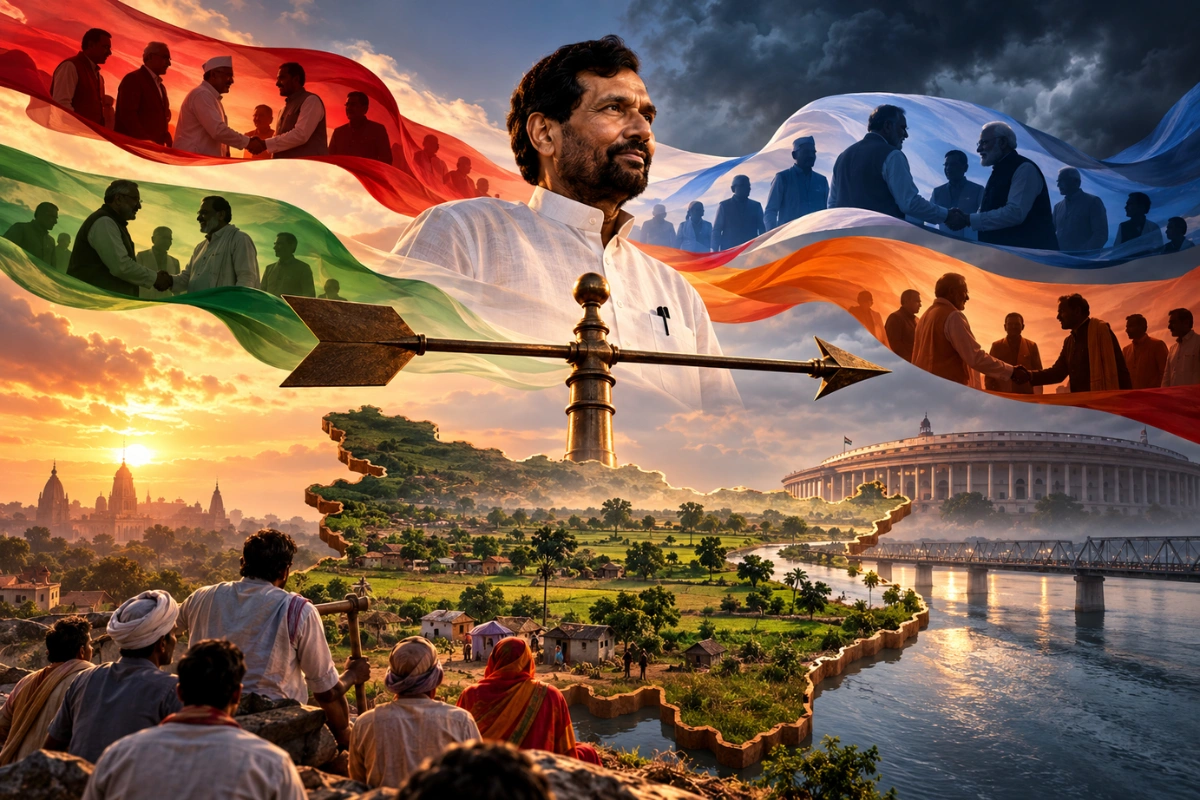
AI Generated Image
A political weathervane is a leader who reads changing power currents early and adjusts alliances before the wider political class accepts that the wind has shifted. In the case of Ram Vilas Paswan, the phrase describes a long career built on a social base, coalition timing, and tactical flexibility in Bihar politics and national government. The label is not the same as saying he never lost an election; rather, it explains how he repeatedly protected relevance, bargaining power, and Ministerial access across very different political eras.
What Does ‘Political Weathervane’ Mean in Ram Vilas Paswan’s Case?
In Ram Vilas Paswan’s case, ‘political weathervane’ means a politician who could sense which coalition was likely to gain power and position himself close to it without fully losing his own identity. Bihar leader Lalu Prasad Yadav famously used the Hindi phrase ‘Mausam Vaigyanik’ for him, a pointed way of saying Paswan could forecast the political weather. The description stuck because Paswan served in governments led by ideologically different Prime Ministers and remained useful to alliances that needed a Dalit face, a Bihar presence, and a negotiator comfortable across party lines.
The phrase can sound dismissive, as if his politics were only opportunism. That is too simple. Paswan’s durability came from a mix of electoral strategies: retaining a recognisable support base, avoiding permanent isolation, building cross-party personal equations, and understanding when a small party could become decisive in a coalition system. His political manoeuvring mattered because Indian politics from the late 1980s onward rewarded leaders who could convert limited seats into national leverage.
The Core Definition: Power Without Permanent Camps
The Paswan model of political strategy can be defined as flexible coalition politics anchored in a stable social constituency. He did not command Bihar the way a Chief Ministerial mass leader might, but he often commanded enough attention to become valuable to larger formations. That distinction is central to any strategy analysis of his career: Paswan’s strength was not always in being the biggest player, but in being the player others could not ignore.
His public career began well before the age of fragmented coalitions. Official biographical records note that he was elected to the Bihar Legislative Assembly in 1969, later entered the Lok Sabha from Hajipur in 1977, and went on to serve multiple terms in Parliament. The Union Cabinet’s condolence resolution after his death also recorded his education, Bihar roots, parliamentary career, Ministerial portfolios, and his final role as Minister of Consumer Affairs, Food and Public Distribution.
The ‘weathervane’ label became powerful because his career coincided with the rise of coalition governments, Mandal politics, regional parties, and caste-based representation. In that environment, political alliances were not just ideological statements; they were instruments for survival, representation, and bargaining. Paswan understood that a party with a concentrated social base could often negotiate beyond its numerical size if it chose its timing carefully.
Defining Characteristics of the Paswan Strategy
Ram Vilas Paswan’s political strategy had several defining features. These traits explain why he remained central to discussions of bihar politics long after many contemporaries faded from national visibility.
- A Durable Identity Base: Paswan emerged as one of Bihar’s most visible Dalit leaders, especially among Paswans/Dusadhs, giving larger alliances a reason to court him.
- Coalition Flexibility: He worked with socialist, anti-Congress, NDA, and UPA formations at different moments, adjusting to national arithmetic rather than remaining frozen in one camp.
- Timing Over Volume: His party did not need to dominate Bihar to matter; it needed enough seats, votes, or symbolic reach to become useful in a close contest.
- National-Office Orientation: Paswan often translated Bihar relevance into Union Cabinet roles, showing that power could be accumulated through Delhi as much as Patna.
- Cross-Party Relationships: Reports and parliamentary tributes repeatedly describe him as a leader with affable ties across party lines, a practical advantage in coalition politics.
These features made his approach different from a purely ideological project or a purely caste-limited mobilisation. He could speak as a representative of marginalised communities, yet he also operated as a coalition tactician. The tension between those two roles is what made his career both influential and controversial.
How Did Ram Vilas Paswan’s Political Strategy Work?
Paswan’s strategy worked by combining a loyal electoral base with high-value alliance positioning. He built enough independent identity through the Lok Janshakti Party, formed in 2000 after leaving the Janata Dal space, to negotiate with larger coalitions rather than simply dissolve into them. The party did not become a sweeping statewide force, but it gave Paswan a platform from which to bargain, switch, or support depending on the political weather.
The logic was straightforward: if politics is fragmented, the decisive actor is not always the largest party. Sometimes it is the party that can add a missing social bloc, soften an alliance’s image, or swing a handful of seats. Paswan’s appeal helped alliances signal outreach to Dalits and marginalised voters, while his parliamentary experience made him credible in central government. This is why his electoral strategies often focused as much on alliance architecture as on seat-by-seat campaigning.
His career also showed a keen sense of exit. In 2002, he left the Vajpayee government and the NDA over the Gujarat violence issue, a move reported at the time as both a moral and political break. By 2004, he was part of the UPA government, holding major portfolios including Chemicals and Fertilisers and Steel. Later, he returned to the NDA before the 2014 election, after which he again entered the Union Cabinet.
For supporters, this was evidence of instinct and adaptability. For critics, it looked like opportunism. Similarly, for political analysis, the important point is that Paswan treated alliances as movable structures, not lifelong homes. That made him unusually effective in an era when national governments depended on coalition management.
Bihar Politics Gave the Strategy Its Foundation
No analysis of Ram Vilas Paswan’s political strategy makes sense without Bihar. The state’s politics has long been shaped by caste coalitions, social justice movements, backward-caste assertion, Dalit mobilisation, and rivalries among leaders who emerged from socialist and JP-movement backgrounds. Paswan belonged to that world but did not follow the same path as Lalu Prasad Yadav or Nitish Kumar. He built a career that was often more national than state-executive in character.
Hajipur became central to his political image. He won from the constituency in the 1977 Lok Sabha election by a record margin, a victory that helped establish him as a national figure after the Emergency period. Later records show that he represented the Lok Sabha repeatedly, though he also faced defeats, including in 1984 and 2009. That nuance matters: he was not literally unbeatable at the ballot box, but he repeatedly recovered from setbacks and returned to relevance.
Bihar’s fragmented social map made Paswan’s concentrated support valuable. A party with a modest vote share can still influence outcomes if its voters are socially identifiable, geographically meaningful, and transferable through alliances. That was the terrain on which Paswan excelled. He understood that in Bihar politics, symbolic representation and coalition arithmetic often work together.
The Alliance Timeline as a Strategy Map
Paswan’s career is best read as a sequence of calibrated moves rather than a straight ideological line. The pattern below shows how his political alliances supported his long-term relevance.
| Phase | Strategic Meaning | Practical Effect |
|---|---|---|
| 1969–1977: Socialist Beginnings and Anti-Emergency Rise | Built credibility in social justice and anti-Congress politics | Entered the Bihar Assembly, then won Hajipur in 1977 with national visibility. |
| 1989–1990s: Coalition-Era Expansion | Converted parliamentary strength into Ministerial office | Served as Union Minister for Labour and Welfare under VP Singh and later held major portfolios in coalition governments. |
| 2000: Formation of LJP | Created an independent bargaining vehicle | Gained flexibility to negotiate with larger alliances instead of remaining inside Janata-family politics. |
| 2002–2004: Exit From NDA and Move Towards UPA | Used moral-political positioning to reset alliances | Left the NDA over Gujarat, then joined the UPA government after the 2004 election. |
| 2014–2020: Return to NDA and Final National Role | Read the national shift towards the BJP-led coalition | Served as Minister of Consumer Affairs, Food and Public Distribution from 2014 until his death in 2020. |
This timeline shows why ‘political weathervane’ is a useful definition rather than just a nickname. Paswan did not merely react after power changed hands; he often moved when the direction of power was still being contested. That ability turned political alliances into a long-term survival mechanism.
When Did the Weathervane Approach Show Its Limits?
The approach showed its limits when alliance manoeuvring could not compensate for electoral fragmentation, organisational weakness, or post-poll deadlock. The clearest example was Bihar in 2005, when the LJP won 29 seats in the February Assembly election but no stable government emerged. Paswan’s insistence on a Muslim Chief Minister became a high-stakes bargaining position, but it did not translate into control of the state government.
That episode is important because it complicates the ‘never lost’ idea. Paswan could win leverage and still fail to convert it into the exact outcome he wanted. A kingmaker position is powerful only if other players accept the terms. If they refuse, the same leverage can become a stalemate.
There were also electoral limits. In 2009, Paswan lost from Hajipur, and his party failed to win Lok Sabha seats in that election cycle. Yet even that did not end his relevance. He later entered the Rajya Sabha and returned to central power through renewed alliance-making, which reinforces the central lesson: his battle was not only for seats, but for continuing access to the field where power was negotiated.
The Difference Between Adaptability and Opportunism
Any serious strategy analysis has to separate adaptability from opportunism, even though the same act can look like either depending on the observer. Adaptability means responding to changed public mandates, coalition arithmetic, and social realities. Opportunism means shifting sides without a consistent public purpose. Paswan’s career contained enough evidence for both interpretations, which is why the debate around him remains interesting.
His supporters would argue that he kept Dalit representation visible across governments and used proximity to power to secure influence. Parliamentary tributes after his death emphasised his work for marginalised sections and his accessibility across affiliations. His critics would counter that frequent alliance changes blurred ideological boundaries and made power retention appear more important than programmatic consistency.
The most balanced reading is that Paswan practised representational pragmatism. He did not build a mass ideological party comparable to the largest regional formations, but he built a portable political asset: himself, his community connect, his party label, and his coalition credibility. That asset could be carried from one alliance table to another.
Practical Examples and Common Misconceptions
The Paswan example is often invoked in discussions of political manoeuvring, but it is easy to flatten the lesson. The following points keep the definition precise.
- Example: Small-Party Leverage. The LJP’s value often came from being a potential add-on to larger coalitions, not from independently ruling Bihar.
- Example: Symbolic Expansion. Larger alliances could use Paswan’s presence to broaden their social message, especially towards Dalit voters.
- Example: Strategic Exit. Leaving an alliance could preserve credibility with one audience while opening space with another.
- Misconception: He Never Lost Elections. He did lose important contests, including the 2009 Hajipur race; the stronger claim is that he repeatedly recovered political relevance.
- Misconception: His Strategy Was Only Personal Ambition. Personal ambition was certainly part of competitive politics, but his leverage also rested on social representation and coalition arithmetic.
- Misconception: Alliance Shifts Are Always Weakness. In coalition politics, shifting can be a sign of weakness, but it can also be a rational response to changing electoral mandates.
For students of electoral strategies, Paswan’s career is useful because it shows how power can be pursued without always seeking the Chief Minister’s chair or leading the largest party. His battlefield was often the negotiation room after voters had produced a fragmented verdict.
Why Paswan’s Model Still Matters for Political Strategy
Ram Vilas Paswan’s model matters because Indian politics continues to reward leaders who can connect identity, arithmetic, and timing. Even when national parties are strong, state-level allies can help shape candidate selection, social messaging, and post-election legitimacy. Paswan demonstrated that a regional leader with a defined support base could become nationally relevant by making himself useful at precisely the right moments.
His career also explains why Bihar politics has such an outsized role in national strategy discussions. Bihar sends a large contingent to Parliament, has a deeply layered social structure, and has produced leaders skilled in coalition bargaining. Paswan’s rise from a Bihar socialist background to repeated Union Cabinet roles shows how state-based social capital can become national political currency.
The lesson is not that every politician should change sides often. The lesson is that alliances work when they connect to a credible base, a clear bargaining purpose, and a realistic reading of power. Without those, political manoeuvring becomes drift. With them, it can become survival.
Key Takeaways
Ram Vilas Paswan was called a political weathervane because he repeatedly anticipated shifts in political power and aligned himself where his influence could remain relevant. His strategy combined Dalit representation, Bihar-based social capital, cross-party relationships, and an unusually sharp reading of coalition politics. He did not literally win every electoral contest, but he rarely disappeared from the power map for long.
That is why the phrase ‘never lost a battle for power’ should be read as a strategic metaphor. Paswan’s true achievement was not permanent victory at the ballot box; it was the ability to turn changing political weather into renewed bargaining space. In the study of political alliances and electoral strategies, few Indian careers illustrate that art as clearly as his.
Also Read: The Landless And The Loud: Why The Left Still Holds The Pulse Of Rural Bihar
To read more such news, download Bharat Express news apps