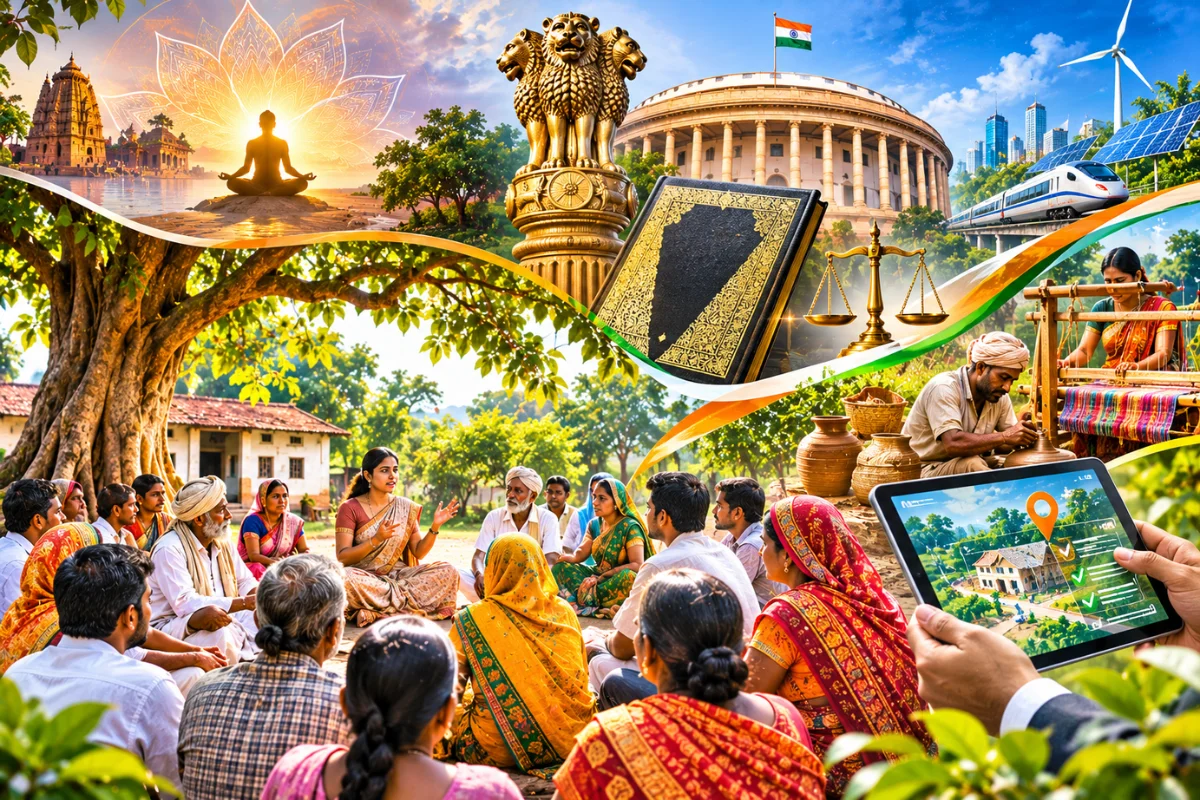
AI Generated Image
The Soul of Indianness and Modern Democracy: A Swadeshi Governance Model Beyond the Western Lens
A swadeshi governance model can be understood as an approach to democracy that places local responsibility, community knowledge, and public accountability at the centre of decision-making. This article proposes a framework rather than describing a single official system: one that connects Indian ethical traditions with constitutional rights, participatory governance, and ecological responsibility. Its purpose is not to reject ideas from elsewhere, but to ask how democratic institutions can become more responsive to the people they serve.
What Is a Swadeshi Governance Model?
A swadeshi governance model, as proposed here, is a locally grounded approach to public administration in which communities help shape priorities, institutions strengthen local capabilities, and every decision remains subject to equal rights and democratic scrutiny. It treats self-reliance as the ability to make informed choices and solve problems, not as withdrawal from wider cooperation.
Gandhi’s explanation of swadeshi offers an ethical starting point. He connected it with service to immediate neighbours, improvement of indigenous institutions, and support for nearby producers. He also argued that service to neighbours should not involve exploiting others. That combination supports a reading of swadeshi as responsibility rooted in place rather than hostility towards outsiders.
Translated into governance, this suggests three commitments:
- Begin With Lived Needs: Ask residents which services fail them before deciding what to build.
- Develop Local Capability: Equip institutions and workers to maintain services rather than creating permanent dependence on outside intervention.
- Keep Power Answerable: Make decisions, spending, and complaint procedures understandable to the people affected.
These are proposed design principles, not evidence that every local institution already follows them.
Beyond the Western Lens Without Rejecting Democratic Learning
Moving beyond a Western lens should mean questioning automatic imitation, not drawing a rigid boundary between Indian and foreign ideas. A useful institution should be judged by whether it protects freedom, distributes power fairly, and delivers public value. Its geographical origin should not settle the argument.
For this proposed model, the soul of Indianness is best understood as an inclusive civic commitment, not a test of religious identity, language, ancestry, or conformity. Local belonging should widen a person’s ability to participate. It should never become a reason to deny another person equal standing.
The choice, then, need not be between inherited practices and modern institutions. Communities could retain useful knowledge, challenge unjust customs, and adapt external ideas to local conditions. A village assembly and a digital budget portal, for example, could serve the same democratic purpose when both make authority easier to question.
Constitutional Democracy as the Foundation
Any swadeshi approach must work within constitutional democracy, not claim cultural permission to bypass it. The Constitution’s Preamble establishes justice, liberty, equality, and fraternity as guiding commitments. These provide a clear standard for assessing whether an appeal to community strengthens citizenship or narrows it.
India also has a constitutional foundation for rural local self-government. The Seventy-third Amendment introduced Part IX on Panchayats and the Eleventh Schedule. Article 243G allows state legislatures to endow Panchayats with powers concerning self-government, development planning, and social justice; the framework does not mean every listed responsibility is automatically or uniformly devolved.
That distinction matters for reform. Before assigning a local body responsibility for a service, policymakers should clarify its legal authority, funding, staffing, and relationship with other departments. Otherwise, decentralisation risks becoming responsibility without the practical means to act.
Local discretion should therefore sit alongside enforceable rights, transparent procedures, and access to review. Community approval alone should never be treated as sufficient justification for excluding a person from public services.
How Can Participatory Governance Become Meaningful?
Participatory governance becomes meaningful when people can influence priorities, understand the choices available, and see how their contributions affect decisions. Attendance is only a starting point. A credible process must also explain what was accepted, what was rejected, and why.
The Gram Sabha provides an institutional basis for village-level participation: its membership comprises people registered on the relevant village electoral rolls, while its powers depend on state legislation. Official Gram Panchayat Development Plan guidance also envisages a participatory planning process connecting community priorities with available resources and departmental schemes.
A stronger participation process could follow this sequence:
- Share Information Beforehand. Present the available budget, existing commitments, and service gaps in accessible language.
- Make Participation Practical. Choose accessible venues and timings, provide language support where needed, and actively invite underrepresented residents.
- Compare Realistic Options. Explain costs, maintenance needs, and who would benefit from each proposal.
- Publish the Decision. Record priorities, reasons, responsible officials, and the next review point.
- Close the Feedback Loop. Report progress publicly and provide a route for questioning delays or omissions.
For example, a discussion about drinking water should examine source reliability, distribution, repair arrangements, and unequal access, not simply approve a new installation. That would give residents a decision to shape rather than a finished proposal to endorse.
Decentralised Governance Needs Capacity and Safeguards
Decentralised governance should bring decisions closer to residents without leaving local bodies isolated. The proposed model therefore needs a division of work: local institutions would identify priorities and oversee suitable services, while higher levels would provide finance, technical support, coordination, and oversight.
Consider a proposed drainage improvement. Residents could identify recurrent flooding points, but engineering assessment and coordination beyond the neighbourhood might still be necessary. A locally informed decision should combine that experience with technical evidence rather than treating either as sufficient alone.
The same principle should guide financial design. Local bodies should know what money they can use, which conditions apply, and who approves changes. Responsibilities should be matched with trained staff, procurement support, and realistic maintenance budgets.
Safeguards should be equally concrete: accessible expenditure records, conflict-of-interest disclosures, independent checks, and complaint channels beyond the immediate decision-maker. Proximity to residents is a reason to strengthen accountability, not assume it.
Sustainable Governance Begins With Stewardship
Sustainable governance, within this framework, means meeting present needs while protecting the resources and institutional capacity required to meet future ones. It asks a different question from project delivery alone: can this service remain useful, affordable, and environmentally responsible after construction ends?
The Eleventh Schedule offers relevant areas for local planning, including water management, social forestry, drinking water, non-conventional energy, and maintenance of community assets. These subjects provide a basis for connecting local development with resource stewardship, subject to the applicable distribution of powers.
A practical sustainability checklist would ask:
- Resource Fit: Does the proposal suit local water availability, land conditions, and expected demand?
- Lifetime Responsibility: Who will operate, repair, and eventually replace the asset?
- Fair Access: Will underserved households receive a usable service, not merely nominal coverage?
- Shared Impacts: Could the decision shift pollution, flood risk, or resource pressure onto neighbouring communities?
Swadeshi procurement should face similar scrutiny. Supporting nearby enterprises could be a policy objective, but locality alone should not excuse poor quality, unfair labour practices, or opaque purchasing. Contracts should define standards and remain open to public examination.
How Can Communities Test the Model in Practice?
Communities can test this model through a bounded planning exercise focused on one shared service problem, with clear responsibilities and a public review. The aim should be to learn whether local involvement improves decisions, not to declare an entire governance philosophy successful after one meeting.
A useful pilot might focus on maintaining existing drinking-water infrastructure. Residents and officials could document failures, compare repair priorities, identify the responsible authority, and agree on how progress will be reported. Any technical or financial constraints should be disclosed before promises are made.
Evaluation should examine both delivery and democratic quality. Did the agreed repair happen? Were excluded households heard? Could residents understand the spending record and challenge an unexplained decision?
Technology could support this process through accessible records and status updates, but participation should not require smartphone ownership. Printed notices, in-person assistance, and offline complaints should remain part of the design. The measure of modernisation should be broader access to power, not simply the number of digital transactions.
A Rooted Democracy Open to the World
The strongest case for a swadeshi governance model is not that everything local is better. It is that democratic institutions should take local knowledge, shared responsibility, and human dignity seriously while remaining open to evidence and learning.
Its practical test is straightforward: can people influence decisions, obtain fair services, protect shared resources, and hold authority accountable? A model that meets those tests would connect cultural rootedness with modern democracy, without making either an excuse for exclusion or unchecked power.
Also Read: Sanatan Bharat’s Cultural Renaissance: Embracing Tradition In Modernity
To read more such news, download Bharat Express news apps