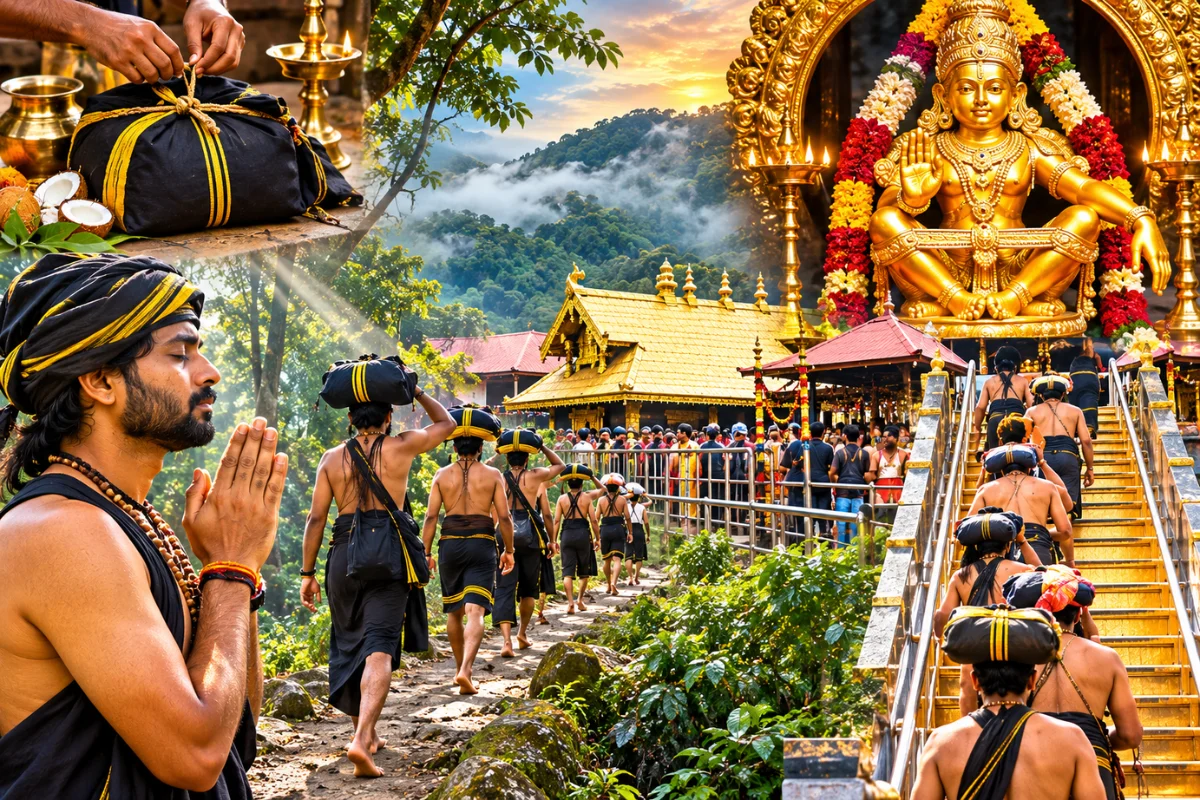
AI Generated Image
The Oath of 41 Days: Why Millions Walk Barefoot for a Glimpse of the Cosmic Brahmachari
The oath of 41 days is the spiritual preparation for the Sabarimala pilgrimage: a period of disciplined living before seeking Lord Ayyappa’s darshan, the sacred encounter with the deity. Known as Mandala Vratam, it asks devotees to simplify their food, habits, relationships and expectations before approaching the forest shrine in Kerala. Understanding this vow reveals why the pilgrimage is as much about transforming everyday conduct as it is about reaching a temple.
What Does the Oath of 41 Days Mean?
The oath of 41 days involves undertaking a sustained religious vow of restraint, prayer and simplicity before the Sabarimala pilgrimage. This commitment period is traditionally called Mandala Vratam, also spelt Mandala Vratham. Its purpose is not merely to count down to departure, but to prepare the devotee through repeated acts of self-control and worship.
For readers exploring the meaning of the oath in this context, ‘vow’ is more appropriate than ‘promise’. A promise may concern a future action; this vow reorganises daily life around a sacred intention. The temple’s official explanation emphasises discipline developed through sustained effort, self-control and prayer.
That distinction matters. Someone may plan a journey in an afternoon, but spiritual commitment asks what they will do the following morning, at the dinner table or during an argument. Viewed this way, the preparation is not separate from the pilgrimage. It is where the journey begins.
Lord Ayyappa and the Meeting of Sacred Traditions
According to Hindu sacred tradition, Lord Ayyappa represents the synthesis of Shiva and Vishnu: Hariharaputhra, the son of Hara, or Shiva, and Hari, or Vishnu. The legend describes Vishnu assuming the form of Mohini, with Ayyappa born from the union of Shiva and Mohini. His divine mission is to defeat the demoness Mahishi.
The story continues with the child being discovered and raised by the king of Pandalam as Manikandan. After fulfilling his mission, Ayyappa identifies the place where his shrine should stand. These accounts belong to the temple’s sacred mythology and should be understood as devotional traditions rather than independently established historical events.
At Sabarimala, Ayyappa is worshipped as a Naishtika Brahmachari, an eternal celibate. The expression ‘Cosmic Brahmachari’ evokes this ideal of divine self-mastery. His shrine stands within the dense forests of the Periyar Tiger Reserve, in Kerala’s Western Ghats, giving the pilgrimage its distinctive forest setting.
The legend’s civilisational significance lies partly in its bringing together Shaiva and Vaishnava traditions through one beloved deity. Sabarimala’s devotional landscape also includes Vavar, remembered as Ayyappa’s close companion. The official temple account presents Vavar’s shrine as an expression of religious harmony. Together, these traditions offer a language of devotion that extends beyond a single sectarian identity.
Mandala Vratam Brings Austerity Into Everyday Life
The observance traditionally begins with wearing a mala, a bead necklace marking the devotee’s willingness to undertake austerity. Guidance comes from a priest or Guruswami, an experienced pilgrim. The mala serves as a visible reminder that everyday decisions now fall within a religious discipline.
Practices vary between devotional communities, but traditional observance commonly includes the following disciplines:
- Eating sattvic food: Simple vegetarian meals support the vow’s emphasis on restraint. Some communities also exclude ingredients such as onion and garlic.
- Observing celibacy and avoiding intoxicants: Sexual abstinence, avoidance of alcohol and abstention from tobacco form part of the traditional discipline.
- Sleeping on the floor: A floor or simple mat replaces more comfortable bedding as an exercise in voluntary simplicity.
- Praying regularly: Daily worship, chanting and participation in devotional gatherings keep religious intention at the centre of everyday life.
- Simplifying appearance and conduct: Plain clothing and deliberate patience shift attention away from display and immediate gratification.
These practices should not be reduced to a contest in discomfort. Their devotional meaning becomes clearer when restraint is accompanied by kindness. Giving up an indulgence while becoming harsher towards others would miss the ethical opportunity the observance offers.
For a first-time pilgrim, the practical starting point is guidance rather than guesswork. Discuss the observance with a knowledgeable priest or Guruswami, clarify the practices followed by your group and understand how the preparations connect to the journey. A list of restrictions cannot provide the context that an experienced guide can offer.
Becoming Swami and Setting Social Status Aside
In the pilgrimage’s language of equality, every pilgrim, rich or poor, sets aside their personal name and is addressed simply as ‘Swami’. Dropping the name is a devotional convention, not a literal erasure of legal identity. It expresses the aspiration that social rank should not determine the respect one pilgrim receives from another.
Relinquishing worldly identity therefore means loosening the importance attached to profession, wealth, prestige and ego. The person walking beside a devotee might be a company executive or a labourer; the shared form of address asks both to interact without allowing these distinctions to take priority. This is an ideal expressed through conduct, not proof that every social inequality disappears.
Its practical challenge is simple to recognise. Can you accept help without embarrassment, offer help without condescension and make room for someone who cannot advance your interests? These questions turn an inspiring principle into a demanding personal practice.
Why Do Devotees Walk Barefoot to Sabarimala?
Devotees traditionally walk barefoot as part of the pilgrimage’s austerity and simplicity. Within the broader observance, giving up footwear forms part of the commitment to plain living and reduced dependence on comfort. Its meaning comes from the vow it expresses, rather than from discomfort alone.
The setting makes that commitment tangible. Pilgrims walk for miles along rugged forest trails towards the hill shrine, although routes differ in length and difficulty. The approach from Pamba is shorter than the traditional forest routes, so there is no single walking experience shared identically by everyone.
It is important not to romanticise hardship as a measure of spiritual worth. A meaningful interpretation of barefoot walking emphasises humility and attentiveness, not competition over endurance. The question is less ‘How much can I suffer?’ and more ‘How do I behave when comfort is no longer assured?’
The Irumudi Kettu and the 18 Sacred Steps
Millions of devotees are drawn to Sabarimala, where the traditional pilgrimage combines physical effort with carefully prepared offerings. A central feature is the Irumudi Kettu, a two-compartment bundle carried on the pilgrim’s head. One compartment contains offerings for the deity, while the other holds items for the pilgrim’s use.
Prepared during the Kettunira ritual, the bundle accompanies the devotee towards the 18 Sacred Steps, known as the Pathinettam Padi. Carrying the Irumudi Kettu is the traditional requirement for ascending these steps. The bundle is therefore not merely luggage; its preparation and carrying form part of the ritual approach to Ayyappa.
The sequence of the journey helps explain its coherence:
- Undertake the vow: Establish the discipline before setting out.
- Prepare the offerings: Pack the Irumudi Kettu through the prescribed ritual.
- Make the approach: Carry the bundle along the pilgrimage route.
- Ascend the sacred steps: Approach the shrine through the traditional ritual entrance.
Seen together, these actions give the pilgrimage a structure: intention, preparation, effort and encounter. The glimpse of the deity is not an isolated moment, but the destination towards which the preceding discipline has been directed.
What Can the Pilgrimage Teach About Personal Transformation?
The pilgrimage offers a model of personal transformation through repeated choices: simplifying consumption, restraining impulses, practising devotion and treating fellow travellers with respect. These are the stated disciplines and aspirations of the observance, not a guarantee that every participant will experience the same spiritual growth.
Its lessons need not end when the journey does. A pilgrim might ask which practices deserve to continue: more patient speech, less attachment to social status or a regular place for prayer. Maintaining one meaningful discipline can be a more honest response than claiming complete transformation.
The oath of 41 days ultimately directs attention beyond the destination. Its challenge is to approach Ayyappa with devotion—and return to everyday life with something worth preserving.
Also Read: Conquering The High Himalayas: Endurance & Devotion
To read more such news, download Bharat Express news apps