



AI Generated Image
The Seat of Shakti: Celebrating the Sacred Cycle of Creation
Kamakhya Temple in Guwahati, Assam, is a sacred seat of Shakti where worship honours the Goddess’s creative power, female fertility, and the renewal of life. Its significance comes into focus during Ambubachi Mela, the annual observance of the Goddess’s menstrual cycle. Understanding its mythology and rituals offers a thoughtful introduction to the divine feminine in a living Hindu tradition.
The Golden Temple of Kamakhya (Guwahati, Assam)
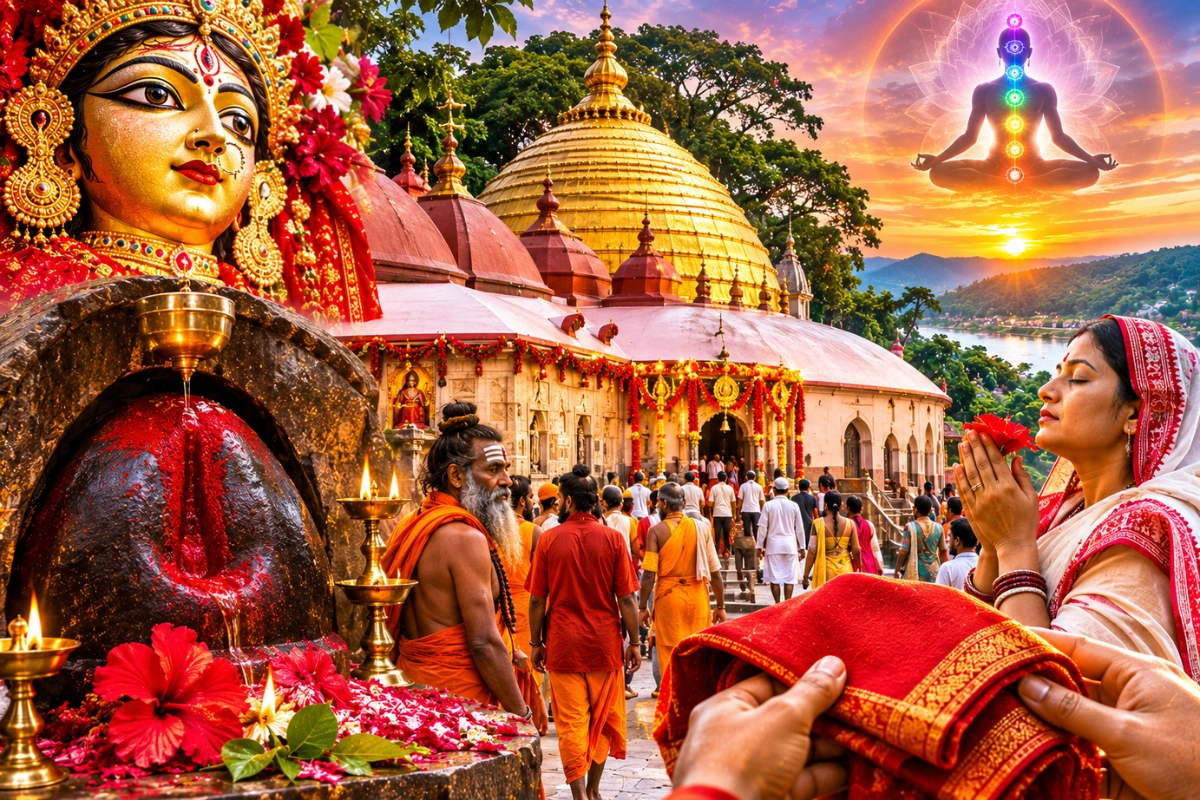
Located atop Nilachal Hill, Kamakhya Temple is among India’s most important centres of Goddess worship. Its gold-adorned dome provides a striking landmark, but the temple’s deeper significance lies in the sacred presence devotees encounter within. The golden embellishment belongs to its visible architecture; the focus of worship remains Goddess Kamakhya.
The temple’s own account regards it as the oldest and most sacred of the 51 Shakti Peethas. Describing it as the oldest and most revered expresses its standing in devotional tradition rather than establishing a universally accepted archaeological ranking. For pilgrims, this distinction connects the hilltop shrine to a sacred geography extending far beyond Assam.
Why Is Kamakhya Known as a Seat of Shakti?
Kamakhya is known as a seat of Shakti because devotees identify it as the place where Goddess Sati’s yoni fell, making it a sacred dwelling of the Goddess’s generative power. Often described devotionally as the Yoni, or womb, the symbol refers more precisely to the female generative organ. Here, creation itself becomes worthy of reverence.
According to the Shakti Peetha legend, Sati died after her father, Daksha, insulted her and Shiva. Overwhelmed by grief, Shiva carried her body, and Vishnu intervened by dividing it. The places where its parts fell became sacred sites associated with different manifestations of the Goddess. This is a religious narrative through which devotees understand the landscape, not an account presented as verifiable history.
The Seat of Shakti: Celebrating the Sacred Cycle of Creation offers a thematic lens for understanding Kamakhya. Read this way, the temple invites reflection on beginnings, loss, renewal, and the power that sustains life. The emphasis is not simply on a destination, but on a relationship with creation.
Shakti Symbolism and the Sacred Source of Life
At Kamakhya, the central object of worship is not a conventional anthropomorphic idol. Assam Tourism describes a sacred stone bearing the yoni symbol, worshipped as the Goddess herself. This makes the generative symbol central to the encounter with the divine rather than a decorative feature surrounding it.
A useful way to approach this Shakti symbolism is to consider several meanings together:
- Creation: Read the yoni as a sacred sign of life’s emergence, not merely an anatomical reference.
- Embodiment: Consider what changes when a bodily process becomes part of religious reflection rather than something excluded from it.
- Renewal: Notice how the festival’s pause and reopening give a visible rhythm to ideas of regeneration.
- Reverence: Ask how honouring a divine source of life might encourage greater care towards living beings.
These are interpretive prompts, not a substitute for the explanations of temple practitioners. They also leave room for a broader understanding of feminine energy without reducing women to reproductive roles. A respectful personal interpretation can honour fertility while recognising that no individual’s worth depends on menstruation, pregnancy, or parenthood.
A Living Epicentre of Tantric Tradition
Kamakhya is an epicentre of Tantric tradition, particularly Tantric Shaktism, in which the Goddess holds a central place. India’s Ministry of Tourism describes it as an ancient seat of Tantric and Shakti worship. Its importance therefore extends beyond the festival: it remains an active pilgrimage centre with established religious practices and communities.
Visitors should resist treating ‘Tantric’ as shorthand for mystery, spectacle, or sexual symbolism alone. The wider tradition includes disciplines, sacred imagery, and understandings of the body as an instrument of spiritual practice. Kamakhya’s association with Tantra deserves this broader context rather than sensational descriptions that obscure its devotional life.
The practical implication is simple: arrive as a respectful guest. Ask before photographing people, avoid interrupting worship, and do not assume that every practitioner owes visitors an explanation. Curiosity is welcome when it leaves space for privacy, concentration, and religious boundaries.
What Happens During Ambubachi Mela?
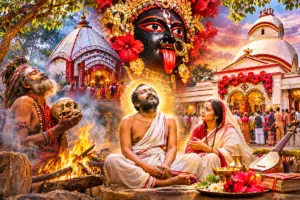
During the annual Ambubachi Mela, Kamakhya Temple remains closed to devotees for three days because the Goddess is believed to undergo her annual menstrual cycle. The closure marks a sacred interval of rest before ritual bathing, worship, and reopening. It is a religious observance of the Goddess’s cycle, not a biological claim requiring scientific confirmation.
Held during the monsoon, the festival connects the Goddess with Mother Earth and agricultural fertility. The temple’s festival account explicitly links Ambubachi to the traditional comparison between fertile earth and a fertile woman. Female fertility and creation are therefore not incidental themes; they shape the meaning of the gathering.
The festival’s progression can be understood in three stages:
- Closure: Public access pauses as the Goddess’s annual menstrual period is observed.
- Waiting: Devotees and sadhus gather, anticipating the reopening of the sanctum rather than expecting ordinary access during the closure.
- Reopening: Following the concluding rituals, pilgrims return for darshan, the devotional encounter with the deity.
For a reflective visitor, the pause offers a compelling thought: renewal need not mean uninterrupted activity. Let this be an invitation to contemplation, without assuming that every devotee interprets the observance in the same way.
The Sacred Red Cloth and the Waiting Pilgrims
Ambubachi brings together devotees and sadhus from India and abroad, many of whom wait for the temple doors to reopen. Attendance varies: an Assam government account recorded two million pilgrims and tourists in 2017, while other years have seen smaller estimates. Millions have participated in particular editions, but this should not be treated as a guaranteed annual figure.
After reopening, devotees seek the sacred red cloth commonly called Rakta Vastra, also described as Angabastra. Associated with the Goddess’s menstrual observance, pieces are received as prasad and treasured as tokens of blessing. Their significance rests in devotional belief, not in a promise of measurable protection or personal transformation.
If receiving the cloth matters to your pilgrimage, ask temple authorities about the arrangements rather than assuming it will be available. Avoid letting the desire for a sacred object overshadow the worship it represents. Patience and consideration for fellow pilgrims are as much a part of the visit as anticipation.
How Do Energy Centres and Kundalini Awakening Relate to Shakti?
In some Tantric and yogic traditions, kundalini represents Shakti within the practitioner, visualised as a coiled serpent at the base of the spine. Kundalini awakening describes its awakening and ascent through chakras, or subtle energy centres. This provides a conceptual connection with Shakti worship, but it does not mean that visiting Kamakhya automatically produces such an experience.
Keep the distinction between pilgrimage and specialised practice clear. You do not need to pursue an intense experience to engage meaningfully with the shrine. Prayer, attentive observation, and a willingness to learn are worthwhile approaches in their own right.
For personal reflection, spiritual strength can mean having the patience to listen rather than pursuing extraordinary sensations. Consider asking yourself what you hope to understand, which assumptions you bring, and how you might leave with greater humility. These questions keep the encounter grounded in learning rather than expectation.
Approaching the Pilgrimage with Care
If you plan to visit, build flexibility into your arrangements and consult the temple’s official notices. Festival access differs from ordinary worship, and reopening can bring heavy crowds. The temple also warns against unauthorised platforms claiming to conduct online pujas on its behalf.
Use this preparation checklist:
- Confirm closure and reopening information before committing to travel.
- Leave time for queues instead of scheduling a tightly timed onward journey.
- Discuss crowd tolerance and rest requirements with everyone in your group.
- Ask permission before photographing worshippers or religious activities.
- Seek ritual guidance from authorised temple representatives, not unsolicited promises.
Kamakhya invites an encounter with creation that makes room for both activity and pause. Whether you approach through devotion or cultural curiosity, carry that balance into the visit: learn carefully, respect the living tradition, and allow understanding to matter more than spectacle.
Also Read: Explore The Pool Of Nectar At Golden Temple
To read more such news, download Bharat Express news apps