



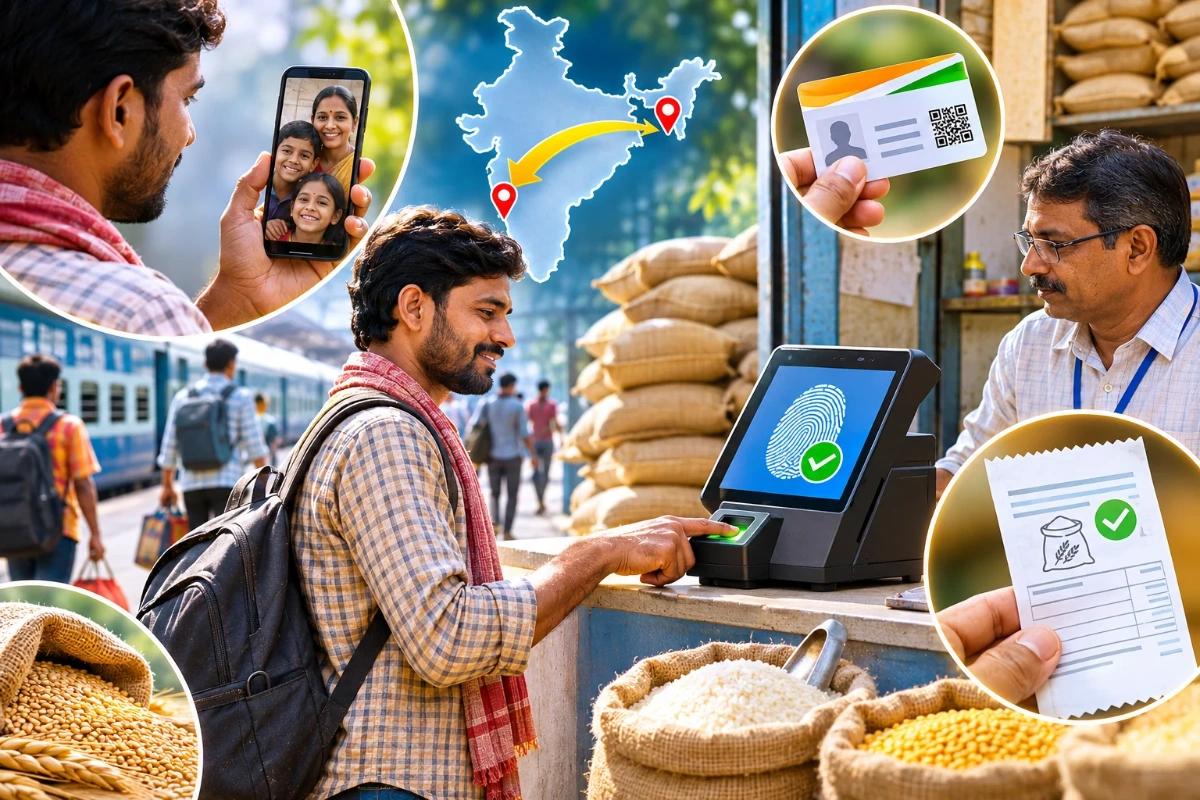
AI Generated Image
Does Your Ration Card Travel With You When You Move for Work?
Yes—if you are covered by the National Food Security Act (NFSA), your foodgrain entitlement can travel with you when you move for work. One Nation One Ration Card (ONORC) enables eligible beneficiaries to collect their entitled grain from an electronic Point of Sale (ePoS)-enabled Fair Price Shop outside their home state using their existing ration card. Understanding the process, checking your records and keeping the transaction receipt can make that first collection easier.
How Does Ration Card Mobility Work Across State Borders?
Ration card mobility allows an existing NFSA beneficiary to access foodgrain entitlements away from the shop linked to their home address. ONORC connects state ration-card systems so that a destination shop can identify the beneficiary and process the collection through Aadhaar-based biometric authentication on an ePoS device. The facility operates across all 36 states and Union Territories.
The important distinction is between portability and a new application. You are accessing an existing entitlement elsewhere, not applying for a second allocation. ONORC does not require you to surrender your home-state card, obtain a destination-state card or complete separate portability registration. The Department of Food and Public Distribution explains these points in its official FAQs.
For migrant workers in India, that distinction matters: the starting point is checking the existing card rather than assuming that a move means starting again.
A Worker’s First Ration Collection Away From Home
Consider Ravi, an illustrative fictional worker, moving from Bihar to Maharashtra for a construction job. His wife and children remain at home, along with the original ration card. Before leaving, he saves a photograph of the card and writes its number in a notebook.
During his first week, Ravi wants to collect grain near his rented room. He worries that leaving the original card behind has made collection impossible. DFPD’s FAQs clarify that a beneficiary can provide a card copy or quote the ration card or Aadhaar number, followed by the required authentication. Carrying the original ration card is not essential.
In this example, a co-worker helps Ravi identify a Fair Price Shop. Ravi tells the dealer that his card was issued in Bihar and that he wants an interstate ONORC transaction. The dealer uses the card details to retrieve his entitlement and asks him to authenticate on the ePoS device. This follows the collection mechanism described by DFPD.
Imagine that the first authentication attempt does not go through. Rather than treating this as proof that his card cannot work outside Bihar, Ravi asks what failed: identification, authentication or transaction processing. He notes the shop and time so he can explain the problem clearly if he needs assistance.
For the illustration, assume a later attempt succeeds. Before accepting the grain, Ravi asks how much is being recorded, checks the quantity handed over and requests the ePoS receipt. He then calls home to explain what he collected. Government guidance confirms that family members remaining at home can collect the available balance on the same card.
The lesson is not that every visit will follow Ravi’s imagined experience. It is that knowing the transaction steps helps a worker ask useful questions instead of abandoning the attempt.
Check These Details Before Your First Visit
A little preparation gives you a clearer starting point. Keep these checks together rather than relying on a hurried phone call from the shop:
- Confirm NFSA coverage. ONORC serves beneficiaries covered under NFSA, including Priority Household (PHH) and Antyodaya Anna Yojana (AAY) categories. Do not assume every state-issued card automatically qualifies.
- Save identifying details securely. Keep a readable card copy or the relevant number accessible, especially if the original stays with your family.
- Check Aadhaar-seeding status. The Mera Ration app provides a way to check this and review portability eligibility. Resolve unclear records with the food department rather than guessing at the counter.
- Find a nearby shop. The app can locate Fair Price Shops and help you navigate to them. Plan the visit around your shift and confirm opening arrangements locally.
- Coordinate with your household. Discuss what has already been collected and what each location needs before another withdrawal. Family members can access the remaining entitlement, not an additional duplicate quota.
For practical mobility assistance, ask a trusted person to help you understand the information or locate the shop. Keep control of your documents and avoid posting Aadhaar or ration-card details in public messages.
What Ration Card Benefits Can You Collect After Moving?
Portability gives you access to your existing eligible foodgrain entitlement; it does not increase it. PHH beneficiaries are entitled to 5 kg per person per month, while AAY households are entitled to 35 kg per household per month. Under the current PMGKAY arrangement, entitled foodgrains are free for five years beginning January 1, 2024.
For example, a PHH household with four eligible members has a total monthly entitlement of 20 kg. If part of this is collected at the work destination, only the remaining balance is available for collection elsewhere. This calculation illustrates how split collection works; it is not an additional allowance for migration.
Keep the scope clear, too. ONORC concerns NFSA foodgrain portability. Do not assume every additional state-funded ration item or separate welfare benefit travels under the same rules. Ask the relevant state food department about those benefits.
Treat the Transaction Receipt as Part of Collection
The collection process should not end when the sack is handed over. In its parliamentary answer dated August 12, 2025, DFPD stated that an ePoS-generated receipt is issued to NFSA beneficiaries. That answer distinguished this receipt from a separate digital-receipt facility, which it said had not been launched at that time.
Use the receipt as your record of the visit. Before leaving, compare the transaction details it displays with the grain actually supplied. Do not assume every state uses an identical receipt layout.
A useful receipt-checking routine is to:
- Read the collection date and shop details wherever shown.
- Compare the recorded grain types and quantities with what you received.
- Ask immediately about any entry you do not understand.
- Keep the receipt, or a readable photograph, for household coordination and any complaint.
These are practical checks, not a claim about mandatory fields on every receipt. If the receipt is unclear or unavailable, make your own dated note of the visit and what the dealer said.
What Should You Do If Ration Collection Fails?
Ask for the specific reason, record the attempt and use an official grievance channel if the problem remains unresolved. DFPD identifies 1967 and state 1800-series helplines, state grievance portals, the NFSA portal and the Mera Ration app among the available complaint routes.
Separate the problem into clear questions: Was the card located? Was an entitlement displayed? Did authentication go through? Was a transaction recorded without the expected grain being supplied? This makes a complaint more useful than simply saying, ‘My ration card did not work’.
Keep the shop’s location, visit date, explanation given and any receipt together. Ask for a complaint reference number and record the response. If your identifying details are involved, share them through the official complaint process rather than in a public social media post.
Digital Tools Support Access, but Preparation Still Matters
The Mera Ration app can help you check entitlements, review previous transactions, verify Aadhaar seeding and locate nearby shops. These functions make it useful when you are unfamiliar with a new neighbourhood or need to compare a collection with your records.
Treat digital mobility solutions as preparation tools, not substitutes for checking what happens at the counter. Save important details before leaving your accommodation, and keep a simple written record if that is easier. When seeking help, explain the step that failed rather than assuming the entire portability facility is unavailable.
Take Your Entitlement Knowledge With You
Ration card portability means an eligible worker’s NFSA foodgrain access need not remain tied to their home-state shop. It is an important part of food security in India for people whose work takes them elsewhere. Before your next collection, check your records, coordinate with your family and plan to keep the receipt. Knowing what should happen—and documenting what actually happens—puts you in a stronger position to seek help.
Also Read: Effective Use Of Your Ayushman Bharat Card
To read more such news, download Bharat Express news apps