



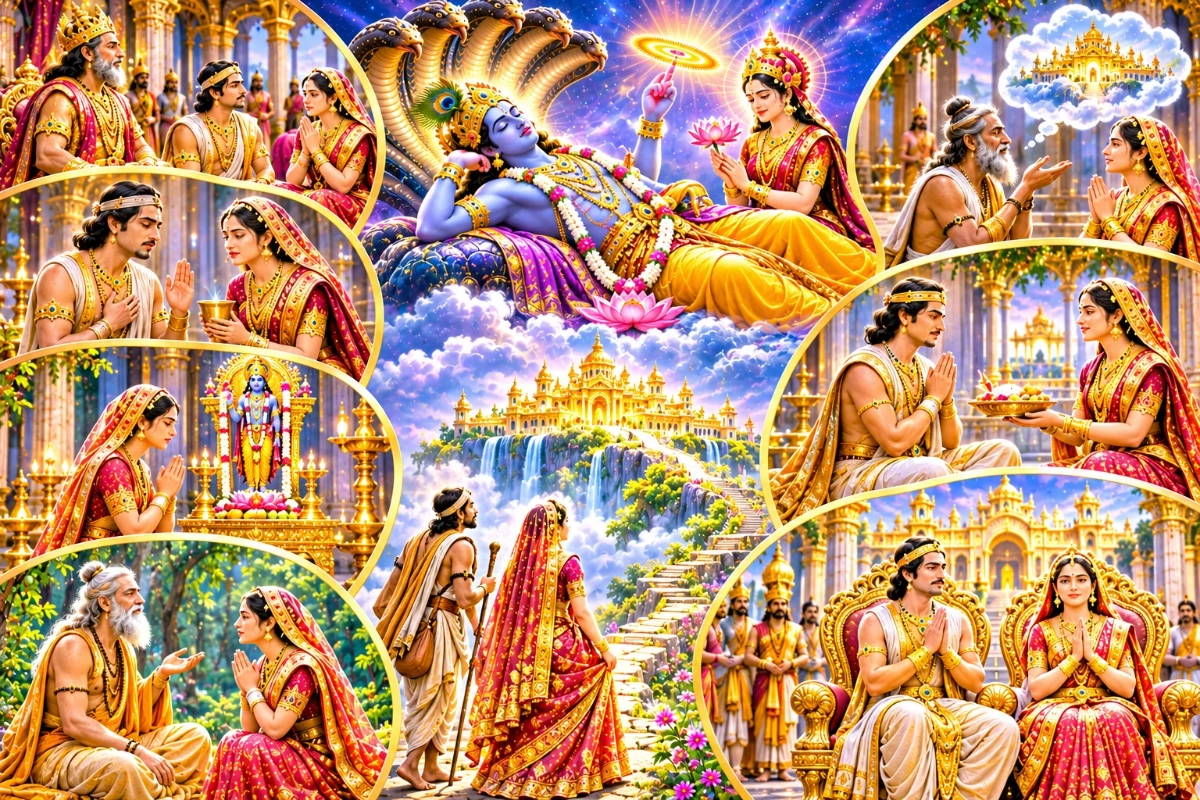
AI Generated Image
A Princess, a Fragile Prince and a Difficult Vow: The Moving Story Behind Rama Ekadashi
The Rama Ekadashi story follows Princess Chandrabhaga and her physically fragile husband, Shobhana, whose difficult fast leads to loss, an extraordinary kingdom and eventual reunion. Preserved in Hindu devotional tradition, the narrative connects the observance of Ekadashi with faith, spiritual merit and steadfast love. Reading it alongside present-day devotional guidance helps distinguish the story’s demanding vow from a practical and responsible approach to worship.
What Is the Rama Ekadashi Story?
The Rama Ekadashi story tells how Prince Shobhana dies after undertaking a fast he cannot physically bear, receives a magnificent but impermanent kingdom through its merit and is eventually reunited with Chandrabhaga, whose faithful observance makes that kingdom lasting. In the ISKCON News account, Krishna narrates the story to Yudhishthira as an explanation of the sacred day’s glories. Its central contrast is between performing a vow without firm faith and sustaining devotion over time.
Rama Ekadashi belongs to the dark fortnight, or Krishna Paksha, of Kartika in the calendar convention used by these devotional accounts. The name Rama here refers to Goddess Lakshmi, the consort of Vishnu; the narrative is not an episode about Prince Rama from the Ramayana. Its devotional focus is the worship of Vishnu and the blessings associated with sincere observance.
The principal figures help keep the unfolding story clear:
- King Muchukunda: A devoted ruler whose household observes Ekadashi with exceptional strictness.
- Chandrabhaga: His daughter, whose longstanding faith becomes decisive.
- Shobhana: Her husband, who is physically unable to endure the kingdom’s demanding fast.
- Somasharma: The travelling Brahmin who carries news between the separated couple.
- Sage Vamadeva: The sage who helps Chandrabhaga reach her husband’s extraordinary realm.
A Royal Household and an Impossible Choice
Shobhana visits his father-in-law’s kingdom as Rama Ekadashi approaches. For Chandrabhaga, the occasion brings anxiety rather than uncomplicated celebration: she knows her husband is frail, while her father expects everyone to observe the fast. The kingdom’s discipline leaves little room for individual limitations.
In this telling, Chandrabhaga explains that the restriction is so severe that even animals receive neither food nor water. She tells Shobhana that leaving is his alternative if he needs to eat. He nevertheless chooses to remain and undertake the vow, accepting whatever may follow.
This is the story’s first difficult moment. Read as a human dilemma, it places belonging, religious expectation and physical vulnerability in painful tension. Chandrabhaga understands the danger, yet the household’s rule remains unchanged. A modern reader can acknowledge the sacred setting without treating that severity as an example to reproduce.
The distinction matters: a traditional narrative can portray an extreme situation without making every detail a universal instruction. Here, the prince’s vulnerability deserves attention, not dismissal as a failure of character.
The Fast, the Loss and the Unexpected Kingdom
Shobhana’s strength fails as hunger and thirst intensify. By the arrival of Dwadashi, the day following Ekadashi, he has died. Chandrabhaga remains in her father’s home after his death, and the narrative appears, briefly, to have reached an irreversible ending.
But the devotional account continues beyond that loss. Through the merit of Rama Ekadashi, Shobhana receives a splendid kingdom on Mount Mandarachala. Its beauty is extraordinary, yet its existence is insecure: the reward is not permanent.
Somasharma encounters Shobhana during his travels and recognises him. Shobhana explains that his kingdom arose through the fast, but his lack of faith has left it unstable. He asks the Brahmin to return to Chandrabhaga and tell her what he has seen, believing that she can help.
The splendour therefore does not resolve the story’s deepest problem. One useful reading is that outward achievement cannot substitute for inward grounding. Shobhana possesses something dazzling, but he still needs the steadiness represented by Chandrabhaga’s devotion.
Chandrabhaga’s Devotion Changes the Ending
When Somasharma brings his news, Chandrabhaga wants to know whether he truly witnessed her husband’s kingdom or merely dreamed it. Once reassured, she asks to be taken there. Her response combines hope with action: she believes the merit of her own Ekadashi observances can make the kingdom permanent.
On the journey, they visit Sage Vamadeva’s ashram. The sage performs sacred rites, and the account describes Chandrabhaga receiving a transcendental form through those rites and her accumulated merit. She can then reach Shobhana on Mount Mandarachala.
Reunited with her husband, she explains that she has faithfully observed Ekadashi since childhood. She offers him the merit of those observances, making his kingdom lasting. Their separation ends through her sustained devotion rather than another dramatic test of endurance.
Chandrabhaga is therefore more than a grieving figure awaiting rescue. She listens, decides, travels and offers what she has cultivated over the years. For a reflective reader, her role gives the ending its emotional force: love becomes practical generosity, and private discipline becomes a means of helping someone else.
The Spiritual Significance Beyond the Miracle
Within the devotional tradition, Rama Ekadashi is associated with purification, divine grace and progress towards Vishnu. Its spiritual significance rests not simply on abstaining from food, but on the faith accompanying the observance. These are religious teachings and promises within the tradition, rather than outcomes that can be measured or guaranteed.
The story invites several reflections on the significance of Ekadashi:
- Intention deserves attention. Shobhana’s unstable kingdom encourages reflection on the difference between outward compliance and inward commitment.
- Consistency can outweigh spectacle. Chandrabhaga’s years of observance offer a counterpoint to a single extraordinary ordeal.
- Devotion need not remain private. Her offering suggests a generous use of spiritual effort, directed towards another’s welfare.
- Compassion belongs in the reading. The prince’s suffering should prompt care for vulnerability, not admiration for preventable harm.
These are interpretive takeaways, not additional events in the katha. They offer a way to reflect on its contrast between Shobhana’s troubled vow and Chandrabhaga’s enduring faith. The devotional resolution itself remains the couple’s reunion and the stabilising power of her merit.
How Can Devotees Approach Ekadashi Rituals Responsibly?
Ekadashi rituals can centre on worship, remembrance, scripture and an observance suited to the individual rather than competitive austerity. ISKCON guidance describes avoiding grains and beans while increasing devotional activity, and also recognises that complete fasting is not appropriate for everyone. The purpose is to deepen remembrance of Krishna, not to impress others through discomfort.
A practical approach keeps preparation and purpose together:
- Confirm the local observance. Consult your temple’s calendar for the fasting date and the Dwadashi period for breaking the fast, known as parana. Do not assume another location’s timings apply.
- Clarify your food practice beforehand. Under ISKCON observance, grains, beans, peas and dal are avoided. Check prepared foods and ingredients rather than relying only on a dish’s name.
- Make room for devotion. Set aside time for chanting, prayer, reading scripture or service. Simplifying meals should support these activities, not become the day’s sole concern.
- Respect personal capacity. Do not use Shobhana’s ordeal as a fasting target. Discuss religious adaptations with a trusted spiritual guide, and seek medical advice if fasting may affect your health. ISKCON pastoral guidance explicitly discourages comparing one person’s endurance with another’s.
Reading Older Retellings With Context
Readers searching for a ‘Rama Ekadashi 2019 story’ are seeking the traditional katha, not a separate story created for that year. For historical context, the October 2019 calendar published by the Hindu Temple and Cultural Society in New Jersey listed Rama Ekadashi on October 24, 2019. That archived date should not be reused for another year.
Likewise, an ‘ISKCON Rama Ekadashi story’ search leads to devotional retellings of Chandrabhaga and Shobhana. Read the narrative for its teaching, and consult a current local calendar separately when planning an observance. Keeping those purposes distinct prevents an older article’s date from becoming an accidental instruction.
Carrying the Story Into Daily Life
The most useful takeaway is not to imitate the prince’s suffering, but to consider what gives a vow meaning. Let Chandrabhaga’s steadiness inspire a manageable commitment: time for prayer, thoughtful reading or an act of service. Approach Ekadashi fasting with care, and allow devotion, not comparison, to guide the day.
Also Read: Redemption After Mistakes: Papankusha Ekadashi’s Path
To read more such news, download Bharat Express news apps