




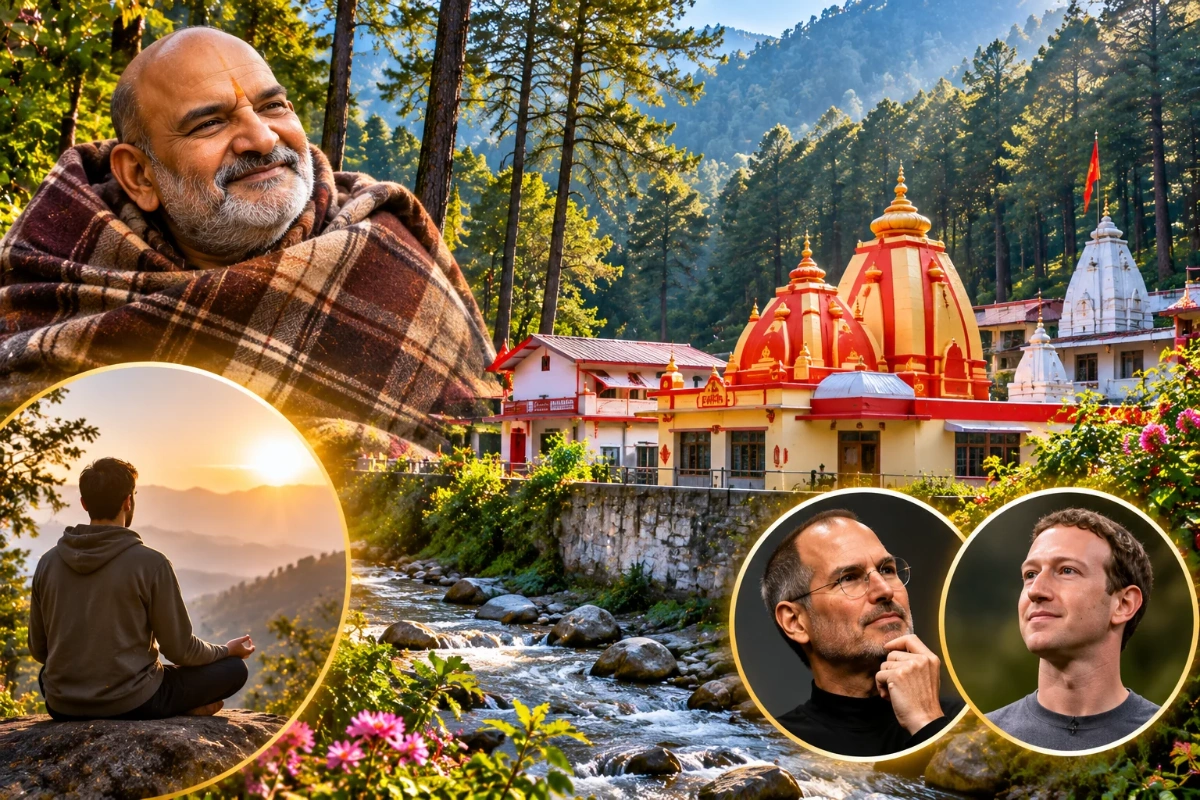
AI Generated Image
The Quiet Ashram in the Pines: Where Tech Pioneers and Seekers Find Silence
Kainchi Dham is a Hindu ashram and temple complex in Uttarakhand’s Kumaon hills, founded by Neem Karoli Baba and dedicated to Lord Hanuman. Known internationally through its connections with Steve Jobs and Mark Zuckerberg, it offers a spiritual setting rooted in devotion rather than a conventional wellness escape. Understanding this distinction helps visitors approach the mountain sanctuary with realistic expectations and respect.
The idea of a quiet ashram in the pines carries a compelling invitation: step away from constant demands and make room for attention. However, the most meaningful visit begins by looking beyond the famous names. Come prepared to encounter a living religious community, not a backdrop for your own transformation.
What Is Kainchi Dham, and Why Does It Draw Seekers?
Kainchi Dham is a pilgrimage centre associated with the Hindu mystic Neem Karoli Baba, affectionately known as Maharaj-ji. Located near Bhowali in the Kumaon hills of Uttarakhand, it brings together devotion to Lord Hanuman, remembrance of Maharaj-ji and the appeal of a mountain setting. Its significance is spiritual first, even when visitors initially discover it through travel stories or connections with the technology world.
Uttarakhand Tourism dates the ashram’s founding to 1962, while the Neem Karoli Baba Ashram’s account records the first temple’s inauguration in June 1964. These dates describe different stages of its beginnings rather than necessarily contradicting one another. Maharaj-ji established the community, while the temple’s consecration became an important milestone in its development.
Think of a visit as an opportunity to listen rather than an experience to complete. You need not arrive with an ambitious spiritual goal. A more useful intention might be to observe respectfully, learn something about the tradition and leave without demanding anything extraordinary from the experience.
Maharaj-ji’s Legacy of Simplicity and Silent Service
The spiritual tradition surrounding Maharaj-ji emphasises loving others, serving others, remembering God and telling the truth. These teachings place ordinary conduct alongside devotion: how you treat another person matters, not merely how long you sit in contemplation. His ashram community in Taos continues to express that legacy through worship and service, including the preparation and sharing of food.
At Kainchi Dham, devotion to Lord Hanuman anchors this spiritual identity. The emphasis on simplicity and silent service is best understood as an invitation to act without seeking recognition, rather than as a promise that everyone remains silent. Service need not become another performance or achievement to display.
For visitors, this suggests an uncomplicated approach. Be patient when someone needs space. Follow instructions without treating them as an inconvenience, and ask before offering help rather than assuming a role is available. If you want to honour the spirit of service, begin with the small act directly in front of you.
This offers a useful counterpoint to travel organised around collecting highlights. Instead of asking what the place can give you, consider what your presence contributes to the people sharing it.
Why Are Steve Jobs and Mark Zuckerberg Associated With the Ashram?
Steve Jobs and Mark Zuckerberg are both identified as notable visitors in Uttarakhand Tourism’s account of Kainchi Dham. The clearest public explanation of their connection comes from Zuckerberg’s remarks at a town hall on 27 September 2015. Jobs had advised him to visit a temple in India when Facebook was navigating a difficult period.
Zuckerberg explained that Jobs had recommended the journey as a way to reconnect with the company’s mission. He also said that travelling through India and observing how people connected reinforced his belief in Facebook’s work. His account links the trip with renewed purpose and a broader vision of connection, rather than describing a specific meditation technique or guaranteed breakthrough.
It is tempting to summarise this as two founders crediting Maharaj-ji’s serene energy with mental clarity and a global vision. However, that wording goes beyond what the cited public remarks establish. The documented story supports inspiration and reflection; it does not establish that both men made that precise spiritual attribution.
The practical lesson is modest but worthwhile. You can make room to reconsider your direction without expecting a destination to supply the answer. Let the founders’ connection spark curiosity, then allow the place’s religious purpose to matter more than its celebrity associations.
A Peaceful Retreat Is Not Necessarily a Silent One
The words ‘forest retreat’ can suggest private cabins, scheduled meditation sessions and uninterrupted solitude. Kainchi Dham should not be assumed to offer that kind of programme. The ashram’s own information describes an active temple destination with substantial visitor numbers, so quiet cannot be guaranteed simply by arriving.
This distinction matters if your main aim is quiet meditation. A peaceful retreat can include other people, religious observances and moments when your preferred pace is not possible. Try not to judge the experience solely by how closely it resembles an empty sanctuary.
Separate two intentions when planning: visiting a sacred place and taking a restorative nature getaway. They can complement each other without being identical. If uninterrupted rest matters to you, make that a separate accommodation decision rather than an expectation placed on the temple.
A calming environment is something you can help protect, too. Keep conversations considerate, avoid turning prayer into a photography opportunity and resist filling every pause with your phone. None of these choices requires a dramatic spiritual experience to be worthwhile.
Make Room for Attention Without Forcing an Outcome
If a suitable place and local guidance allow you to pause, keep your practice simple. Treat the following as an optional reflection exercise, not an official Kainchi Dham programme. The point is to notice your experience without turning it into another task.
- Choose one intention. Try ‘I will pay attention’ rather than ‘I must leave transformed’. Give yourself permission to have an ordinary visit.
- Put your phone away. Handle necessary travel arrangements first, then choose a manageable period without checking messages or composing updates.
- Let breathing stay natural. Sit or stand comfortably where permitted. There is no need to impose an elaborate technique on the moment.
- Notice the urge to evaluate. If you start asking whether the visit is working, gently return your attention to what you can hear and see.
- Leave with one observation. Later, write down something you noticed about your habits, priorities or response to waiting.
Perhaps you discover that you reach for your phone whenever there is nothing to do. Perhaps you notice how quickly you turn rest into a productivity assignment. Use that observation as a starting point for reflection, not a verdict about yourself.
Plan Respectfully and Verify Practical Arrangements
Start with information from Shri Kainchi Hanuman Mandir Trust, the body responsible for administering the temple properties. Its official notice warns that no outside agent is authorised to issue permits, arrange stays or darshan, or solicit donations on its behalf. Verify claims of affiliation before sharing money or personal information.
Overnight accommodation deserves particular care. The Neem Karoli Baba Ashram’s Kainchi information states that the site is not currently inviting overnight stays and directs visitors to the temple trust for guidance. Do not build a travel itinerary around an assumed ashram room or an unverified booking offer.
Before setting out, use this checklist:
- Confirm current access information. Check official notices rather than relying entirely on an older blog, video or forwarded message.
- Verify accommodation independently. Distinguish a nearby commercial property from an authorised ashram arrangement.
- Leave room in the itinerary. Avoid a schedule so tight that waiting becomes a reason to rush or pressure others.
- Check local etiquette on arrival. Ask about footwear, photography, permitted areas and any instructions you do not understand.
- Keep expectations flexible. Decide beforehand that a respectful, uneventful visit can still be meaningful.
Carry the Quiet Into Ordinary Life
You do not need to return from Kainchi Dham with a revelation. A more grounded takeaway might be one small commitment: an unhurried meal, a short phone-free pause or an act of help that receives no public acknowledgement. Choose something you can continue when the journey is over.
The enduring invitation is not to imitate a famous founder’s story. It is to approach a sacred place with humility, make room for attention and consider how simplicity and service might shape your everyday life.
Also Read: Nath Sampradaya Yoga: Tradition, Reform, & Khichdi Mela
To read more such news, download Bharat Express news apps