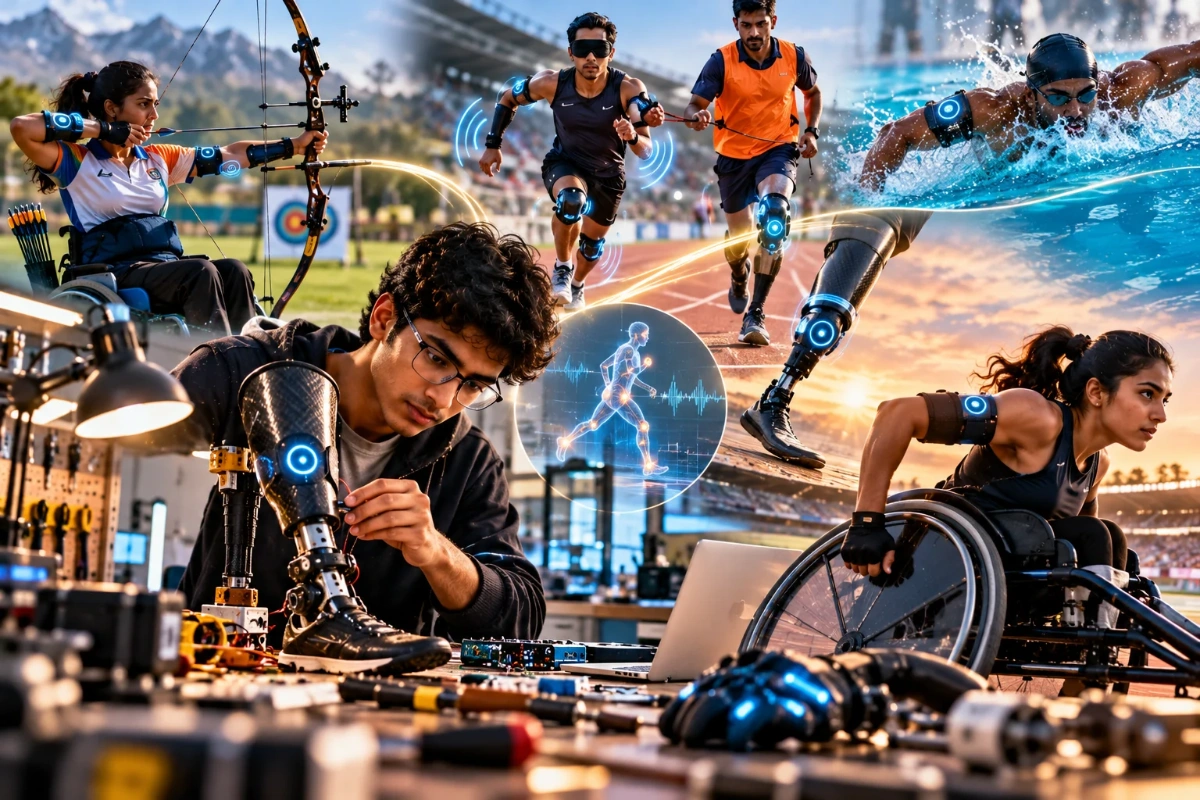
AI Generated Image
The Haptic Inclusive Revolution: How Young Engineers Are Re-Engineering Life for Specially-Abled Athletes
Haptic technology for specially-abled athletes uses touch-based signals, feedback and guidance to help athletes move, train, communicate and compete with greater confidence. Instead of relying solely on sight or sound, haptic systems translate information into vibrations, pressure, motion, resistance or tactile cues that the body can feel. The inclusive revolution behind this technology is not just about better gadgets; it is about young engineers designing sport around more bodies, more senses and more ways to participate.
What Is Haptic Technology for Specially-Abled Athletes?
Haptic technology for specially-abled athletes refers to engineered systems that use the sense of touch to support athletic performance, safety, coaching and accessibility. These systems can be integrated into wearables, prosthetics, training devices, sports equipment, navigation tools and communication systems. The core idea is simple: when an athlete cannot easily access visual, auditory or physical information in a conventional way, touch can become a powerful channel for real-time feedback.
In practical terms, a haptic cue might be a vibration on the wrist telling a runner to adjust direction, a pressure signal in a glove helping an athlete sense grip, or resistance feedback in a training device that encourages smoother movement. For a visually impaired athlete, haptics can reduce dependence on shouted instructions. For an athlete with a limb difference, it can make interaction with a prosthetic device feel more responsive. For an athlete with hearing loss, tactile signals can replace whistles, alerts or timing cues.
The term ‘specially-abled’ is often used to emphasise capability rather than limitation. However, inclusive design works best when it respects individual preferences. Some athletes may identify as disabled athletes, adaptive athletes, para-athletes or athletes with disabilities. The most important principle is that technology should be developed with athletes, not merely for them.
The Touch-Based Idea at the Centre of Haptics
Haptics begins with the human body’s ability to sense touch, pressure, vibration, texture, motion and force. Engineers use this ability to transmit information through the skin and muscles. Instead of displaying a message on a screen, a haptic device creates a physical sensation that an athlete can interpret quickly.
This matters in sport because athletes often need information while moving at speed. Looking down at a screen may be unsafe. Listening for a command may be difficult in a noisy arena, pool, court or outdoor environment. A tactile cue can be immediate, private and less distracting when designed well.
The technology can be simple or advanced. A basic system may use small vibration motors, similar to those found in mobile phones. A more advanced system may use force feedback, soft robotics, pressure mapping, motion sensors or artificial intelligence to adapt cues to an athlete’s movements. The best designs avoid overwhelming athletes with constant signals. Instead, they deliver the right cue at the right time in a way that can be understood without disrupting concentration.
Defining Characteristics of Haptic Sports Technology
A haptic system for inclusive athletics usually includes several defining features:
- Sensory Input: The system gathers information through sensors, cameras, GPS, pressure pads, motion trackers, or connected equipment.
- Translation Layer: Software converts that information into a meaningful tactile pattern, such as a pulse, rhythm, pressure change or directional vibration.
- Feedback Point: The athlete receives the cue through a wearable, prosthetic interface, glove, shoe insert, belt, sleeve, handle or training surface.
- Clear Purpose: The cue supports a specific action, such as correcting posture, finding direction, pacing effort, detecting contact or responding to a game signal.
- Human-Centred Design: Athletes test the system and help shape how it feels, because comfort, timing and trust matter as much as technical accuracy.
These characteristics distinguish useful haptic tools from novelty devices. A wearable that vibrates without serving a clear athletic purpose is not necessarily inclusive. A tactile system that reduces friction, improves understanding or expands participation comes much closer to fulfilling the promise of this field.
How Does Haptic Technology Work in Adaptive Sport?
Haptic technology works by detecting something important, converting it into a tactile signal and delivering that signal to the athlete in real time or near real time. For example, a wearable might detect that a runner is drifting out of their lane and send a gentle vibration on the left or right side of the body. A rowing training system might detect uneven force and provide feedback that encourages balanced movement. A sports prosthetic might use pressure sensors to help the user better understand contact with the ground, a ball or other equipment.
The process depends on the sport and the athlete’s needs. In some cases, haptic feedback replaces information that is usually visual or auditory. In others, it adds another layer of body awareness. Many athletes, whether disabled or not, can benefit from better feedback. The distinction in inclusive design is that accessibility is treated as a starting point, not an afterthought.
A useful way to understand the process is to view it as a feedback loop:
- Movement: The athlete moves or interacts with equipment during a sprint start, wheelchair push, jump, throw, stroke, swing or balance adjustment.
- Data Collection: Sensors capture relevant information, including speed, pressure, angle, direction, force, distance, rhythm or contact.
- Data Interpretation: Software determines whether the athlete needs a cue, warning, correction or confirmation.
- Tactile Feedback: The device delivers a vibration, pulse, resistance, squeeze, tap or change in pressure.
- Athlete Response: The athlete responds to the cue, which may help build skill, confidence, timing or independence over time.
This feedback loop can make coaching more immediate. Instead of waiting for feedback after a drill, an athlete can receive guidance during the movement itself. That does not mean haptics replaces coaches, guides, classifiers, trainers or therapists. It provides another communication tool within the training environment.
Young Engineers Are Changing the Design Mindset
The inclusive revolution is being shaped by young engineers because many are approaching assistive sports technology with fresh expectations. They often come from robotics clubs, university laboratories, maker communities, biomedical engineering programmes, product design studios and startup environments where rapid prototyping is standard practice. More importantly, many are learning that disability inclusion is not charity; it is a sophisticated design challenge.
Older assistive devices were sometimes built around a narrow objective: compensating for a limitation. Newer inclusive thinking asks a better question: what kind of experience does the athlete want? That shift changes the entire approach. It moves the focus from ‘fixing’ a person to improving the relationship between the athlete, equipment, environment and sport.
Young engineers are also more likely to combine disciplines. A haptic sports project may involve mechanical design, electronics, materials science, software, biomechanics, psychology, coaching knowledge and user research. Creating a comfortable vibration pattern is not just an engineering problem. It is also a question of perception, usability and athletic performance.
What Young Engineering Teams Often Bring to the Field
- Rapid Prototyping: Teams can test ideas using 3D printing, microcontrollers, wearable sensors and modular components before committing to a final product.
- Collaborative Design: Many teams involve athletes early, assessing how a device feels during actual movement rather than judging success only in a laboratory.
- Low-Barrier Experimentation: Student and maker projects often explore ideas that large manufacturers may overlook until demand becomes apparent.
- Cross-Sport Innovation: A solution developed for running may inspire tools for swimming, cycling, wheelchair sports, climbing or ball games.
- Digital Fluency: Young developers can connect haptics with apps, analytics, machine learning and remote coaching interfaces.
However, enthusiasm must be matched with responsibility. Inclusive technology should be durable, safe, maintainable and respectful of the athlete’s autonomy. A clever prototype is only the beginning. A meaningful solution must withstand sweat, impact, fatigue, weather and repeated use, while accounting for the emotional realities of competition.
What Does Haptic Inclusion Actually Improve?
Haptic inclusion improves access to information, but its deeper value lies in agency. When athletes can feel cues directly, they may make faster decisions, train more independently and participate in environments that were not originally designed for them. The technology can support performance while reducing the constant need to ask someone else for information.
For visually impaired athletes, haptic signals may support navigation, pacing, lane awareness or obstacle detection. For deaf or hard-of-hearing athletes, tactile alerts can communicate starts, stops, timing signals or coaching prompts. For athletes using prosthetics or orthotics, haptic feedback may make contact, alignment or pressure easier to interpret. For athletes with neurological or motor differences, structured tactile cues can support rhythm, repetition and movement learning.
These improvements are not automatic. Poorly designed haptics can distract, irritate or confuse users, creating new barriers. The best systems are tailored to the athlete’s sport, body, skin sensitivity, attention and personal preferences. In high-pressure competition, a cue must be simple enough to understand instantly.
Practical Examples and Use Cases
Haptic technology for specially-abled athletes can take many forms, including:
- Direction-Guidance Wearables: A belt, wristband or vest can use left-right vibration cues to support running, cycling or navigation in training spaces.
- Tactile Start Signals: Instead of relying solely on a whistle, light or spoken command, athletes can receive a tactile pulse marking the start of a race or drill.
- Grip-Feedback Gloves: Pressure sensors can help athletes understand how firmly they are holding a racket, handle, oar, bar or ball.
- Prosthetic Feedback Systems: Sensors in a prosthetic limb or socket can translate pressure, ground contact or equipment interaction into tactile sensations.
- Wheelchair Sport Feedback: Haptic cues can support push rhythm, turning awareness, collision warnings or training consistency.
- Balance and Posture Coaching: Wearables can alert athletes when their body position moves outside a target range during drills.
- Remote Coaching Cues: Coaches can send pre-agreed tactile signals without shouting across a noisy field or gym.
- Rehabilitation-to-Sport Transitions: Haptic feedback can help athletes practise controlled movements as they return to training after injury or adapt to new equipment.
These examples show why haptics is not a single product category. It is a design language in which information becomes touch, and touch becomes action.
The Difference Between Assistive, Adaptive and Inclusive Technology
Assistive technology helps a person perform a task that might otherwise be difficult or inaccessible. Adaptive technology modifies a tool, environment or method to better suit an individual’s needs. Inclusive technology takes a broader approach: it aims to design systems from the outset so that more people can use them with dignity, flexibility and choice.
Haptics can belong to all three categories. A tactile navigation device may be assistive when it helps an athlete access a route. A modified training handle with vibration feedback may be adaptive when it changes existing equipment. A sports facility that offers tactile alerts as part of its standard timing and communication systems moves towards inclusive design.
The distinction matters because inclusion is not only about adding devices for individuals. If every solution requires an athlete to carry extra equipment, pay additional costs or seek special permission, the environment is still doing too little. A more inclusive future would incorporate tactile access into sports systems, training platforms and equipment options from the start.
A Simple Comparison
| Concept | Main Focus | Example in Sport |
|---|---|---|
| Assistive Technology | Helping an athlete complete a specific task | A wearable that gives navigation cues to a blind runner |
| Adaptive Technology | Modifying equipment or methods | A racket handle with pressure feedback for grip control |
| Inclusive Technology | Building access into the system itself | A training facility with tactile alerts available to athletes who want them |
This comparison does not rank one approach above another. Athletes often need a combination of all three. The goal is to make that combination feel normal, high-quality and ready for competitive use.
Design Principles Behind Meaningful Haptic Sports Tools
Good haptic design begins with listening. Athletes know what feels helpful, what feels distracting and what builds trust during movement. Engineers may understand sensors and circuits, but athletes understand the lived experience of training with a particular body, device, classification, impairment or adaptation.
The strongest projects usually follow several principles. First, the cue must be easy to learn. If athletes have to memorise too many vibration patterns, the tool may become mentally exhausting. Second, the device must be physically comfortable. A sensor that rubs, shifts, overheats or adds awkward weight can undermine the entire purpose. Third, feedback must be reliable enough for athletes to trust it as the pace increases.
There is also an ethical dimension. Data relating to movement, location, health or performance can be personal. Inclusive engineering should treat privacy and consent as design requirements, not legal footnotes. Athletes should understand what is being measured, who can access it and how it will be used.
Checklist for Evaluating a Haptic Sports Solution
A promising solution should answer ‘yes’ to most of these questions:
- Does the device solve a real problem identified by athletes themselves?
- Can athletes understand the cue without stopping or looking at a screen?
- Is the feedback adjustable for intensity, pattern, placement and sensitivity?
- Does the device remain secure during sport-specific movements?
- Is it comfortable for repeated use, including in heat, sweat, impact and fatigue?
- Can coaches, guides or support staff learn the system quickly when necessary?
- Does it protect personal data and give athletes control over settings?
- Is the design affordable, repairable or scalable enough to move beyond a prototype?
- Does it preserve the athlete’s dignity rather than making them feel like a test subject?
A checklist like this helps distinguish inclusive innovation from technology for its own sake. The goal is not to add more devices to sport, but to remove avoidable barriers.
Common Misconceptions About Haptic Technology
One misconception is that haptic technology is only for elite athletes. In reality, tactile feedback can be useful at many levels, from beginner instruction to competitive training. A young athlete learning body positioning may benefit from simple vibration cues just as much as an experienced athlete refining technique.
Another misconception is that haptics makes sport less authentic. This assumes that traditional equipment is neutral, even though sport has always incorporated technology. Shoes, wheelchairs, prosthetics, timing systems, playing surfaces, protective gear and training tools all shape performance. The more useful question is whether the technology supports fair, safe and meaningful participation.
A third misconception is that one device can serve every athlete with the same disability label. Two athletes may share a classification or diagnosis and still have very different sensory preferences, movement patterns, goals and training environments. Personalisation is not a luxury in haptic design; it is often the difference between adoption and abandonment.
Misconceptions to Avoid
- ‘More Feedback Is Always Better’. Too many cues can overwhelm attention and slow decision-making.
- ‘The Engineer Knows What the Athlete Needs’. The athlete’s experience should guide the design from the beginning.
- ‘Accessibility Means Lower Performance Standards’. Inclusive tools can support serious training, competition and skill development.
- ‘A Prototype Proves the Concept Is Ready’. Real-world sport requires durability, comfort, safety and long-term usability.
- ‘Haptics Replaces Human Support’. It may reduce dependence in some situations, but coaches, guides, teammates and families remain important.
Understanding these misconceptions keeps the discussion grounded. The revolution is not about impressive technology alone. It is about thoughtful engineering that respects athletes as experts in their own performance.
The Future of Touch-Driven Inclusive Athletics
The future of haptic technology for specially-abled athletes will likely be shaped by smaller sensors, softer wearables, smarter feedback systems and deeper athlete involvement. Devices may become more discreet, comfortable and easier to customise. Training platforms may allow athletes to choose visual, auditory, tactile or combined feedback depending on the situation.
Young engineers have an important role because they are entering the field at a time when inclusion is becoming a design expectation. Their work can help move adaptive sport away from one-off modifications and towards flexible ecosystems. That could mean equipment that adjusts to different bodies, coaching tools that support multiple communication styles and facilities that treat tactile access as standard.
The most exciting possibility is cultural rather than technical. When haptic systems are designed well, they remind us that athletic intelligence is not limited to what the eyes see or the ears hear. The body can interpret information through touch, pressure, rhythm and movement. In that sense, haptic inclusion does more than re-engineer devices. It challenges assumptions about whom sport is designed to serve.
Key Takeaways
Haptic sports technology turns information into touch, allowing athletes to receive guidance, alerts or feedback through the body. For specially-abled athletes, this can improve access to directional guidance, timing, posture, grip, balance, contact and coaching cues. The technology is most valuable when it is developed with athletes, tested in real sporting conditions and adapted to individual preferences.
Young engineers are helping expand this field by combining prototyping, sensors, software, biomechanics and inclusive design. Their real contribution is not simply creating clever devices. It is asking better questions about access, dignity, independence and performance.
The haptic inclusive revolution is still developing, but its purpose is already clear: to make sport more responsive to touch, more adaptable and more welcoming to athletes whose abilities challenge outdated design assumptions.
Also Read: Border Villages Initiative: Empowering Frontier Youth
To read more such news, download Bharat Express news apps