AI Generated Image
The Battlefield Shrine Where Sati’s Ankle Fell and Krishna Spoke the Gita
Bhadrakali Temple is a Shakti Peetha near Brahma Sarovar in Kurukshetra, Haryana, where Hindu tradition holds that Sati’s right ankle fell. Its story connects goddess worship, the Pandavas’ prayers before the Mahabharata war, and the continuing custom of offering miniature horses after wishes are fulfilled. Krishna’s delivery of the Bhagavad Gita belongs to the same sacred landscape, but is associated specifically with nearby Jyotisar, not the temple itself. Understanding that distinction makes this battlefield shrine more meaningful to explore.
What Makes Bhadrakali Temple a Battlefield Shrine?
Bhadrakali Temple is a battlefield shrine because local religious tradition connects it directly with the Pandavas’ preparations for the Kurukshetra war. According to the Kurukshetra Development Board, the brothers worshipped the goddess here with Krishna before the battle began, seeking her blessings for victory. Their association with the shrine continued after the fighting, when they are said to have returned in gratitude.
That connection gives the temple a different character from a conventional war memorial. Rather than approaching it only through battlefield remembrance, visitors can understand it through prayer, divine protection, and thanksgiving. The central story concerns warriors seeking help before an uncertain confrontation, then acknowledging that help afterwards.
For a visitor accustomed to a military tribute honouring a fallen soldier, this distinction matters. Such terms can suggest commemorative monuments; here, the more useful starting point is a living place of goddess worship. Let the epic connection inform your visit without allowing the language of warfare to obscure the temple’s devotional purpose. Its significance is not exhausted by the battle attached to its story.
The Sacred Well and the Story of Sati’s Ankle
The temple stands on Jhansa Road in Thanesar, within Kurukshetra. Also called Shri Devi Koop Temple, it belongs to the network of Shakti Peethas associated with the goddess Sati. Brahma Sarovar is nearby within the wider pilgrimage landscape, but the temple and the sacred tank are separate destinations.
In the traditional account, Sati dies after the humiliation of Shiva at her father Daksha’s sacrifice. Shiva carries her body in grief, and Vishnu intervenes with his discus. The places where parts of her body fall become sacred seats of Shakti, the divine feminine. At Bhadrakali, devotees identify the fallen part as her right ankle.
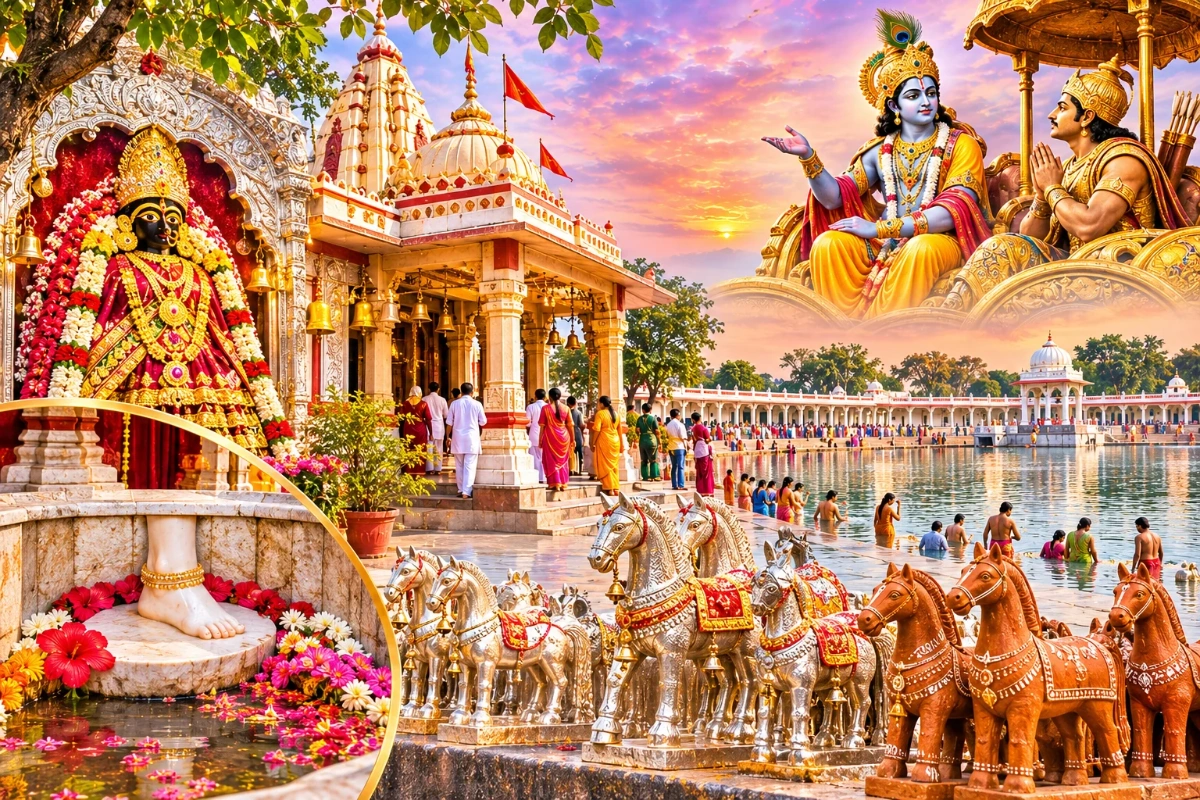
The local focus is Devikupa, the sacred well where the ankle is believed to have fallen. A marble representation of the right ankle above the well recalls this foundational story. For a first-time visitor, understanding that connection makes the image more than an unfamiliar detail: it identifies why the place is revered.
Official descriptions vary slightly: Haryana Tourism refers to Sati’s anklet, while the Kurukshetra Development Board identifies her right ankle. Both connect the tradition with the well and its marble representation. Describing the site as the place where Sati’s ankle is believed to have fallen respects the locally documented tradition without presenting religious belief as archaeological proof.
The Pandavas’ Promise Lives On in Miniature Horses
The shrine’s horse offerings connect its epic associations with present-day devotion. Haryana Tourism recounts that the Pandavas returned after victory and offered their horses in the goddess’s service. Today, devotees offer terracotta and metal horses after their wishes have been fulfilled, continuing a practice explained through that remembered act of gratitude.
Silver horses belong to this wider votive tradition. Research documenting worship at the temple records offerings made from clay, silver, and gold, including pairs of horses presented after wishes came true. The material may differ, but the devotional meaning remains an acknowledgement of the goddess’s help. The offering is associated with fulfilling a vow, not simply decorating the shrine.
These details offer a useful way to understand what you see:
- The horse recalls the epic connection: Its meaning comes from the tradition of the Pandavas’ return after victory, rather than from an unrelated decorative motif.
- The miniature makes gratitude tangible: A personal prayer becomes a physical offering that can be brought back to the goddess.
- Silver is one option, not the whole custom: Clay and other metal horses also belong to the documented practice.
If you wish to participate, ask temple attendants about the appropriate procedure before buying an offering. Treat it as a religious commitment rather than a souvenir purchase, and avoid assuming that a more expensive material makes a prayer more worthy.
Where Did Krishna Speak the Bhagavad Gita?
Krishna is traditionally believed to have delivered the Bhagavad Gita to Arjuna at Jyotisar in Kurukshetra, not at Bhadrakali Temple. The district government identifies Jyotisar as the birthplace of the Gita, while the Kurukshetra Development Board connects it with the teaching given before the Mahabharata battle. The two sites share an epic landscape but have distinct sacred identities.
At Jyotisar, the emphasis shifts from the goddess’s blessing to Krishna’s instruction. The teaching addresses action, devotion, knowledge, and the pursuit of righteousness. That makes Jyotisar a complementary stop: it invites reflection on how to act, rather than simply whether victory will come.
The banyan tree and representations of Krishna teaching Arjuna help visitors recognise this association. Haryana Tourism describes a platform around the revered tree and a chariot installation depicting the Gita discourse. These features give the philosophical story a visible setting while remaining expressions of the site’s religious tradition.
Keep the distinction clear when planning or discussing your journey: Bhadrakali is associated with Sati and the Pandavas’ worship; Jyotisar is associated with Krishna’s teaching. Visiting both allows each story its own space instead of compressing Kurukshetra into one supposedly all-encompassing shrine.
Solar Eclipses Bring Pilgrimage to Brahma Sarovar
Solar eclipses are important bathing occasions in Kurukshetra. The district government describes large gatherings at Brahma Sarovar and other sacred water bodies, where pilgrims take holy dips. Haryana’s official account explains that bathing during an eclipse is believed to bring exceptional religious merit; that significance belongs to faith rather than any measurable property of the water.
The scale can be extraordinary, but attendance should not be treated as a fixed number. On 22 July 2009, ABC reported more than one million Hindu pilgrims gathering at Kurukshetra. Reporting that morning also described Brahma Sarovar as the focus of the holy bathing, with local authorities expecting nearly 1.5 million arrivals. These accounts demonstrate the scale of a major gathering, not a claim that every eclipse draws the same crowd.
Bathing and temple worship form parts of the wider pilgrimage tradition. A devotee’s observance may include a holy dip in Brahma Sarovar, followed by prayers at Bhadrakali Temple. Those returning after an answered prayer may offer silver horses in fulfilment of their vows. These are connected devotional practices, not a compulsory sequence followed by every pilgrim.
Planning a Respectful Visit Across the Sacred Landscape
Give each place a clear purpose in your itinerary rather than treating the area as a single attraction. Bhadrakali Temple centres on goddess worship, Brahma Sarovar on sacred bathing, and Jyotisar on the Gita tradition. The district’s visitor guidance includes all three among Kurukshetra’s religious attractions.
Use this checklist to prepare:
- Confirm arrangements locally: Check temple access, transport, and any event restrictions close to your visit rather than relying on an old schedule.
- Allow time for worshippers: Avoid treating a queue or ritual as an obstacle to sightseeing; leave room for people who have come to pray.
- Ask before photographing: Seek permission around worship, offerings, and bathing, particularly when individuals would be identifiable.
- Plan eclipse visits separately: Check official crowd-management guidance and decide whether a major gathering suits everyone in your group.
- Keep participation voluntary: Observe respectfully if you do not wish to bathe, make an offering, or join a ritual.
The most rewarding approach is attentive rather than hurried. Notice which story belongs to which place, ask respectful questions, and let worshippers set the rhythm around you.
A Landscape Larger Than Its Battlefield
Kurukshetra’s sacred places preserve different strands of one religious landscape: Sati’s ankle at Bhadrakali, the Pandavas’ worship, holy bathing at Brahma Sarovar, and Krishna’s teaching at Jyotisar. Their power lies in those connections—and in their differences. Visit with both in mind, and the battlefield shrine becomes more than an epic reference: it becomes a place to understand how remembered stories continue through living devotion.
Also Read: Vijayanagara Stone Chariots: Timeless Cultural Marvel
To read more such news, download Bharat Express news apps