



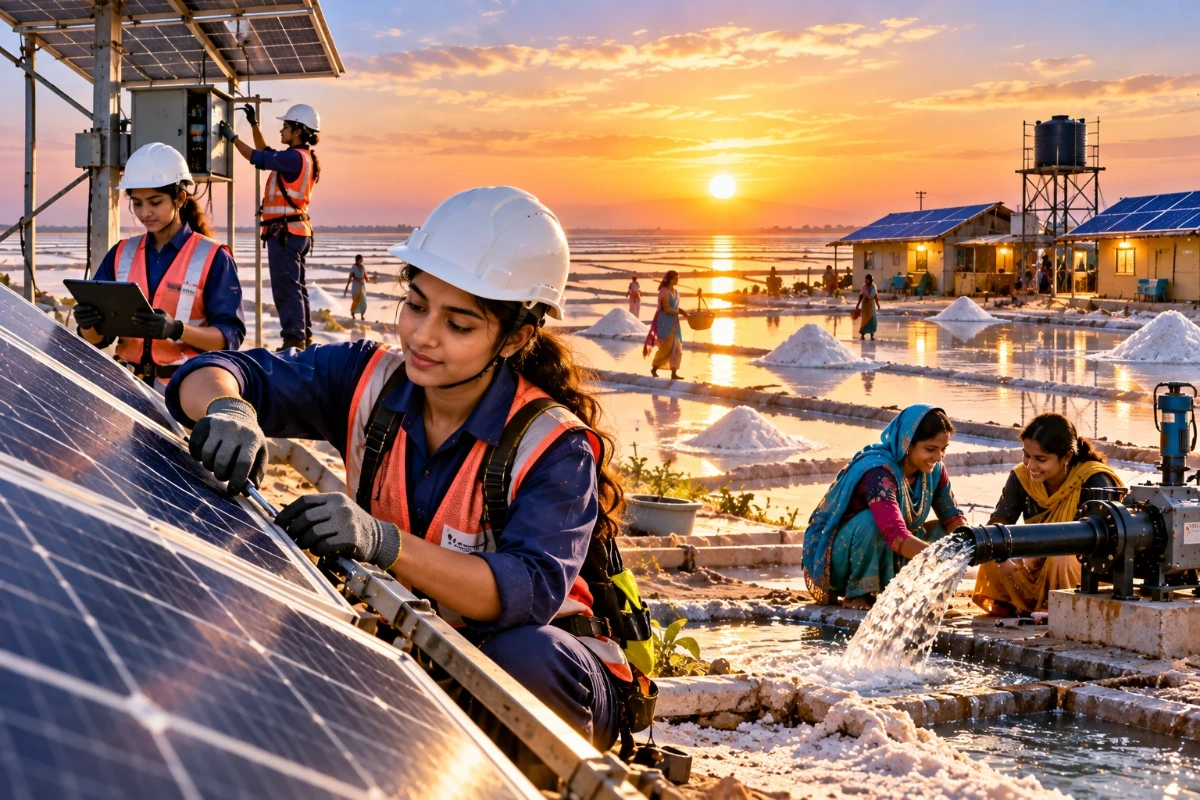
AI Generated Image
The Solar Mahilas of the Salt Flats: Young Female Technicians Powering Off-Grid Microgrids
In India’s salt-flat communities, a quiet clean-energy transition is being led by young women learning to install, maintain, and explain solar power in areas where conventional infrastructure is difficult to access. These solar mahilas are not just beneficiaries of energy access; they are technicians, troubleshooters, entrepreneurs, and trusted local guides helping households and salt farmers move away from costly, polluting diesel-powered systems. Their story shows how women working in solar energy can transform both the energy system and social expectations about who gets to build it.
Who Are the Solar Mahilas?
Solar mahilas are women trained to work with solar technologies in their own communities, often in places where access to energy, mobility, and formal employment has been limited. In Gujarat’s salt-pan areas, initiatives involving SEWA, UNEP, and ReNew have trained women salt-pan workers for renewable-energy livelihoods, including roles as solar panel and solar pump technicians. The term matters because it places women at the centre of technical work rather than at the margins.
For many readers, the phrase may sound unfamiliar. ‘Mahila’ means woman in several Indian languages, and in this context, it represents a practical, community-rooted approach: train local women, support them with tools and networks, and enable them to solve local energy problems. Instead of waiting for engineers from distant towns to visit remote salt flats, communities gain technicians who understand the terrain, work cycles, weather conditions, and household decisions behind every pump or panel.
Why Salt Flats Make Energy Access More Difficult
Salt farming is physically demanding, seasonal, and closely linked to water movement. In the Little Rann of Kutch, Agariya salt-farming families work across a harsh landscape that floods during the monsoon and later becomes a vast salt desert. Reports describe extreme heat and difficult working conditions for thousands of families who depend on salt production for their livelihoods.
In this environment, reliable power is more than a convenience. Pumps are needed to move brine, lighting affects safety and productivity, and repairs can take time when workers are far from towns. Diesel pumps have long filled the gap, but they bring fuel costs, exhaust fumes, maintenance requirements, and dependence on supply chains that may not adequately serve remote workers.
Solar power does not eliminate every hardship, but it can reduce one recurring pressure: the need to keep buying and transporting fuel simply to keep work moving.
Why Do Women Technicians Matter in Off-Grid Communities?
Women technicians matter because energy systems are more likely to remain functional when the people closest to their daily use can operate, maintain, and advocate for them. In many rural and informal work settings, women already manage household energy, water, food, care responsibilities, and decisions about managing income, yet they are often excluded from technical training. When women trained in solar technology become local points of contact, repairs can happen faster, adoption can feel less intimidating, and girls can see technical work as a career within their reach.
This is particularly important for off-grid microgrids and distributed solar systems. A microgrid is not just hardware; it is a functioning system of panels, wiring, batteries or pumps, payment arrangements, maintenance routines, and community trust. If nobody nearby knows how to identify a loose connection, clean a panel correctly, report a fault, or explain safe usage, the system can deteriorate. Solar mahilas help turn equipment into dependable infrastructure.
Their presence also changes the social meaning of technology. When a woman climbs onto a roof, opens a toolkit, checks a controller, or explains why a pump is underperforming, she challenges the assumption that energy work belongs exclusively to men. The shift is gradual, but powerful because it happens in public, in front of families, neighbours, employers, and younger girls.
From Diesel Dependence to Local Solar Entrepreneurship
The clean-energy transition is often discussed in terms of ambitious targets and utility-scale projects. On the salt flats, however, the transition feels more immediate: Can a pump run reliably? Can a family reduce fuel expenditure? Can a worker acquire a skill that generates income outside the most demanding months of salt production?
Solar entrepreneurship grows from these everyday needs. A trained woman may help install or maintain a solar pump, run a small service business, guide neighbours through financing options, or connect a household with a supplier. Some programmes have also explored asset ownership and financial services so that women do not merely use solar equipment but gain greater control over the income and decisions associated with it.
CGAP notes that a solar water pump project in Gujarat has enabled 1,292 women salt farmers to replace diesel pumps with solar systems since 2017, while also examining how access to finance affects women’s ownership and decision-making.
This is where solar entrepreneurship becomes more than a slogan. The opportunity is not simply to sell panels. It is to build a local clean-energy service economy encompassing installation, preventive maintenance, pump support, user training, record-keeping, and coordination with lenders, cooperatives, and project partners.
Practical Roles Solar Mahilas Can Play
- System caretakers: Clean panels, check for visible wear, monitor pump performance, and help users avoid preventable damage.
- First responders: Identify basic faults and determine when specialist repairs are necessary.
- Community educators: Explain safe usage, seasonal maintenance, and the importance of correct installation.
- Energy entrepreneurs: Offer paid services, support solar product adoption, or coordinate with local groups.
- Role models: Make technical work visible to younger women who might not otherwise imagine themselves pursuing careers in the energy sector.
The Microgrid Mindset Is Local, Flexible, and Resilient
Off-grid microgrids work best when they are designed around the community rather than simply installed within it. A salt-flat settlement, a farming hamlet, and a village market may each require different system sizes, ownership models, and service routines. The most successful approach usually begins with straightforward questions: Who uses the power? Who pays for maintenance? Who notices problems first? Similarly, who has the authority and training to fix them?
Women in solar bring valuable perspectives because they often understand the entire chain of energy use. A pump failure is not merely a technical fault; it can affect working hours, debt, household cash flow, and safety. A lighting upgrade is not just about installing a bulb; it can influence study time, evening work, and mobility. A local technician who understands these connections can recommend solutions that fit people’s everyday lives.
There is also a resilience benefit. Remote systems face dust, extreme heat, salt exposure, rough handling, and long journeys for replacement parts. A community with trained technicians has a better chance of keeping systems running between formal service visits. This does not replace professional engineering standards, but it adds a crucial layer of local care.
What Makes This Model Different From Traditional Energy Development?
This model stands out because it treats women as builders of the energy transition, not merely users of new technology. Traditional development programmes sometimes focus on delivering assets: a pump, a panel, a battery, or an electricity connection. The solar mahila approach adds skills, livelihoods, confidence, and local ownership to the equipment itself.
The difference is evident in three areas. First, training creates practical capacity that remains within the community after installation. Second, local women can reduce the social distance between technology providers and users, particularly in households where women may feel more comfortable raising questions with another woman. Third, the model links climate action with income generation, making clean energy relevant to families that need immediate economic benefits as well as long-term environmental gains.
Programmes in Gujarat have also connected women salt farmers with broader clean-energy opportunities. IHRB has documented how women salt farmers supported by SEWA trained as solar technicians and developed skills associated with replacing diesel-powered pumps with solar-powered alternatives.
The Barriers Are Real, but They Can Be Addressed
The rise of solar women should not be romanticised. Young female technicians may face scepticism, safety concerns, travel restrictions, limited access to capital, uneven digital access, and the burden of unpaid care work. Even when training is available, women may need family support, reliable transport, tools, and a steady supply of paid work to turn their skills into income.
Technical confidence also takes time to develop. A short course can introduce the basics of solar technology, but field experience builds practical judgement: diagnosing a weak connection, communicating with a hesitant customer, documenting a repair, and knowing when to escalate a problem. For solar entrepreneurship to thrive, training must be followed by mentoring, market access, and fair payment.
The strongest programmes therefore combine several forms of support:
- Hands-on technical training: Cover installation, safety, maintenance, and troubleshooting.
- Business support: Provide guidance on pricing, customer communication, bookkeeping, and service planning.
- Access to tools and finance: Enable women to work independently rather than remain unpaid assistants.
- Community support: Secure engagement from families, local leaders, cooperatives, and employers.
- Ongoing professional networks: Give technicians opportunities to share problems, referrals, and potential work.
A Wider Lesson for Clean Energy
The story of the solar mahilas is not limited to Gujarat or salt farming. It offers a broader lesson for any region seeking to expand renewable energy in hard-to-reach areas: technology adoption depends on trust, maintenance, and local livelihood benefits. Panels and pumps may initiate the transition, but people keep it going.
As countries invest in clean power, the workforce question becomes increasingly important. Who will install systems in remote areas? Who will maintain them after the first funding cycle ends? Similarly, who will explain them in local languages and address the everyday concerns associated with unfamiliar equipment?
Solar mahilas point towards one answer: train people who already carry responsibilities within their communities, then make their expertise visible and economically viable.
The Takeaway
The solar mahilas of the salt flats represent a practical form of climate progress, combining technical skills, local trust, and renewable energy tailored to real working conditions. Their impact extends beyond cleaner pumps or brighter homes to include women’s income, confidence, mobility, and authority in places where technical roles have often been inaccessible.
For anyone interested in women in solar energy, off-grid power, or community-led climate solutions, this movement offers valuable lessons. It shows that young women can help build the future of clean energy beyond factories, boardrooms and national grids. By carrying tools across salt flats, they demonstrate how communities can share the benefits of renewable power.
Also Read: Digital Bunkars: Gen-Z Weavers’ E-Commerce Revolution
To read more such news, download Bharat Express news apps