



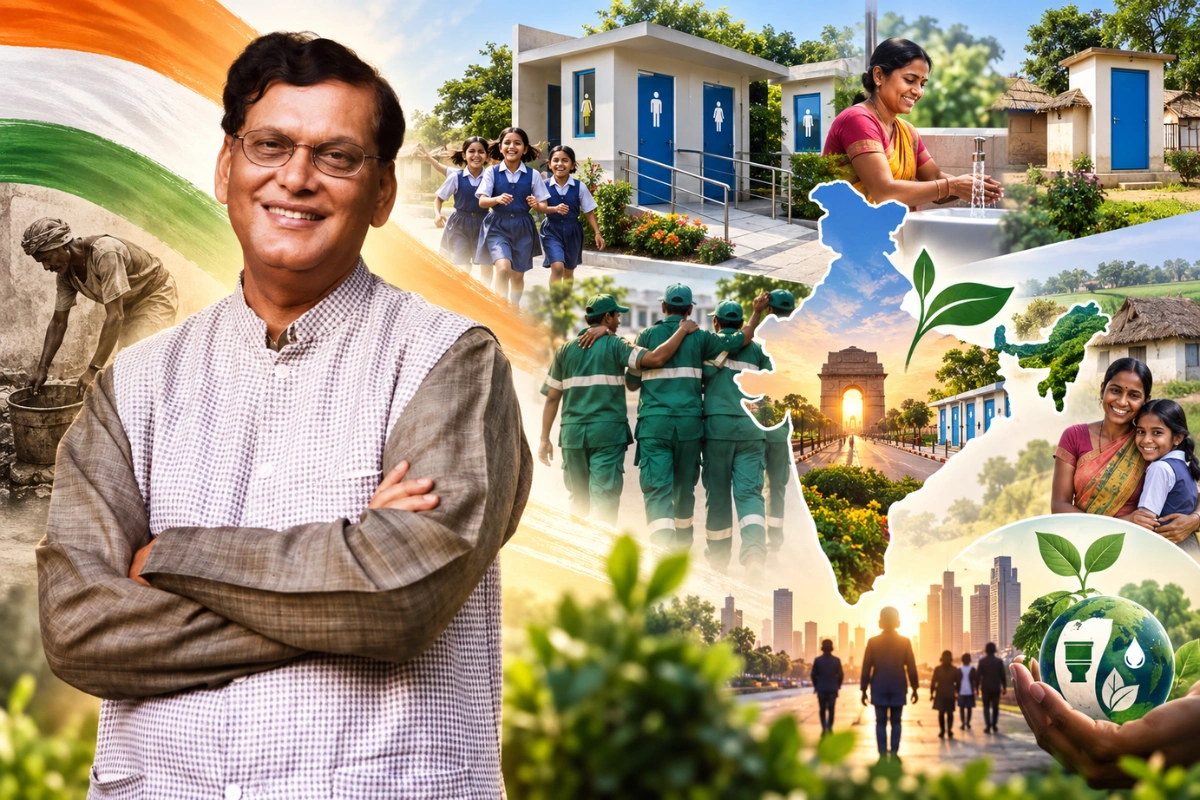
AI Generated Image
Dr Bindeshwar Pathak is remembered as the ‘Toilet Man of India’ because he turned sanitation from a hidden social problem into a public movement for dignity, health, and equality.
As the founder of Sulabh International, Dr Bindeshwar Pathak connected clean toilets with human rights, especially for people forced into manual scavenging. His life story matters not only as a biography, but also as a practical lesson in how one social entrepreneur can change everyday habits and public systems at the same time.
Who Was Bindeshwar Pathak?
Bindeshwar Pathak was an Indian social reformer, sociologist, and founder of Sulabh International Social Service Organisation, a movement closely associated with low-cost toilets, public sanitation, and the rehabilitation of manual scavengers. He was born in Rampur Baghel village in Vaishali district, Bihar, and later studied sociology at BN College in Patna, a background that helped shape his lifelong interest in caste, dignity, and social behaviour.
Unlike many reformers who focused only on awareness, Dr Bindeshwar Pathak built a model that brought together technology, public service, and social change. He understood that a sanitation problem is never only about infrastructure. It is also about stigma, access, gender, caste, economics, and whether ordinary people feel a system is usable in daily life.
A Village Childhood Shaped His View of Dignity
Pathak’s early life in Bihar exposed him to the contradictions of Indian society: strong family values on one side and deep caste-based exclusion on the other.
Sulabh’s official biography notes that his mother, Yogmaya Devi, strongly influenced him with a spirit of service, while his father, Ramakant Pathak, valued education as a path forward.
That upbringing gave him a moral foundation, but his later work gave it direction. He saw how people who cleaned dry latrines were treated as ‘untouchable’, not because of any lack of humanity or ability, but because society had attached impurity to their occupation. This realisation became central to his mission: if the occupation could be eliminated through better toilet technology, a major source of humiliation could also be challenged.
Dr Bindeshwar Pathak’s study of sociology mattered here.
Rural sanitation was not simply a matter of building latrines in villages. It required understanding habits, beliefs, affordability, water use, maintenance, and the social distance between those who used toilets and those who were forced to clean them.
The Turning Point Came Through Gandhi-Inspired Work
In 1968, Pathak joined the Bihar Gandhi Centenary Celebration Committee, where he encountered the discrimination faced by communities associated with manual scavenging.
Sulabh’s timeline describes this period as a turning point that led him towards low-cost sanitation technology and the larger goal of freeing people from cleaning dry latrines by hand.
This Gandhi-inspired setting gave his work a clear ethical frame. Cleanliness, for him, was not cosmetic.
A clean India had to mean cleaner homes, safer public spaces, and social respect for people historically pushed into degrading labour. His approach was practical rather than abstract.
If dry latrines created the demand for manual scavenging, then a new toilet model had to remove that demand. If poor households could not afford expensive systems, the model had to be low-cost. Additionally, if public toilets failed because no one maintained them, the system had to include management and accountability.
Why Was He Called the Toilet Man of India?
Dr Bindeshwar Pathak was called the Toilet Man of India because he helped popularise affordable toilet technology and public toilet systems that addressed both sanitation and social exclusion.
In 1970, Dr Bindeshwar Pathak founded Sulabh International with the objective of converting dry household latrines into two-pit pour-flush toilets, and in 1973, the Sulabh toilet journey gained public demonstration support in Arrah municipality, Bihar.
The phrase may sound simple, but it points to a radical idea: toilets can be instruments of social reform.
A toilet inside or near a home can reduce exposure, improve privacy, and protect dignity.
A hygienic public toilet can make markets, bus stands, pilgrimage centres, and city neighbourhoods more usable for everyone. A toilet that does not require manual cleaning can weaken a centuries-old chain of caste-based humiliation.
Pathak’s work also made sanitation visible. In many places, toilets had been treated as a private embarrassment or a municipal afterthought. He helped bring them into public discussion, policy conversations, and civic planning.
His Major Contributions to Sanitation and Society
Dr Bindeshwar Pathak’s contributions are best understood as a chain of connected reforms. Each idea supported the next, which is why his work lasted beyond a single campaign.
Key contributions include:
- Low-cost toilet innovation: The Sulabh model focused on affordable, practical sanitation that could be adapted for households and communities.
- Two-pit pour-flush technology: This design reduced dependence on manual cleaning and made toilet use more manageable in settings with limited resources.
- Pay-and-use public toilets: Pathak introduced a model in which public toilets could be maintained through small user fees, helping solve the common problem of neglected facilities.
- Rehabilitation of manual scavengers: His work connected sanitation infrastructure with skill development, alternative livelihoods, and social dignity.
- Public awareness: He helped make sanitation a subject of national conversation long before cleanliness campaigns became mainstream.
- Support for Swachhata efforts: Indian public figures later recognised his support for the broader Swachh Bharat Mission and the dream of making India cleaner.
This combination is what made him a social entrepreneur rather than only an inventor. He did not stop at designing a toilet. He built an institution, a funding model, a service network, and a reform message around it.
Rural Sanitation Became a Social Reform Issue
In rural India, sanitation challenges are often tied to water availability, income, land, custom, and awareness.
Pathak’s insight was that a successful rural sanitation movement could not simply drop a technology into a village and leave. It had to consider whether families trusted the design, whether it could be maintained, and whether it reduced the burden on marginalised workers. His model also helped reframe sanitation as a matter of dignity for women.
Access to toilets affects privacy, safety, menstrual hygiene, and participation in school or work. While Pathak’s most recognised contribution was linked to toilets and manual scavenging, the broader impact touched family life and community health.
The idea of a clean India, in his vision, was therefore not limited to streets and drains. It included the right of every person to use a safe toilet and the right of every sanitation worker to live without social degradation.
The Sulabh Model Blended Service With Sustainability
One reason Sulabh became widely known is that it treated maintenance as part of the solution.
Many public toilets fail not because they are built badly, but because no one takes responsibility for cleaning, supplies, repairs, and user behaviour.
The pay-and-use concept gave public facilities a way to remain functional instead of becoming abandoned structures.
This was an important lesson in social entrepreneurship. Pathak understood that compassion needs a working system.
A good idea must survive budgets, daily use, staff needs, local politics, and public habits.
For readers interested in development work, his model offers a useful checklist:
- Start with a real pain point. Pathak focused on dry latrines and manual scavenging because they created visible harm.
- Design for the user’s reality. The technology had to be affordable and suitable for local conditions.
- Build dignity into the solution. The goal was not just cleanliness, but liberation from degrading labour.
- Create a maintenance model. Public service must include long-term upkeep.
- Turn reform into behaviour change. Toilets work only when people accept, use, and maintain them.
Recognition and Bindeshwar Pathak News After His Passing
Bindeshwar Pathak passed away on August 15, 2023, after suffering a cardiac arrest in Delhi; reports noted that he was 80.
Public tributes described his death as a major loss for India’s sanitation and social reform movement.
Since then, Bindeshwar Pathak news has often focused on his legacy rather than new personal activity.
In 2024, the Government of India listed Shri Bindeshwar Pathak for the Padma Vibhushan posthumously in the field of Social Work, and Sulabh later marked his 82nd birth anniversary in 2025 with the inauguration of the Dr Bindeshwar Pathak Memorial Centre at Sulabh Gram, New Delhi.
These recognitions matter because they show how sanitation has moved from the margins to the centre of national respect.
A person once working on a subject many avoided became one of India’s most recognisable names in public health and social dignity.
What Can Today’s Changemakers Learn From Dr Bindeshwar Pathak?
Today’s changemakers can learn that durable reform needs empathy, technology, financing, and behaviour change working together.
Dr Bindeshwar Pathak succeeded because he treated sanitation as a human issue first, then built practical systems around that human need. His life also shows the power of choosing an uncomfortable problem.
Toilets, caste stigma, and manual scavenging were not glamorous subjects. Yet by working precisely where society looked away, he created one of India’s most memorable social reform movements.
The practical lesson is clear: social impact becomes stronger when it solves a daily problem in a way people can actually use.
Whether the issue is water, waste, housing, education, or healthcare, Pathak’s example encourages reformers to ask:
- Who is suffering silently,
- What system keeps that suffering in place? and
- What simple design could begin to break it?
A Legacy Built on Dignity, Not Just Toilets
Bindeshwar Pathak’s story is ultimately about dignity. Toilets were the tool, but human freedom was the larger purpose.
By linking rural sanitation, public hygiene, and the fight against manual scavenging, he changed how India discussed cleanliness and social justice. His legacy continues because the problem he addressed was both ordinary and profound. Everyone needs sanitation, but not everyone has equal access to it.
Dr Bindeshwar Pathak reminded India that a cleaner society goes beyond swept streets and built toilets. It also depends on whether the most marginalised people can live with respect.
Also Read: SCO Must Unite To Dismantle Terrorism Ecosystem, Says PM Modi
To read more such news, download Bharat Express news apps