




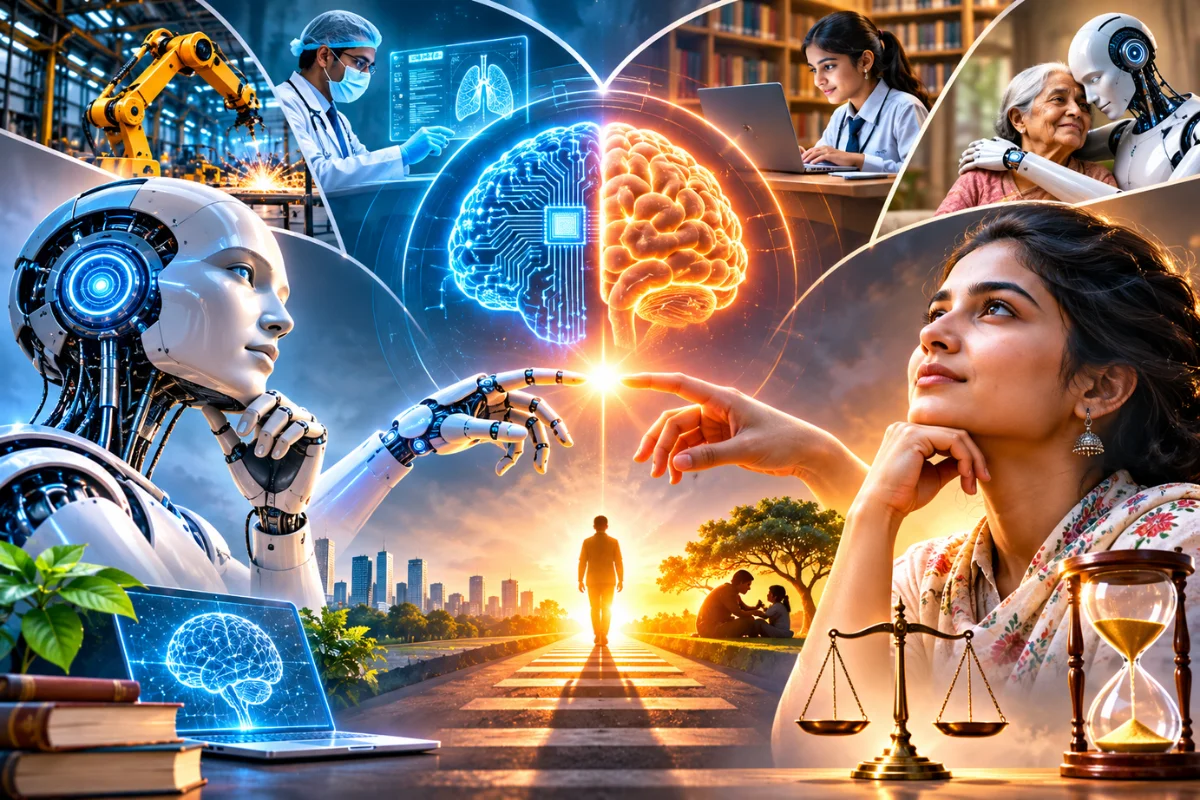
AI Generated Image
Artificial Intelligence and Human Consciousness: Will Technology Displace Human Sensibility?
Artificial intelligence and human consciousness raise two different questions: whether machines can have subjective experiences, and whether we should let them replace human judgement and care. Neither fluent conversation nor impressive performance settles the first question. The second demands practical choices about responsibility, relationships and what we value beyond efficiency. Understanding that distinction helps us use AI without treating human sensibility as an outdated feature.
What Separates Artificial Intelligence From Human Consciousness?
Artificial intelligence concerns capabilities such as recognising patterns, generating language and solving problems. Consciousness, in this discussion, means subjective experience: there being something it feels like to see a colour, feel pain or hear music. A system’s ability to describe an experience is not, by itself, evidence that the system has that experience. This distinction is central to evaluating claims about conscious machines.
Three concepts help keep the discussion clear:
- Intelligence: The capacity to perform cognitive tasks, learn or solve problems. It concerns what a system can do.
- Consciousness: Subjective awareness or experience. It concerns whether anything is experienced from the system’s perspective.
- Human sensibility: Here, the combination of emotional responsiveness, contextual judgement and concern for others that we want to preserve in human affairs.
These are useful distinctions, not interchangeable labels. Researchers studying AI consciousness therefore examine proposed mechanisms and indicators rather than assuming that stronger task performance establishes an inner life. Even those indicators remain dependent on theories that are open to challenge.
For everyday decisions, separate two evaluations: whether a tool performs reliably and whether there is credible evidence of subjective experience. Neither answer should be inferred automatically from the other. A useful tool need not be treated as a person.
Neural Networks Are Not Miniature Human Minds
Neural networks learn patterns by adjusting numerical parameters during training. Their interconnected processing units take inspiration from biological neurons, but the name does not mean they reproduce the human brain. They are computational models that transform inputs into outputs through learned relationships.
For example, a network trained to identify unwanted email can learn combinations of features associated with spam. Recognising those patterns demonstrates a capability; it does not establish an experience of annoyance or an understanding of why an interrupted person feels frustrated. The training process explains how predictions improve, not whether the system feels anything.
Human cognition provides inspiration for AI research, but resemblance at one level does not settle equivalence at another. Researchers disagree over whether consciousness depends on the right computational organisation, biological processes or other physical properties. These disagreements matter because different accounts imply different possibilities for conscious technology.
The sensible position is neither to dismiss artificial minds as impossible nor to assume that sufficient complexity guarantees them. Ask which properties a claim relies on, why those properties should matter and what evidence could challenge the conclusion.
Could AI Consciousness Become a Scientific Reality?
AI consciousness remains an open scientific and philosophical question, not a conclusion established by convincing dialogue. Some theories allow consciousness in non-biological systems; others place greater importance on living processes. Evaluating the possibility therefore requires both better theories and detailed examination of particular systems.
A research approach developed by Patrick Butlin and colleagues derives potential indicators from theories of consciousness. These include properties associated with recurrent processing, information sharing between specialised components and higher-order representations. The purpose is to assess evidence systematically rather than judge consciousness from a machine’s conversational style.
Importantly, indicators are not a definitive checklist. The researchers explain that individual indicators are not necessarily required for consciousness, and possessing a combination does not establish it with certainty. Their usefulness depends partly on whether the underlying theories are correct.
When encountering a claim about machine consciousness, look for:
- A clear definition: Does ‘conscious’ mean subjective experience, self-monitoring or simply sophisticated behaviour?
- System-specific evidence: Does the claim examine internal mechanisms rather than quote an emotional response?
- Alternative explanations: Could training or prompting explain the behaviour?
- Stated uncertainty: Does the assessment acknowledge competing theories and missing evidence?
Fluent Empathy Is Not Proof of Feeling
An AI response can sound considerate without establishing that its source feels concern. Murray Shanahan’s research on language models warns that humanlike language encourages anthropomorphism: attributing human characteristics to systems whose workings differ from ours. Everyday words such as ‘thinks’ and ‘believes’ can quietly introduce assumptions that the evidence does not justify.
That does not mean a supportive response has no value. Consider someone using a chatbot to draft a difficult apology. A useful outcome might be clearer wording that helps them begin a real conversation. But the person still needs to decide whether the apology is sincere, acknowledge what happened and accept the other person’s response.
Compare two standards: producing appropriate words and participating in a relationship with obligations. For responsible use, we should not treat those standards as equivalent. The relevant question is not only whether the message sounds caring, but whether someone will take responsibility for what follows.
Use AI-generated empathy as material to evaluate, not a reason to stop evaluating. Read the suggested message aloud. Remove promises you cannot keep, and replace generic reassurance with something you genuinely mean.
Will Technology Displace Human Sensibility?
Technology need not displace human sensibility, but we should not assume that preserving it happens automatically. The practical choice is whether to use automation to support judgement or to avoid exercising judgement. NIST’s AI Risk Management Framework emphasises that human roles, oversight and decision-making responsibilities need to be defined for the context in which a system operates.
Imagine a customer service team using AI to prepare replies. A responsible process would let staff examine the customer’s circumstances, revise unsuitable suggestions and offer a route to someone empowered to resolve the problem. A less defensible process would make the generated reply effectively final while calling a superficial approval step ‘human oversight’.
Relationships deserve similar attention. A four-week MIT Media Lab study found that participants who voluntarily used a chatbot more showed worse psychosocial outcomes, while the assigned experimental conditions produced no significant effects. The association does not establish that heavier use caused those outcomes. It does support caution about assuming that more interaction necessarily means greater well-being.
The goal should be meaningful assistance, not maximum dependence or minimum human contact.
Putting AI Ethics Into Everyday Practice
AI ethics should address observable effects as well as hypothetical conscious machines. NIST notes that mathematical representations of human situations can lose necessary context, and that human-AI interaction can sometimes amplify bias rather than correct it. Keeping a person involved is therefore not enough; the process must help that person identify problems and act on them.
For personal use or organisational adoption, consider these safeguards:
- Set a purpose before opening the tool: Decide whether you need brainstorming, drafting, comparison or another bounded task. Define what a satisfactory result would look like.
- Keep ownership of consequential choices: Name who checks the output and who answers for the final decision. Give reviewers enough time, information and authority to disagree.
- Check claims independently: Treat a polished answer as a starting point, not supporting evidence. Inspect relevant original material before relying on important factual statements.
- Practise before delegating: Attempt a paragraph, interpretation or solution yourself, then compare it with the tool’s response. Use the differences to sharpen your reasoning rather than merely replace your work.
- Protect room for human contact: When a task involves conflict, grief or trust, ask whether automated help prepares you for a conversation or becomes a way to postpone it.
- Evaluate what efficiency leaves out: Alongside speed, review whether people can question an outcome, explain unusual circumstances and reach someone able to make changes.
For teams, turn these principles into a review of actual cases. Examine a useful output, an error and a case where someone overruled the system. Ask what made correction possible and whether the same safeguards would work for a less confident user.
Keep the consciousness question separate but open. Researchers proposing principles for responsible consciousness research argue for policies covering investigation, deployment and public communication. Uncertainty warrants careful inquiry, not unsupported marketing claims or blanket dismissal.
Human Responsibility Remains the Priority
The most useful response to artificial intelligence and human consciousness is disciplined curiosity. Demand evidence for claims about machine experience, and make deliberate choices about the responsibilities you delegate. Do not confuse a compelling interaction with permission to abandon judgement.
Human sensibility need not compete with machines on speed. Preserve it through attention, honest communication and accountability. Use technology to help people understand and respond to one another—not to make those obligations disappear.
Also Read: Freebie Culture’s Impact On Nation Building: Balancing Growth And Welfare
To read more such news, download Bharat Express news apps