




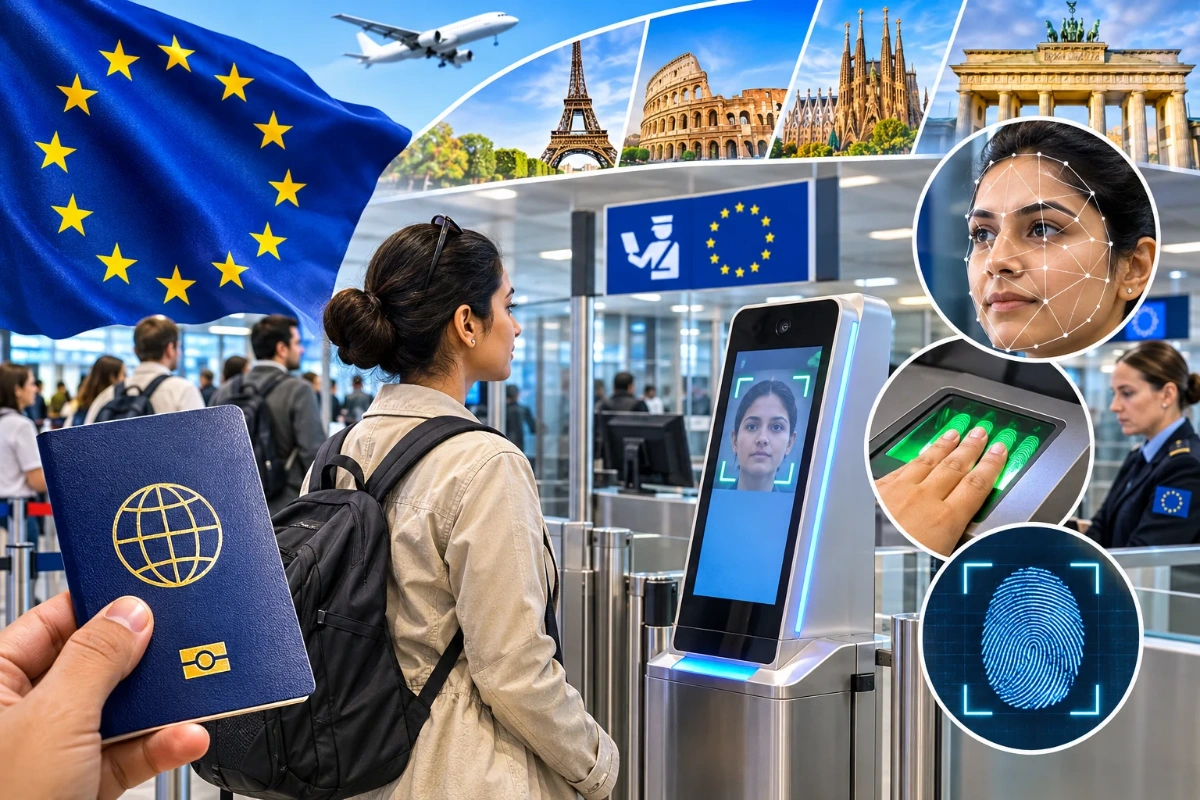
AI Generated Image
Europe’s New Border Checks: What Happens to Your Passport, Fingerprints and Photo?
Europe’s new border checks use the EU Entry/Exit System (EES) to create digital records for most non-EU visitors entering and leaving the Schengen Area for short stays. Your passport remains essential, but electronic entry and exit records replace routine passport stamping, while facial images and fingerprints help verify identity. According to the European Commission, EES became fully operational on 10 April 2026, following its phased launch on 12 October 2025.
Who Faces Europe’s New Border Checks?
The EES generally covers non-EU nationals crossing an external Schengen border for a short stay, whether they require a visa or travel visa-free. This includes many British, American and Indian visitors travelling for holidays, family visits or business.
Short stays are generally limited to 90 days within any 180-day period, calculated across participating countries rather than separately for each destination.
The system operates in 29 European countries, including France, Spain, Italy, Germany, Switzerland, Norway and Iceland. Ireland and Cyprus do not use EES. Therefore, European border control does not follow one uniform procedure: the relevant distinction is whether you are crossing the external border of a country participating in the system.
Important exemptions include EU citizens and nationals of Schengen-associated countries, along with holders of qualifying residence permits or long-stay visas issued by participating countries. Certain non-EU family members with qualifying residence documentation are also exempt.
A UK residence permit alone does not provide an exemption from Schengen registration. Travellers should present any relevant qualifying documents alongside their passports.
What Happens at Your First Registration Crossing?
A first registration crossing is your first external-border crossing at which your details are registered in EES. It is not necessarily your first-ever European holiday. Someone who visited before the system began may still need an initial registration.
The process creates a digital file linking travel-document details with the required biometric information.
For an eligible short-stay traveller arriving from outside the Schengen Area, the process generally follows these stages:
- Present Your Passport: Border staff or a self-service device read your travel-document details and check whether an EES file already exists.
- Provide the Required Biometrics: A facial photograph is taken, with fingerprints collected or verified as appropriate to your visa status and circumstances.
- Complete the Normal Entry Checks: An officer may ask about your destination, accommodation, available funds and return plans, and examine your visa where required.
- Receive an Entry Decision: If admitted, your entry date and border-crossing location are recorded digitally. Completing biometric registration does not itself guarantee admission.
Some crossing points offer kiosks or an official mobile application through which travellers can submit information before the officer’s checks. Availability depends on the country and location. First-time registration still involves meeting a passport control officer. Follow local instructions rather than assuming every airport uses an identical process.
Your Passport, Fingerprints and Photograph Have Different Roles
Your passport remains your travel document; EES is an electronic record associated with it. The system stores travel-document information, entry and exit dates and locations, biometric information and any refusal of entry. Routine passport stamps are replaced by digital records for travellers covered by the system.
The phrase EES fingerprints can be misleading if it suggests that everyone provides an entirely new set of fingerprints. For short-stay visa holders, fingerprints are already stored in the Visa Information System (VIS) and are not stored again in EES. Border officers can still use biometric checks to establish that the person presenting the passport is its rightful holder.
Children under 12 are exempt from fingerprint scanning, although they can still be registered and photographed. If a disability or physical condition affects fingerprint collection, inform border staff rather than attempting to bypass registration.
Refusing required biometric collection is different from being physically unable to provide it. Refusal can result in denied entry.
Return Crossings and Departure Checks
A return crossing is a later external-border crossing when an EES file already exists. Instead of repeating the entire initial registration, border authorities normally retrieve the record and verify the traveller’s identity using their facial image and/or fingerprints. This can make processing quicker, although officers may need to collect information again or conduct additional checks.
The shared record is not confined to the country of original arrival. For example, an eligible traveller can enter through France and leave through Italy, with both external-border events registered in EES. Moving between Schengen countries does not restart the short-stay allowance.
On departure from the Schengen Area, present your passport again and follow the biometric-verification instructions. The exit is recorded electronically, allowing authorities to check the duration of your stay against your entry history. Allow sufficient time for departure formalities rather than treating the departure gate as the only deadline.
Schengen border checks at external borders should not be confused with temporary controls between member countries. Internal checks can be reintroduced under separate rules, but travelling from one Schengen country to another does not count as a new external entry or exit.
How Is EES Different From a Visa?
EES records border crossings; a visa is a separate permission required before travel for certain nationalities. Registration does not replace a visa, extend its validity or increase its permitted number of entries. Anyone who needs a Schengen visa must still obtain one, even though their border crossing will also be recorded in EES.
| System | Main Purpose | What the Traveller Does |
|---|---|---|
| EES | Records covered travellers’ external-border entries, exits and biometric identity data. | Registers at the border and completes checks on later crossings. |
| Short-stay Schengen visa | Provides the visa permission required by certain nationalities. | Applies before travel and observes the visa’s conditions. |
| ETIAS | A separate travel-authorisation system for eligible visa-exempt travellers. | Follows its own application requirements, distinct from EES. |
These systems serve different functions. None removes the need to satisfy the applicable entry conditions. EES registration should not be treated as advance travel approval.
What UK and Indian Travellers Should Expect
For UK travellers, EU membership and Schengen participation are different concepts. British passport holders making ordinary short visits to Schengen countries generally fall within EES, unless an exemption applies.
On certain journeys through Dover, Eurotunnel or Eurostar, French border checks take place before departure from the UK. Biometric processing may therefore happen before boarding.
For Indian travellers, Europe has not become visa-free because border processing is digital. Ordinary Indian passport holders generally still need a short-stay Schengen visa. Their visa application and EES border record are separate processes, even where identity checks draw on fingerprints already held in VIS.
In both cases, check requirements against your nationality, destination and immigration status rather than simply the country where you live or begin your journey.
Where Your Biometric Data Goes
Europe’s biometric border checks create records accessible to authorised authorities, not a public travel profile. Border, visa and immigration authorities can use the information to carry out their duties. Law-enforcement authorities and Europol have access under specified conditions.
Standard entry and exit records are generally retained for three years after exit. Individual files generally remain for three years and one day after the last exit or refusal where no new entry occurs. Records without an exit after the authorised stay expires can remain for five years. Special retention rules apply to some travellers.
Travellers can request access to their data and seek corrections to inaccurate information through the responsible authority.
Prepare for the Crossing, Not Just the Flight
Treat these changes in European border policy as an additional preparation task, not a reason to abandon a trip. Before departure:
- Keep Documents Accessible: Carry your passport, visa if required, and any qualifying residence documentation.
- Check Your Operator’s Instructions: Pay particular attention to journeys involving border processing before boarding.
- Review Your Stay Allowance: Include previous Schengen visits, not just the current itinerary.
- Allow Time at Both Ends: Initial registration and departure checks are separate parts of the journey.
The key takeaway is that border checks in Europe are becoming digital, but your passport and existing entry obligations remain essential. Check official destination advice for travel restrictions, follow border staff instructions and keep your documents ready. EES changes how crossings are recorded, not whether travellers must meet the rules.
Also Read: Spain’s Housing Crisis Sparks 2026 Snap Election
To read more such news, download Bharat Express news apps