



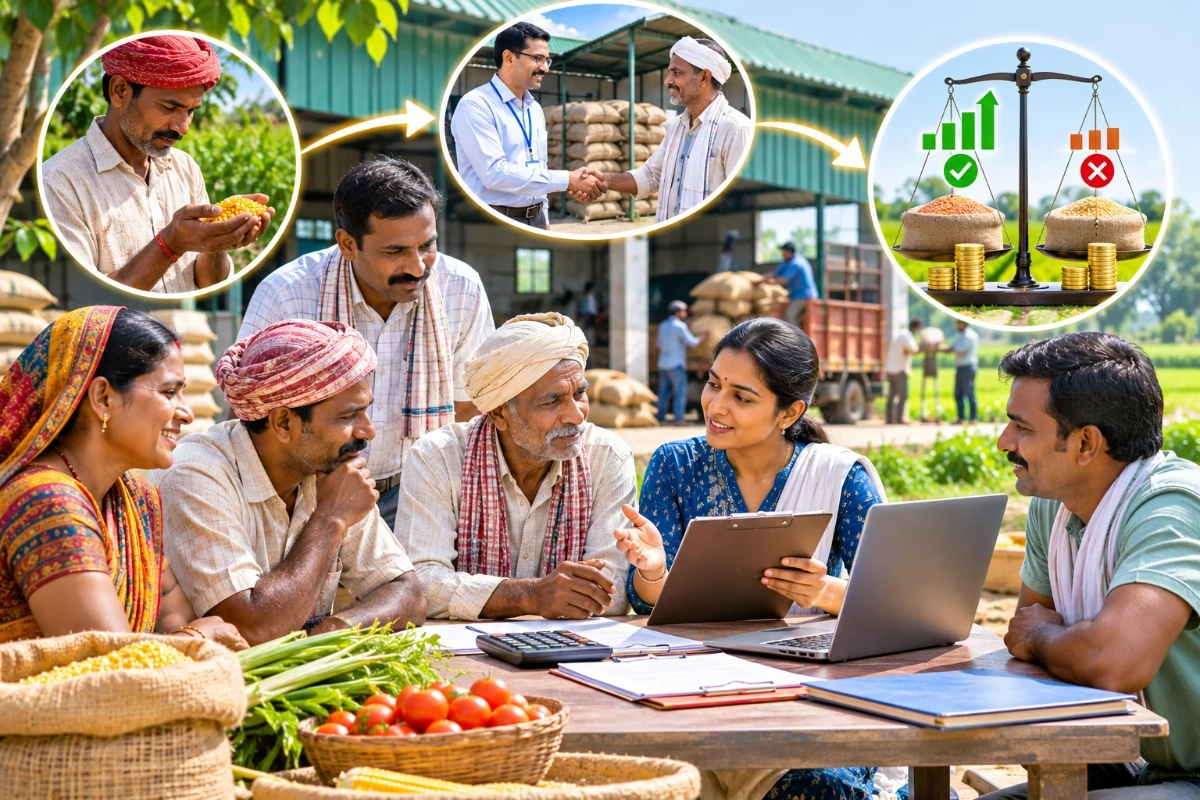
AI Generated Image
When Farmers Sell Together, Who Sets the Price?
Selling together does not allow farmers to name any price they want. A farmer producer organisation (FPO) can strengthen their negotiating position by pooling produce, reducing transaction costs and improving access to buyers, but the final deal still depends on market conditions and agreed terms. The useful test is not the headline selling price: it is what members receive after selling costs and deductions.
Who Sets the Price When Farmers Sell Together?
The price emerges from negotiations between the collective and its buyer, informed by demand, supply, quality and alternative market offers. The FPO represents farmers in those negotiations; it does not control the wider market. Wholesale prices can provide a reference, while a supply agreement may specify a fixed price or an agreed pricing formula.
It helps to distinguish three decisions:
- The buyer’s offer: What a trader, processor or retailer will pay for the specified produce and delivery terms.
- The collective’s acceptance decision: Whether that offer is preferable to available alternatives after accounting for the costs of fulfilling it.
- The member settlement: What each farmer receives after applicable charges, quality adjustments and other disclosed deductions.
Ask for all three figures when reviewing a sale. A buyer’s purchase price and a member’s payment should never be treated as interchangeable without checking the intervening costs.
An FPO is a producer organisation whose members are farmers. Its ownership rests with its members, while management operates through their representatives. Collective ownership therefore creates a route for farmers to influence commercial decisions rather than leaving every household to negotiate separately.
Collective Selling Changes the Negotiating Position
A buyer collecting small quantities from scattered farms faces coordination and transport costs. Aggregation can make a larger transaction practical while giving producers greater negotiating power over prices and payment terms. That is the economic opportunity behind collective marketing: farmers can offer a commercially useful supply rather than merely request a better rate.
Volume alone is not the whole offer. Cleaning, drying, grading, storage and quality control are among the activities producer organisations can undertake, alongside marketing to institutional buyers. These services help connect what farmers harvest with what a particular buyer requires. They also need to be organised and paid for.
Across agricultural value chains, a direct buyer relationship can bring stricter commitments on quantity, quality and delivery schedules. Before promising access to a premium market, the collective should establish who will perform those tasks, what they will cost and whether members can meet the requirements consistently. A sales opportunity is useful only if the organisation can fulfil it without absorbing unexpected losses.
An FPO Sale Compared With an Independent Sale
A 2022 study in Karnataka’s Davangere district compared maize marketing through an FPO with non-member sales through village traders. The figures below use its reported channel averages to compare a one-quintal sale, not two individually matched transactions. These are historical study figures, not current quotations.
| Sale Calculation, Per Quintal | Through the FPO | Outside the FPO: Village Trader |
|---|---|---|
| Reported producer price | Rs 1,423.00 | Rs 1,390.00 |
| Farmer’s marketing costs | Rs 35.33 | Rs 42.60 |
| Calculated net sale receipt | Rs 1,387.67 | Rs 1,347.40 |
Net receipts are calculated here as the reported producer price minus the farmer’s marketing costs. On that basis, the FPO route leaves Rs 40.27 more per quintal: Rs 33 from the higher price and Rs 7.27 from lower selling costs. These receipts are before cultivation costs, so they are not farm profit.
The comparison demonstrates why both sides of the calculation matter. It does not establish that membership alone caused the difference or that every FPO sale will outperform independent selling. For a decision today, request comparable local offers and record all farmer-borne costs.
How Should Farmers Compare Competing Offers?
Compare the amount the farmer will actually receive for an equivalent quantity and quality, under clearly stated payment and delivery terms. A market quotation is a starting point, not a complete comparison. Reliable market information includes varieties, quality, packaging, quantities, destinations and price trends—not simply the highest reported rate.
For practical market value analysis, put each offer on the same worksheet:
- Match the produce. Record the crop, variety, grade and any moisture or quality requirements. Do not compare a premium-grade quotation with an offer covering an unsorted harvest.
- Match the delivery point. Identify whether collection happens at the farm, an aggregation centre or the buyer’s premises. Assign each transport and handling charge to the party paying it.
- List deductions separately. Request an explanation of weighing, bagging, testing, commission and service charges. Avoid a single unexplained deduction labelled ‘expenses’.
- Record payment terms. Write down the advance, balance-payment date and conditions for settlement. If waiting requires borrowing, include the actual financing cost in your decision.
- Calculate the expected net receipt. Deduct farmer-borne selling costs from expected proceeds. Keep uncertain bonuses separate from payments already committed.
Use this as a decision worksheet, not an assumption that every sale carries every charge. Ask for written confirmation wherever an item could change the outcome.
Discussions of farmers’ market pricing can become misleading when they mix retail prices, wholesale quotations and farm-gate prices. Each refers to a different transaction point. Always ask which services and costs sit between the quoted price and the farmer’s payment.
Transparent Settlements Keep Ownership Meaningful
NABARD describes producer organisations as having an elected board that can engage professionals to manage their affairs. It also stresses responsible, transparent governance that puts members’ interests first. For farmers, that principle should translate into access to understandable sale and settlement information—not simply reassurance that management obtained a good deal.
Before supplying produce, request a settlement format showing:
- Quantity delivered, quantity accepted and the recorded grade.
- The applicable member price and how it was determined.
- Each charge deducted, with its basis of calculation.
- The amount paid immediately and any outstanding balance.
- The process for questioning a weight, grade or payment discrepancy.
Also ask management to explain whether the organisation is buying the crop from members or arranging a sale on their behalf. Request clarity on who bears rejection, storage and buyer-payment risks. Treat any promised later distribution separately from the immediate crop payment until its amount and conditions are confirmed.
A retained surplus is not automatically evidence that farmers have lost out: producer organisations may retain part of their surplus for business expansion. Nevertheless, members should be able to distinguish their own receipts from money held by the organisation. Membership and management accountability belong together.
A Larger Collective Still Needs Alternatives
Collective action can reduce some external transaction costs while creating internal costs for coordination, information sharing, monitoring and decision-making. FAO notes that excessive internal costs can undermine collective marketing and make other intermediaries more efficient. An FPO should therefore be assessed as a functioning business, not assumed to be the cheapest route simply because farmers own it.
Payment timing deserves equal attention. FAO’s work on agribusiness linkages documents how delayed payments and other commercial costs can weaken producer organisations’ competitiveness against traders offering cash. A higher promised rate should therefore be evaluated alongside the reliability and timing of settlement.
Before each major marketing season, ask the organisation to review its buyer options and compare completed settlements with realistic outside alternatives. Include unsuccessful transactions in that review, not just the best sale. Check whether smaller suppliers receive the same clarity on grading and deductions as larger suppliers. These are practical accountability checks, rather than a demand that every transaction achieve the season’s highest price.
Judge the Outcome at the Farmer’s Account
The debate about farmer income in India needs a sharper measure than collective turnover. When assessing an FPO in India, start with comparable net receipts, then examine service quality, payment reliability and the costs members bear. Aggregation and value addition are intended to improve members’ income realisation; organisational growth should serve that purpose.
Before the next sale, request one clear comparison: the expected member settlement through the collective alongside a credible independent offer. Keep the grade, quantity and delivery terms comparable. That turns ‘Who sets the price?’ into the more useful question: ‘Which arrangement leaves the farmer better off?’
Also Read: First Year Home Ownership Guide: Tips & Budgeting
To read more such news, download Bharat Express news apps