



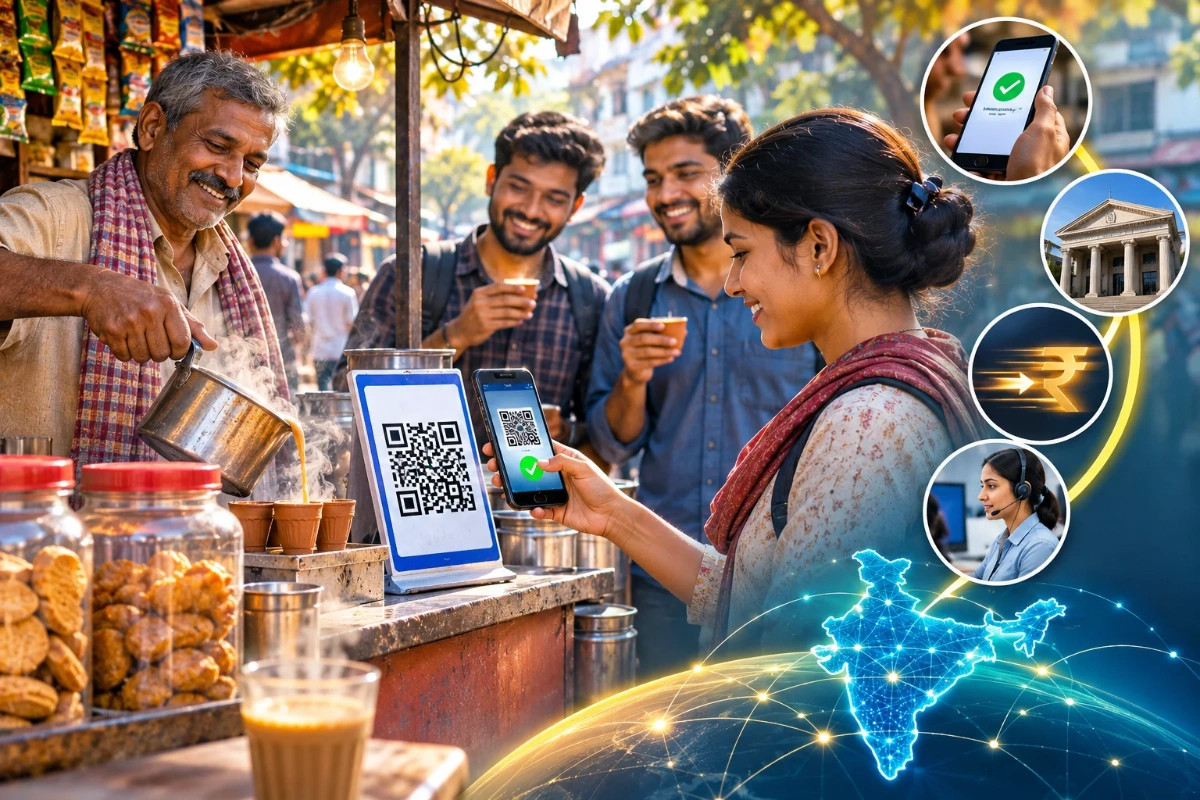
AI Generated Image
What a Tea Stall’s QR Code Can Teach the World About Digital Payments
A tea stall’s QR code illustrates what makes digital payments useful: customers can pay through different apps while the seller receives money through a shared system. India’s Unified Payments Interface (UPI) makes this interoperability possible. Its wider lesson is that adoption depends not just on technology, but also on reliable access, clear confirmation and trust when something goes wrong.
How Does a Tea Stall’s QR Code Payment Work?
A customer scans the stall’s UPI QR code using a compatible app, checks the recipient and amount, and authorises the payment. The app provides the interface, while UPI connects participating payment providers and banks. Customers and merchants do not need to use the same app, making one QR code useful across competing services.
Imagine three customers ordering tea. This is an illustrative transaction flow, not a reported merchant interview:
- Choose an app: One customer opens Google Pay, another uses PhonePe, and a third chooses BHIM Axis Pay. Each offers a way to scan a merchant’s UPI code. These are alternative entry points, not three apps required for a single purchase.
- Scan the displayed code: The customer points the app’s scanner at the stall’s QR code. Interoperability means the branding beside that code does not necessarily determine which UPI app the customer must use.
- Check and authorise: For this standard bank-account payment, the customer confirms the recipient, enters the bill amount when required and approves the transaction using a UPI PIN. The PIN remains private.
- Confirm receipt: The customer checks the payment status, while the seller verifies the incoming transaction through their own account or merchant records. A successful transaction requires both the debit and the corresponding credit.
The Infrastructure Matters More Than the Sticker
The printed square is the visible doorway into a much larger network. UPI is an instant payment system developed by the National Payments Corporation of India (NPCI). Payment apps make that network accessible, while participating banks and providers handle the underlying processing.
Shared Rails, Competing Experiences
This separation is central to digital public infrastructure: shared systems can support different public and private services. Providers can compete on usability and merchant support without requiring every customer and seller to join a single closed platform. The World Bank identifies India’s UPI as an example of this infrastructure approach.
For a small seller, the practical implication is straightforward: accepting payments need not involve persuading customers to download the seller’s preferred app. This reduces one barrier at the counter and gives customers the freedom to choose an interface they understand.
Apps, Wallets and Gateways Have Different Roles
Mobile payments describe a channel, not a single funding method. In the bank-account example above, funds come from a linked account. Digital wallets, by contrast, provide a prepaid balance, with supported wallets also offering UPI QR acceptance. The distinction matters when customers check which balance funded a purchase.
Payment gateways serve another purpose: they provide technology for processing online payments. A gateway is not the same as the UPI network or a wallet. Understanding these different layers helps businesses choose fintech solutions based on their actual needs rather than treating similar-sounding terms as interchangeable.
The Numbers Show Scale, Not Universal Adoption
Official measures support the story of growth, but they track different aspects of digital payments. The RBI’s Digital Payments Index measures payment digitisation; NPCI transaction statistics count activity across payment systems. World Bank Global Findex surveys show how people use financial services. These measures should complement, rather than replace, one another.
| Measure | Dated Finding | What It Tells Us |
|---|---|---|
| RBI Digital Payments Index | A July 2025 government release reported 465.33 for September 2024, against a March 2018 base of 100. | Infrastructure and payment adoption had expanded substantially. |
| NPCI UPI Statistics | The Economic Survey 2025–26 records approximately 185.87 billion UPI transactions in FY2024–25, compared with 131.13 billion a year earlier. | Transaction activity grew, but transactions do not represent unique users. |
| World Bank Global Findex 2025 | In 2024, 42% of adults in low- and middle-income countries made a digital merchant payment, up from 35% in 2021. | Adoption increased but remained far from universal. |
Sources: Ministry of Finance, NPCI data reproduced in the Economic Survey, and World Bank Global Findex. The NPCI figures are separate from the RBI index, rather than statistics attributed to an unverified combined report.
The implication for digital payments in India is important: impressive network volumes do not establish that every customer pays digitally. Global Findex adds the human-use perspective that transaction totals alone cannot provide.
Settlement Through the Merchant’s Eyes
For the tea seller, the essential question is when the proceeds become available to buy milk, tea and fuel. NPCI states that merchant payments are received immediately into the merchant’s pool account or bank account, depending on the agreement. That qualification matters: receipt into a collection arrangement and the availability of funds in the seller’s own account should not be assumed to be identical.
Before adopting a service, a merchant should establish:
- Destination: Does each payment reach the business bank account directly or enter a pooled collection arrangement?
- Availability: If onward settlement is involved, what payout schedule, cut-off times and exceptions does the provider specify?
- Reconciliation: Which reference connects a sale, its payment confirmation and the eventual bank entry?
- Support: Who investigates a missing credit—the acquiring bank, merchant service provider or both?
These checks turn an apparently simple payment acceptance tool into a manageable business process. Avoid assuming that every QR provider follows a universal next-day settlement rule. Read the actual agreement and test the reporting process.
Failed Transactions Are a Test of Trust
A pending payment creates an awkward moment: the customer sees a debit, but the seller cannot confirm receipt. NPCI distinguishes pending transactions from completed ones, while the RBI recognises communication failures and time-outs as possible causes of failed payments. At a busy counter, uncertainty itself becomes a cost.
A sensible response is to check both parties’ records, retain the transaction reference and raise an issue through the payment app or bank. Do not treat an uncertain status as proof that another payment is automatically necessary. If both parties agree on a replacement payment, record it so that any subsequent credit can be reconciled.
The RBI’s failed-transaction framework distinguishes UPI transfers where the beneficiary is not credited from merchant payments where confirmation is not received. It specifies reversal limits of T+1 and T+5 days respectively for these scenarios, with T representing the calendar date of the transaction. These are limits for resolving exceptions, not ordinary merchant settlement promises.
Why Do Customers Still Choose Cash?
Customers may continue using cash because it is familiar, works without a functioning payment app and fits the surrounding economy. Global Findex 2025 identifies habit as the most common reason account holders who pay merchants exclusively in cash do not switch to digital merchant payments. Acceptance alone, therefore, does not guarantee use.
From a merchant’s perspective, useful explanations to investigate include:
- Habit: The customer already has cash ready and sees little benefit in changing routines.
- Access: A customer may lack a suitable phone, connectivity or confidence in using an app.
- Trust: Unclear payment statuses and the fear of mistakes can make physical money feel simpler.
- Supplier needs: Digital receipts are less convenient if restocking still requires cash withdrawals.
These are explanations to investigate, not invented quotations from tea sellers. World Bank evidence highlights both cash habits and the friction merchants face when suppliers still require cash. Cashless payments in India should expand choice rather than make essential purchases harder for people facing these barriers.
What the World Should Take From the Counter
The strongest lesson is not simply to print more QR codes. It is to combine interoperable payment acceptance with dependable receipt, understandable records and accessible support. Contactless payments become valuable when the entire transaction works for both parties, not merely when the customer can initiate it.
For payment designers, the tea stall offers a practical standard: preserve app choice, make merchant cash flow clear, explain transaction failures and retain workable alternatives. The goal is not to make cash disappear. It is to make digital payments sufficiently useful and trustworthy that people choose them again.
Also Read: Viksit Bharat: Future-Ready Generations By 2047
To read more such news, download Bharat Express news apps