AI Generated Image
The Eternal Blue Flame: Where Nature Worship Meets Divine Shakti
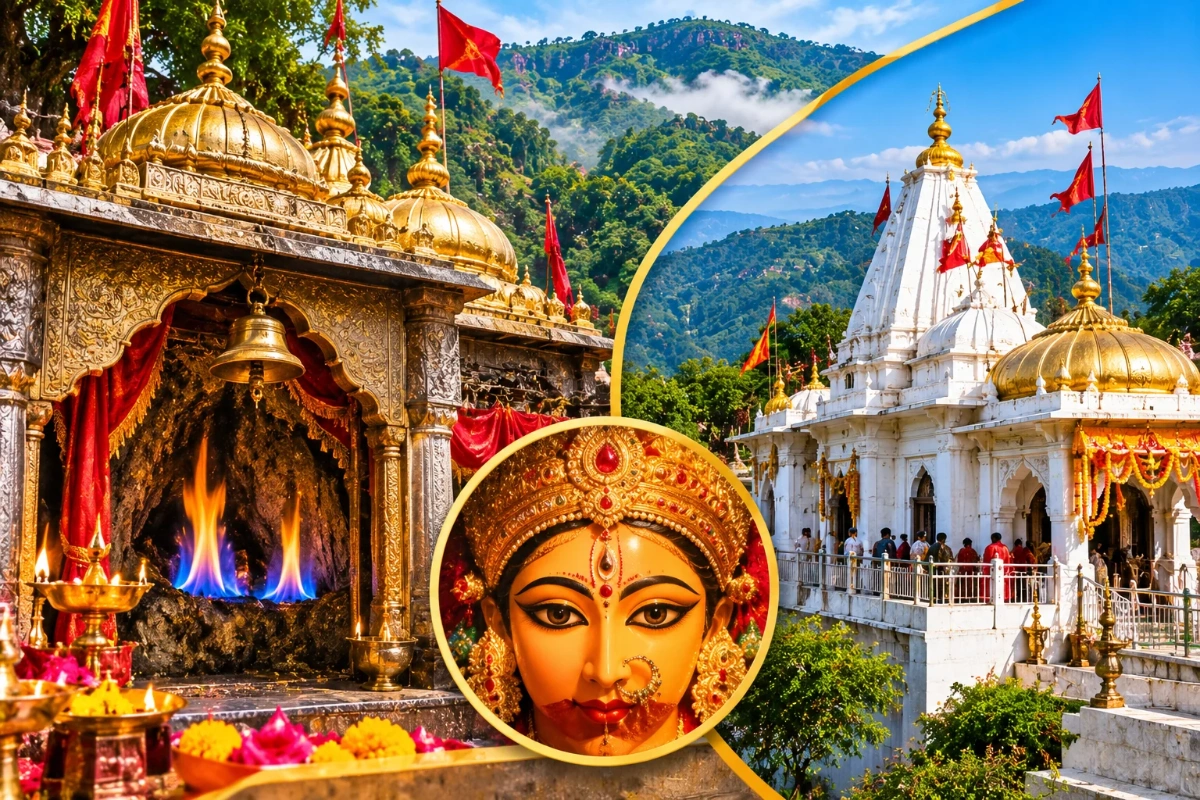
At Jwala Ji Temple in Himachal Pradesh, naturally burning flames are worshipped as the presence of the Goddess, bringing a geological phenomenon into the heart of devotion. Alongside Shree Naina Devi, the shrine offers a compelling way to understand how landscape, legend and sacred power meet in Hindu pilgrimage. Their stories invite a closer look at the eternal blue flame—not simply as a spectacle, but as a focus of faith.
The Eternal Blue Flame: Where Nature Worship Meets Divine Shakti captures Jwala Ji’s central significance: the natural world becomes the place where devotees encounter the divine.
Shree Naina Devi and Jwala Ji (Himachal Pradesh)
Shree Naina Devi stands on a hilltop in Bilaspur district, while Jwala Ji, also known as Jwalamukhi, is situated in Kangra district. Both belong to the sacred geography of Goddess worship, although each expresses that connection differently. At Naina Devi, the founding legend centres on Sati’s eyes; at Jwala Ji, the flame itself is revered as the Goddess’s manifestation.
According to the Shakti Peetha tradition, Goddess Sati died following the insult directed at Shiva during her father Daksha’s sacrifice. Shiva carried her body in grief, and Vishnu intervened by dividing it with his discus. The places where her body parts fell became sacred sites: Naina Devi marks the spot where her eyes fell, while Jwala Ji is traditionally associated with her tongue. These are religious narratives rather than independently verifiable accounts of the temples’ origins.
Read together, the two legends suggest a meaningful pairing: sight and expression, seeing and speaking. This is one interpretive approach to the shrines, not a requirement of worship. It offers visitors a thoughtful connection to carry between them.
Why Is the Eternal Blue Flame Worshipped at Jwala Ji?
The eternal blue flame is worshipped because devotees regard the fire emerging from the rock as the living manifestation of Jwala Devi. The central sacred presence is therefore not dependent on a sculpted idol: the flames themselves receive devotion. Official tourism descriptions likewise identify the ever-burning flame in the sanctum as an embodiment of the Goddess.
Devotional accounts describe Jwala Ji as having been worshipped for millennia without an idol at the centre of its flame worship. That timescale should be understood as traditional belief, not a securely established archaeological chronology. Nor should ‘without an idol’ be taken to mean that every part of the wider temple complex lacks images; the temple administration also describes an installed idol form.
This distinction helps preserve what makes the shrine remarkable without exaggerating it. For the worshipper, fire is not merely an illustration of divine power placed beside the deity. It is the form through which the deity is encountered.
What Keeps the Blue Fire Burning?
Underground natural gas feeds the flames at Jwala Ji, escaping through fissures in the rock and burning at the surface. Both the Kangra district administration and India’s official tourism portal describe this natural gas connection. The fire therefore has a physical fuel source, even when devotional language calls it an eternal flame.
Descriptions sometimes refer to ‘natural copper jets’ emitting blue flames from the rocks. More precisely, accounts describe naturally escaping gas and, in certain locations, copper pipes or outlets through which the gas is presented during worship. Copper fittings should not be confused with naturally occurring rock fissures, and the metal itself is not the underground fuel.
A useful way to approach the subject is to keep three layers distinct:
- Physical source: Gas emerges from below ground and sustains combustion at the surface.
- Sacred presence: Devotees worship the flames as Jwala Devi rather than treating them solely as an unusual natural feature.
- Devotional language: ‘Eternal fire’ expresses sacred continuity; it does not establish a scientifically measured, uninterrupted burning history.
This separation need not diminish the wonder. It simply allows the explanation of the fuel and the meaning of worship to answer different questions.
Blue Flame Meaning and the Language of Shakti
At Jwala Ji, the meaning of the blue flame begins with the shrine’s own religious context: the fire is revered as the Goddess’s presence. It is more useful to begin there than to impose a universal spiritual meaning on its colour. The connection between flame and divine manifestation is central; additional personal meanings are interpretations.
As a way of reflecting on that presence, flame symbolism offers several possibilities. A flame illuminates without becoming a solid object that can be held. It moves while remaining recognisable. For a visitor, those qualities can become prompts for thinking about attention, change and continuity, rather than claims about a single prescribed teaching.
Consider these reflective starting points:
- Illumination: Let the visible light prompt a question about what deserves clearer attention in your own life.
- Transformation: Use the changing flame as an image for habits or assumptions you wish to reconsider.
- Continuity: Reflect on what remains meaningful through change, without treating the flame as proof that nothing ever changes.
Similarly, ‘blue flame energy’ can serve as poetic language for an experience of vitality or devotion. Here, the phrase is best used to describe spiritual meaning, not to imply a demonstrated healing force. A personal sense of peace can be acknowledged without turning it into a promise for everyone.
Akbar’s Challenge and the Golden Umbrella
One of Jwala Ji’s best-known legends concerns Mughal Emperor Akbar. In the traditional account, he doubted the flames’ sacred power and tried to extinguish them by directing water through channels and covering them with an iron canopy or disc. The flames resisted his efforts. Humbled, he repented and presented a golden umbrella, or Chattra, to the Goddess.
Some versions add that the golden offering changed into another metal. Details differ across retellings, so the episode is best introduced as temple legend rather than settled documentary history. Its religious message is clearer than its historical verification: worldly authority discovers the limits of its control.
Read symbolically, the story moves from challenge to humility. The emperor first approaches the flame as something to defeat, then returns to it as something deserving reverence. That contrast offers a useful perspective for visitors, too: curiosity need not become a demand that a sacred place prove itself on our terms.
A Landscape That Carries Civilisational Memory
The significance of these temples extends beyond their individual legends. Naina Devi’s hilltop setting and Jwala Ji’s rock-born flames show two ways a landscape can become inseparable from religious memory. The stories identify particular places as sacred, while pilgrimage and festival observances continue to bring people into a relationship with them. Official descriptions highlight Navratri celebrations at both shrines.
One way to understand their civilisational importance is to see them as places where stories remain active rather than merely preserved. A legend can be read in a book, but visiting its sacred setting invites a different kind of attention. Landscape, worship and remembered narrative become part of the same encounter.
‘Nature worship’ is therefore a useful starting phrase, but an incomplete conclusion. In the devotional understanding described at Jwala Ji, worship is not directed towards fire solely because it is impressive. The flame is recognised as the Goddess’s manifestation. Respecting that distinction helps visitors avoid reducing a living religious tradition to either scenery or spectacle.
Make Room for a Thoughtful Visit
Approach both temples as places of worship first. You do not need to share every belief to behave respectfully, nor do you need to settle every question before appreciating what the sites mean. A little preparation can help keep your attention on the experience rather than on avoidable confusion.
- Check official information before departure. Confirm access arrangements, worship schedules and any festival notices rather than relying on an old itinerary.
- Follow local directions. Ask temple staff about footwear, offerings, photography and movement around the sanctum.
- Give others space. Avoid blocking worshippers while observing or trying to take a photograph.
- Observe fire from the permitted area. Do not touch outlets, rock openings or flames, or attempt to test the stories yourself.
- Leave time to reflect. Afterwards, consider what you noticed beyond the visual spectacle: a story, a gesture or a changed assumption.
The most useful takeaway is not a choice between nature and devotion. It is an appreciation of how they meet here. Whether you arrive seeking blessings or understanding, let the eternal blue flame invite careful attention—and allow those who worship before it the space to do so.
Also Read: Great Living Chola Temple: Architectural Marvel Of Tamil Nadu
To read more such news, download Bharat Express news apps