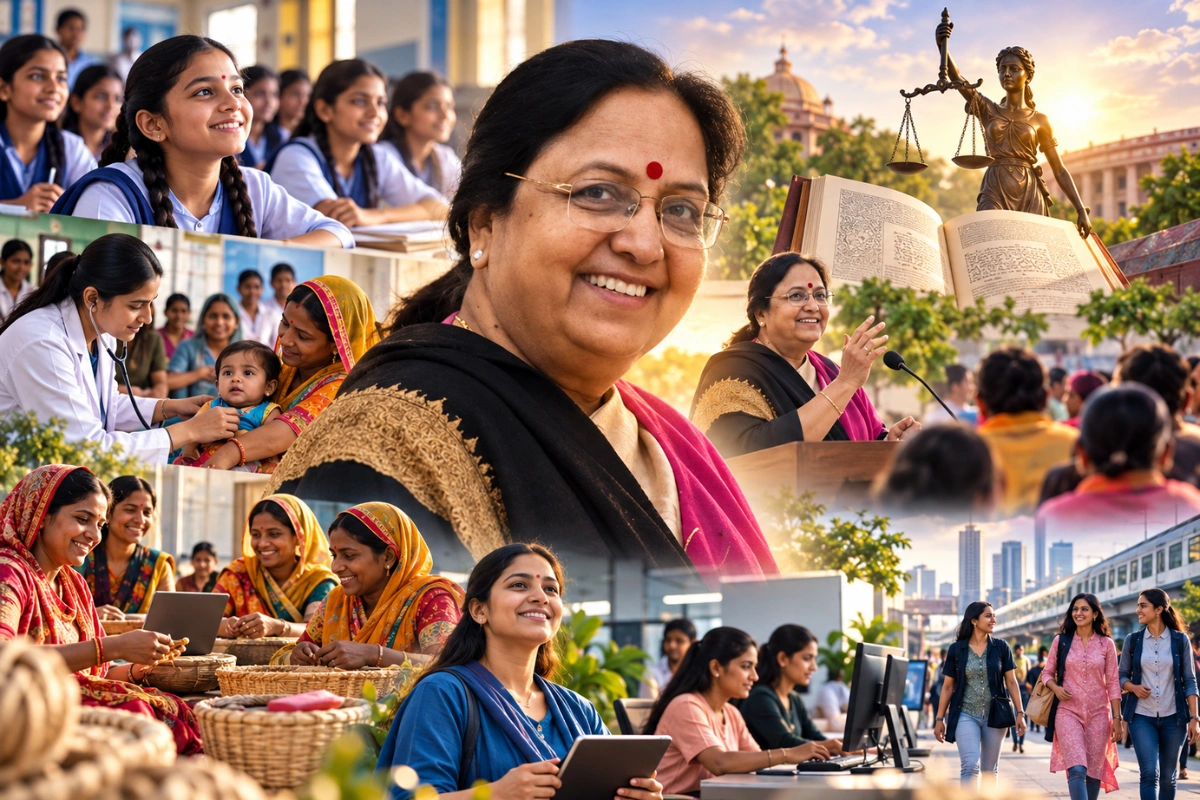
AI Generated Image
Baby Rani Maurya’s public life offers a useful lens for understanding women empowerment as more than a slogan. Her journey has moved through local governance in Agra, constitutional office at Raj Bhavan in Uttarakhand, electoral politics, and welfare administration in Uttar Pradesh, making her career a case study in how leadership, service delivery, and community trust can work together. Today, her public role is closely associated with women welfare, child development, nutrition, and the wider goal of empowering women in everyday life.
The larger lesson is clear: women empowerment grows when rights, education, safety, livelihood, health, and representation are treated as connected priorities. It is not achieved by one speech, one policy, or one symbolic appointment. It is built when institutions listen, communities participate, and women are able to make meaningful choices about their lives.
What Does Baby Rani Maurya’s Journey Teach About Women Empowerment?
Baby Rani Maurya’s journey suggests that women empowerment becomes stronger when public leadership is rooted in both representation and practical service. Her career includes service as Mayor of Agra from 1995 to 2000, membership in the National Commission for Women in the early 2000s, the office of Governor of Uttarakhand from 2018 to 2021, and a later role in Uttar Pradesh as a legislator and Cabinet Minister connected with women’s welfare, child development, and nutrition.
That path matters because it connects three levels of public life: the city, the state, and the community. Local governance teaches leaders how public services affect households. Constitutional office brings visibility, dignity, and institutional reach. Welfare administration then tests whether ideas about women’s rights and gender equality can be translated into programmes that reach families, children, adolescent girls, and women who may otherwise remain outside formal systems.
Her career also reminds readers that empowering women is not only about placing women in high office, though representation is important. It is also about what leaders do with that platform: encouraging education, supporting self-reliance, speaking about dignity, strengthening delivery systems, and making public institutions more approachable for women from different social and economic backgrounds.
From Civic Leadership to Raj Bhavan
A blueprint for women empowerment often begins far from national debate. It begins in municipal offices, neighbourhood meetings, schools, health centres, and women’s groups. Baby Rani Maurya’s early public record as Mayor of Agra placed her in a role where governance is immediate: sanitation, public facilities, local administration, and civic responsiveness affect women’s daily routines in direct ways. Her official biographical profile describes a long public life involving administrative, political, and social responsibilities before her appointment as Governor of Uttarakhand.
This stage of leadership is important because local government is where policy touches the household most visibly. A woman’s ability to study, work, travel, access health services, participate in meetings, or seek help often depends on basic public systems. When civic administration becomes more responsive, the idea of gender equality becomes less abstract.
Her later appointment as Governor of Uttarakhand placed her within the formal space of Raj Bhavan, a constitutional office associated with ceremony, oversight, and public trust. But the significance of such an office also lies in what it can signal: that women can occupy institutions historically dominated by men, and that women from varied social backgrounds can be seen in positions of authority.
Public Service Beyond Symbolism
Symbolism has value, especially in societies where girls often need visible examples of possibility. A woman in a high public office can challenge assumptions about who belongs in leadership. Yet symbolism alone is not enough. It must be followed by systems, budgets, outreach, accountability, and everyday access.
That is why Baby Rani Maurya’s movement from Raj Bhavan into elected and Ministerial public service is worth examining. In the 2022 Uttar Pradesh Assembly election, she won from Agra Rural, a Scheduled Caste constituency, according to Election Commission data; the Uttar Pradesh Legislative Assembly lists her as the member from Agra Rural for the Bharatiya Janata Party.
Her current Cabinet portfolio is listed by the Uttar Pradesh Chief Minister’s Office as Women’s Welfare, Child Development and Nutrition. That portfolio naturally brings women empowerment into contact with children’s health, maternal support, adolescent wellbeing, family nutrition, and frontline delivery networks. In practical terms, this shows how women’s issues cannot be separated from public health, social justice, education, and economic opportunity.
One example from her time as Governor also reflects this link between dignity and material support. On International Women’s Day in 2021, she inaugurated a Saree Bank for needy women at Raj Bhavan, and the official Raj Bhavan report recorded her emphasis that real empowerment is possible through women’s economic empowerment. Whether the initiative is small or large, the underlying principle is meaningful: dignity improves when support reaches women in tangible forms and when public institutions acknowledge everyday needs.
The Rights Foundation of Empowerment
Women empowerment must rest on women’s rights. Without rights, empowerment becomes dependent on goodwill. With rights, it becomes a matter of dignity, citizenship, and justice.
In India, the constitutional framework provides an important foundation for gender equality. Government summaries of constitutional provisions note that Article 15 prohibits discrimination on grounds including sex and also enables special provisions for women and disadvantaged groups, while Article 16 guarantees equality of opportunity in public employment. These protections matter because legal equality creates the framework within which education, employment, political participation, safety, and welfare measures can be pursued.
Globally, the language of empowerment is also tied to the work of institutions such as UN Women, which was created by the United Nations General Assembly to advance women’s rights, gender equality, and the empowerment of women and girls. The Sustainable Development Goals include Goal 5, which is focused on achieving gender equality and empowering all women and girls, while also recognising that structural barriers such as discriminatory laws, harmful norms, and low levels of political participation continue to affect progress.
This rights-based foundation keeps the conversation honest. It prevents women empowerment from being reduced to motivation alone. Encouragement matters, but rights decide whether women can claim education, safety, property, wages, health services, justice, political participation, and public respect.
Why Do Women’s Rights Matter Beyond Law Books?
Women’s rights matter beyond law books because they shape what a woman can actually do when she faces discrimination, exclusion, violence, unequal opportunity, or denial of services. A right gives her a claim; an institution gives her a route; awareness gives her the confidence to use both.
For example, equal opportunity in public employment is not only a constitutional phrase. It can influence who becomes a teacher, officer, health worker, police official, administrator, entrepreneur, or elected representative. Anti-discrimination principles are not only legal ideals. They help define whether a girl can remain in school, whether a woman can enter a workplace, and whether public services must treat her with dignity.
This is where the feminist movement, in its broadest sense, remains relevant. At its best, the feminist movement is not about replacing one hierarchy with another. It is about questioning unfair power, expanding freedom, and ensuring that women’s lives are not limited by gendered expectations. In India, that conversation must also remain attentive to caste, class, rural access, disability, language, region, and religion, because women do not all experience inequality in the same way.
A Practical Blueprint for Empowering Women
A useful blueprint for empowering women should be both ambitious and grounded. It should speak about leadership and rights, but it should also ask whether a woman can reach a health centre, open a bank account, continue her education, report violence, travel safely, access nutrition support, learn digital skills, and participate in decisions at home and in public life.
The following pillars can guide communities, institutions, educators, public officials, and civil society groups that want to turn women empowerment into real progress.
1. Education That Builds Agency
Education is the first pillar because it affects nearly every other area of life. A girl who remains in school has more opportunities to understand her rights, delay harmful pressures, build confidence, develop employable skills, and participate in civic life. But education must be more than attendance. It should include safety, sanitation, mentoring, digital access, career guidance, and encouragement to pursue fields where girls are underrepresented.
Baby Rani Maurya’s official profile notes her sensitivity towards women empowerment and girl child education, including involvement with efforts to encourage girls’ education and support women’s self-reliance in poorer settlements. That detail is important because empowerment efforts often succeed when they combine public messaging with community-level encouragement.
Practical education-based action can include:
- Supporting girls who are at risk of dropping out because of household work, early marriage pressure, distance, cost, or lack of safe transport.
- Creating mentorship circles where older students, teachers, professionals, and local women leaders guide adolescent girls.
- Teaching legal literacy, financial literacy, digital safety, health awareness, and communication skills alongside formal academics.
- Encouraging families to see girls’ education not as a favour, but as an investment in dignity, livelihood, and social progress.
2. Economic Independence and Livelihood
Economic empowerment is central to women empowerment because income and assets can expand decision-making power. When women earn, save, own, inherit, borrow, insure, invest, and participate in markets, they are better positioned to negotiate within families and communities. Economic agency also helps women leave exploitative situations and plan for long-term security.
The challenge is that livelihood support must be realistic. A training certificate alone does not guarantee income. Women may also need childcare, safe mobility, market linkages, digital tools, credit access, family support, and freedom from harassment. Programmes should ask: Can women sell what they make? Can they travel safely? Can they control their earnings? Similarly, can they scale from informal activity to a stable livelihood?
A stronger livelihood model includes:
- Skill mapping: Identify what women already know, what the local market needs, and what training can realistically lead to income.
- Financial access: Connect women to bank accounts, savings groups, credit options, insurance awareness, and digital payment tools.
- Market support: Help women reach buyers through fairs, cooperatives, local institutions, online platforms, or producer groups.
- Household negotiation: Engage families so women’s paid work is not treated as secondary or temporary.
- Asset ownership: Encourage legal awareness around inheritance, property, documentation, and identity records.
This is where slogans must become systems. ‘Empowering women’ sounds inspiring, but the test is whether a woman has resources she can use, choices she can make, and support she can count on.
3. Health, Nutrition, and Care
Health is not separate from gender equality. A woman’s ability to learn, work, lead, and participate depends on physical well-being, nutrition, reproductive health, mental health, and access to respectful care. When girls are undernourished, when mothers lack support, or when women delay treatment because of cost or stigma, empowerment remains incomplete.
Baby Rani Maurya’s current portfolio connects women’s welfare with child development and nutrition, which reflects a broader policy reality: women’s wellbeing and children’s wellbeing are deeply linked. This does not mean women should be valued only as mothers. Rather, it means public systems must recognise how care burdens, maternal health, early childhood nutrition, and household wellbeing affect women’s freedom and opportunity.
A practical health-and-care approach should include adolescent nutrition, menstrual health awareness, maternal support, childcare services, mental health conversations, and respectful frontline delivery. It should also recognise unpaid care work, which is often performed by women without recognition, rest, or economic value. Gender equality requires changing that imbalance, not merely praising women for sacrifice.
4. Safety, Dignity, and Access to Justice
Safety is one of the most immediate conditions for women empowerment. If women cannot move freely, speak openly, report abuse, use public transport, attend school, work late, access digital spaces, or seek help without shame, their choices shrink. Safety includes law enforcement, but it also includes social attitudes, infrastructure, family support, and institutional sensitivity.
Women’s rights become meaningful when women know how to use complaint systems, helplines, legal aid, workplace protections, and local support networks. Awareness campaigns should avoid placing the burden entirely on women to protect themselves. Instead, they should focus on accountability: families, schools, workplaces, police systems, transport providers, digital platforms, and community leaders all have roles to play.
A dignity-based safety checklist might include:
- Safe routes to schools, colleges, workplaces, markets, and health centres.
- Responsive complaint mechanisms in institutions and workplaces.
- Community awareness against victim-blaming and forced silence.
- Digital safety education for girls and women without restricting their access to technology.
- Support services that treat survivors with confidentiality, respect, and urgency.
5. Leadership and Representation
Representation changes imagination. When girls see women as mayors, governors, Ministers, officers, entrepreneurs, artists, teachers, judges, scientists, and community organisers, leadership feels less distant. Baby Rani Maurya’s public career is notable because it crosses multiple leadership spaces, from municipal leadership to Raj Bhavan and elected office.
But representation must not stop at visibility. Women leaders need authority, resources, teams, and decision-making power. They also need protection from tokenism, personal attacks, and unrealistic expectations. A woman in leadership should not be expected to solve every gender issue alone, just as a man in leadership is not expected to represent all men.
Communities can build women’s leadership by encouraging girls to speak in school assemblies, supporting women in local committees, training women in public speaking, creating leadership roles in self-help groups, and ensuring that public meetings are scheduled and conducted in ways that women can actually attend.
What Role Can Culture, Quotes, and Art Play in Empowering Women?
Culture, women empowerment quotes, and women empowerment art can inspire change when they are connected to action. A quote can spark courage, a mural can make women visible in public space, and a story can help communities question old assumptions, but inspiration must lead to education, safety, livelihood, rights awareness, or participation.
Art matters because it reaches people emotionally before it reaches them intellectually. A poster of girls studying, a wall painting of women farmers, a street play on women’s rights, or a community exhibition on local women leaders can make empowerment visible. Women empowerment art is especially powerful when it features ordinary women, not only famous figures, because it tells girls that leadership is not limited to a few exceptional people.
Quotes can also be useful, but they should be chosen carefully. The best women empowerment quotes do not reduce women to endurance or sacrifice. They affirm courage, freedom, learning, equality, and self-respect. In schools, community centres, offices, and campaigns, quotes should be paired with information: where to seek help, how to continue education, how to join a skills programme, or how to participate in local decision-making.
A culture-based empowerment activity can include:
- A community wall featuring portraits of local women achievers, teachers, health workers, artisans, athletes, and public servants.
- A student-led exhibition on constitutional values, gender equality, and women’s rights.
- A storytelling circle where women share lessons about education, work, leadership, and resilience.
- A poster campaign that pairs women empowerment quotes with practical resources.
- A local art competition where boys and girls together imagine safer, more equal public spaces.
Lessons for Institutions and Communities
The most useful blueprint is one that different groups can adapt. Government departments, schools, colleges, civil society organisations, businesses, families, and local leaders all influence whether women’s empowerment becomes a lived reality.
Here is a practical framework:
| Level | What to Focus On | Practical Action |
|---|---|---|
| Family | Support and equal opportunity | Share care work, support girls’ education, respect women’s financial decisions |
| School | Confidence and continuity | Provide mentoring, safety, sanitation, career guidance, and legal awareness |
| Community | Participation and dignity | Include women in committees, public meetings, local planning, and cultural programmes |
| Workplace | Fairness and growth | Ensure safe reporting, equal opportunity, maternity support, respectful culture, and skill development |
| Government | Delivery and accountability | Strengthen welfare access, frontline services, nutrition support, legal aid, and data-based planning |
| Media and culture | Visibility and attitude change | Highlight women’s achievements without stereotyping or sensationalism |
The table is simple, but the principle is deep: women empowerment is shared work. It fails when every responsibility is placed on women alone. It succeeds when institutions remove barriers and communities change expectations.
A Balanced View of Empowerment
A serious discussion of women empowerment must avoid two extremes. One extreme treats empowerment as only personal confidence, as if a woman can overcome every barrier by thinking positively. The other treats empowerment as only government policy, as if schemes alone can change social attitudes. Real change needs both inner confidence and outer support.
It also requires listening to women who are not always centred in mainstream conversations: rural women, Dalit women, women from minority communities, migrant women, widows, single mothers, women with disabilities, informal workers, adolescent girls, and elderly women. A one-size-fits-all approach often misses the lived reality of those who face multiple forms of exclusion.
This is where Baby Rani Maurya’s public identity as a woman leader from a Scheduled Caste background becomes part of the broader conversation on representation. Her election from Agra Rural, an SC constituency, and her listing as its MLA place her within a political context where caste, gender, and public leadership intersect. A blueprint for gender equality in India must recognise that women’s experiences are shaped not by gender alone, but by many layers of social location.
Turning Inspiration Into Action
Readers who want to support women empowerment do not need to wait for a large platform. Action can begin in a family, classroom, office, neighbourhood, or local institution. The important thing is to move from admiration to participation.
A simple action checklist:
- Listen first: Ask women and girls what barriers they actually face instead of assuming the answer.
- Support education: Help prevent dropout, encourage higher studies, and create mentoring networks.
- Respect financial agency: Encourage women to manage accounts, savings, assets, and income decisions.
- Share unpaid care work: Treat cooking, cleaning, caregiving, and household management as shared responsibilities.
- Promote legal awareness: Make information on women’s rights accessible in local languages and simple formats.
- Make spaces safer: Improve lighting, reporting systems, transport access, and institutional accountability.
- Celebrate without stereotyping: Honour women’s achievements without limiting them to sacrifice, patience, or family roles alone.
- Include men and boys: Gender equality improves when boys learn respect, consent, cooperation, and shared responsibility early.
The goal is not to create a society where women must constantly prove their worth. The goal is to build a society where people already recognise their worth and protect their rights. It should also give women the freedom to make real choices.
The Enduring Message
From Raj Bhavan to public service, Baby Rani Maurya’s career shows how women’s leadership can operate across symbolic, administrative, and welfare spaces. Her journey does not provide a finished formula, but it does point towards a workable blueprint:
- Begin with rights,
- Invest in education,
- Strengthen economic agency,
- Protect dignity,
- Support health, and
- Create room for women in leadership
Women’s empowerment is not a single event. It is a continuous public commitment that lives in constitutional promises, government programmes, community action, family attitudes, and cultural imagination. It also lives in the everyday courage of women who claim space for themselves and others.
The most powerful blueprint is therefore not only about one leader. It is about what society chooses to learn from women leaders: that equality must be visible, practical, inclusive, and sustained. When women’s rights are protected and gender equality becomes part of daily life, empowering women becomes more than an aspiration. It becomes the foundation of a more just and confident society.
Also Read: The Western Anchor: How Bhupendra Chaudhary Strengthened UP’s Organisational Roots
To read more such news, download Bharat Express news apps