



AI Generated Image
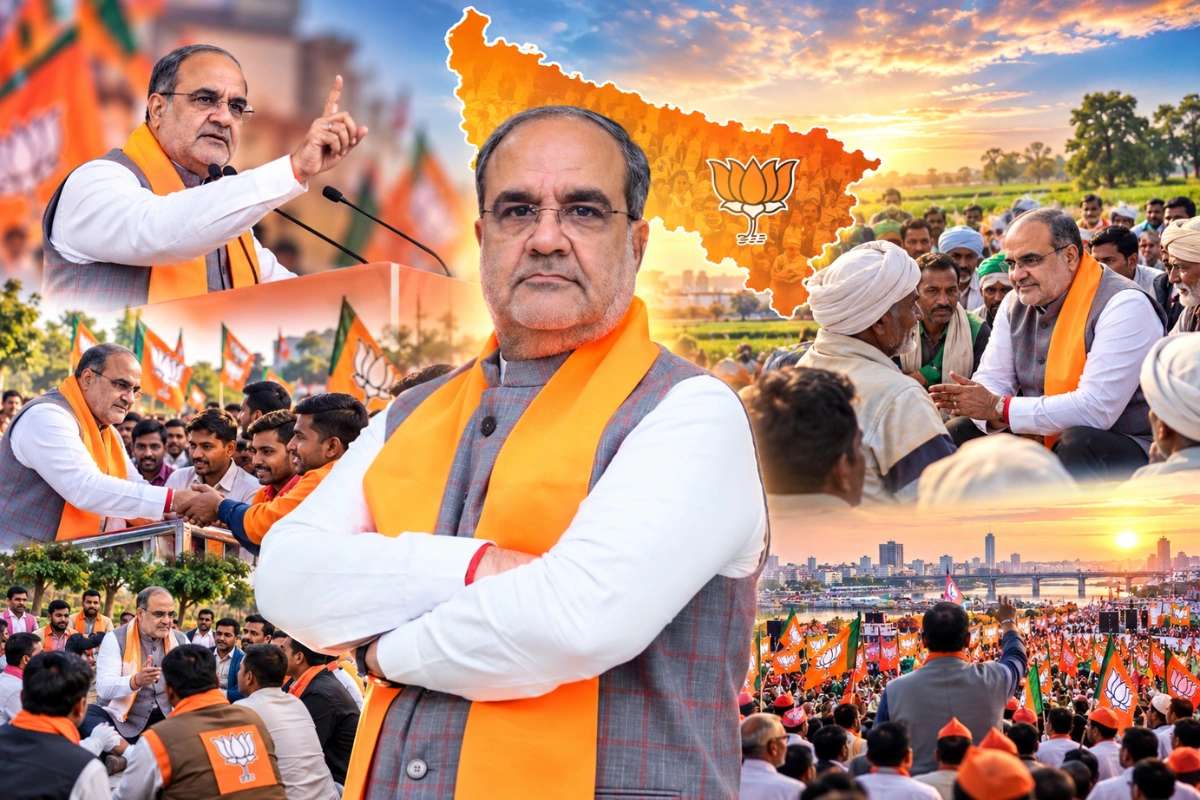
Bhupendra Chaudhary’s tenure in Uttar Pradesh politics is being read through one central lens: organisation before optics. Appointed as the BJP’s Uttar Pradesh unit president in August 2022, the western UP Jat leader brought a ground-level focus to a state where political organisation often decides electoral momentum as much as headline leadership does. His role became especially important in western Uttar Pradesh, a region shaped by farmer politics, caste alignments, and intense party competition.
Why Did Bhupendra Chaudhary Matter to UP’s Organisational Map?
Bhupendra Chaudhary mattered because he connected regional credibility with statewide political leadership. Before leading the UP unit, he had been associated with western UP organisation work and served as a Minister in the Yogi Adityanath government, giving him both party and governance experience. His appointment was widely seen as a move to strengthen the BJP’s reach in western UP after the farmer agitation and during the challenge posed by rival social coalitions.
That context made his leadership more than symbolic. In UP politics, district units, booth committees, local influencers, and caste-community networks can shape turnout long before campaign rallies begin. Chaudhary’s public emphasis on the party structure reflected that reality; in a 2022 interview, he argued that government is the result of organisational hard work and that the organisation stands above government.
The Western Anchor in a Statewide Strategy
Chaudhary’s political value came from western Uttar Pradesh, but the challenge before him was statewide. The BJP had to keep its base engaged across regions while responding to local pressures in Jat-dominated belts, urban pockets, and mixed rural constituencies. By placing a leader from western UP at the centre of state strategy, the party signalled that the region was not peripheral to its future calculations.
His profile also fit the BJP’s leadership development model in Uttar Pradesh: promote leaders who can speak to a social base while managing the mechanics of political organisation. For Chaudhary, that meant balancing identity, cadre discipline, and messaging. The result was a leadership style less associated with mass spectacle and more with coordination between state leadership, district workers, and campaign machinery.
Key organisational themes associated with his phase included:
- Western UP consolidation: renewed attention to Jat and farmer-belt politics after a turbulent period for the BJP in the region.
- Cadre communication: emphasis on party workers as the link between government schemes, local grievances, and voter outreach.
- Booth-level discipline: continued focus on the granular election apparatus that has become central to BJP strategy in Uttar Pradesh.
- Leadership development: use of regional leaders to carry statewide responsibilities without losing local credibility.
Membership Drive Kept the Structure Active
A major test of organisational depth came through membership and outreach campaigns. During the BJP’s Sanghthan Mahaparv 2024, Chaudhary said the party had made 2.5 crore ordinary members in Uttar Pradesh in the first phase, a claim that underlined how the state unit framed expansion as a measurable organisational exercise.
Such drives matter because they keep political workers active outside election season. They also create contact points for future campaigns, local feedback, and booth-level mobilisation. In a state as large as Uttar Pradesh, the ability to repeatedly reactivate workers can be as important as candidate selection.
What Comes Next for the Legacy
Chaudhary’s phase is now part of a broader BJP recalibration in Uttar Pradesh. Reports and party publications later identified Pankaj Chaudhary as his successor, placing Bhupendra Chaudhary’s tenure in the category of a completed organisational chapter rather than an ongoing presidency.
Even so, his imprint remains visible in how analysts discuss Bhupendra Chaudhary’s organisational roots: regional anchoring, worker-first messaging, and practical leadership development. For a state where elections unfold lane by lane and booth by booth, that organisational inheritance may prove as consequential as any single campaign speech.
Also Read: The Guardian Of The Treasury: How Suresh Khanna Engineered UP’s Trillion-Dollar Economic Blueprint
To read more such news, download Bharat Express news apps