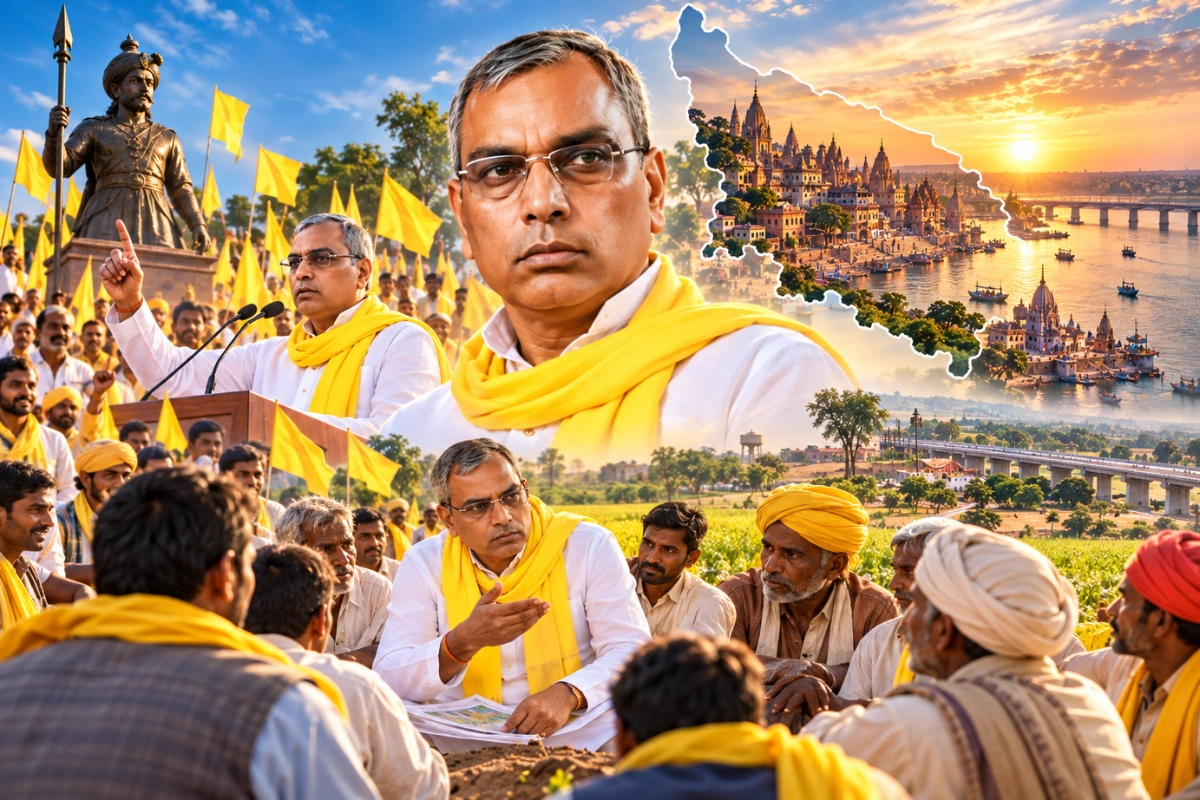
AI Generated Image
The phrase kingmaker of Purvanchal describes Om Prakash Rajbhar’s ability to make larger parties take his smaller Suheldev Bharatiya Samaj Party seriously in eastern Uttar Pradesh. It does not mean he controls every election outcome. It means he has built enough influence among Rajbhar and other non-dominant OBC voters to affect political alliances, candidate selection, leadership roles, and the balance of power in closely fought seats.
What Does ‘Kingmaker of Purvanchal’ Mean?
A ‘kingmaker’ is a political actor who may not always win the biggest office, but can influence who does. In Rajbhar’s case, the term points to a regional bargaining position: his party’s vote base, public messaging, and alliance flexibility give him leverage in Purvanchal, the eastern belt of Uttar Pradesh. The label is strongest when elections are competitive, margins are narrow, and larger parties need smaller caste-based formations to expand beyond their core voters.
This influence is rooted in identity politics, but it works through practical electoral mechanics. Rajbhar has positioned himself as a voice for communities that often feel overshadowed by larger caste blocs within the OBC category. That positioning lets him negotiate with bigger parties over seats, Ministerial space, and policy attention, especially where Rajbhar voters are locally significant.
The Identity Base Behind the Bargaining Power
Om Prakash Rajbhar leads the Suheldev Bharatiya Samaj Party, which was formed in 2002 and built around the political assertion of the Rajbhar community in eastern Uttar Pradesh. Indian Express has described the Rajbhar community as having a presence across many eastern UP constituencies, while ThePrint has reported that Rajbhars are an OBC community with a major hold in several districts of the region.
The political capital comes from converting a social identity into a recognisable electoral bloc. Once a leader can credibly say, “I can influence this community’s vote,” larger parties begin to treat that leader as a channel to voters they cannot easily reach on their own.
Defining characteristics of Rajbhar’s model include:
- Community Anchoring: A clear association with Rajbhar identity and non-Yadav OBC assertion.
- Regional Concentration: Influence that matters most in Purvanchal seats where caste arithmetic is finely balanced.
- Alliance Mobility: The ability to shift between larger coalitions when it improves bargaining power.
- Symbolic Representation: Presenting political participation as dignity, recognition, and a share in power.
- Local Governance Leverage: Using Ministerial or alliance roles to remain visible beyond campaign season.
How Did Om Prakash Rajbhar Turn Identity Into Political Capital?
He did it by making sub-caste identity politically legible. Instead of allowing Rajbhar voters to remain a small part of someone else’s broad coalition, he organised them under a party label, attached that label to specific demands, and then used elections to test his bargaining value.
His strategy also depends on constant visibility. Rajbhar’s politics is not limited to manifesto language; it involves rallies, blunt public statements, negotiations, departures, returns, and pressure on allies. That style keeps him in the news and signals to larger parties that ignoring him may carry electoral costs.
Electoral Strategies That Made a Small Party Matter
Rajbhar’s electoral strategies show how a smaller regional party can punch above its numerical weight. The SBSP does not need to dominate Uttar Pradesh to matter; it needs to be relevant in enough seats to influence power shifts.
Key strategies include:
- Seat-Level Concentration: Focusing on constituencies where Rajbhar and allied OBC voters can affect the result.
- Negotiated Alliances: Trading vote-transfer potential for seats, visibility, and leadership roles.
- Issue-Based Positioning: Raising themes such as representation, reservation within OBC categories, and welfare access.
- Personal Branding: Making Om Prakash Rajbhar himself the shorthand for the party’s identity and bargaining strength.
- Coalition Signalling: Moving towards the party that appears most useful for the next electoral cycle.
These tactics explain why the phrase ‘kingmaker of Purvanchal’ is more about leverage than absolute control.
Political Alliances and Power Shifts
Rajbhar’s career is often discussed through his alliance shifts. The SBSP fought the 2017 Uttar Pradesh Assembly election with the BJP, later parted ways before the 2019 Lok Sabha election, and then contested the 2022 Assembly election with the Samajwadi Party. In 2022, the SBSP contested 17 seats with the SP alliance and won six.
He later returned to the BJP-led NDA, and in March 2024 was inducted into the Yogi Adityanath government. The official Uttar Pradesh Chief Minister’s Office list names Shri Om Prakash Rajbhar as a Cabinet Minister handling Panchayati Raj, Minority Welfare, Muslim Waqf and Haj, giving him a role directly tied to local governance and community-facing administration.
The 2024 Ghosi Lok Sabha result also shows the limits of kingmaker politics. The NDA fielded his son Arvind Rajbhar from Ghosi, but Samajwadi Party candidate Rajeev Rai won by 1,62,943 votes.
What Are the Limits of This Model?
The model works only when identity influence translates into votes. If voters split, if local anti-incumbency dominates, or if an alliance partner’s broader image hurts the candidate, the claimed vote bank may not transfer cleanly.
There is also a credibility risk. Frequent alliance changes can increase bargaining power, but they can also make supporters and rivals question consistency. A caste-based party must continually prove that its negotiations produce representation, not just posts for a few leaders.
Common Misconceptions and Practical Examples
Common Misconceptions:
- ‘Kingmaker’ Means Guaranteed Victory. It does not; it means influence in competitive political dynamics.
- Sub-Caste Politics Is Only Symbolic. In practice, it affects tickets, campaign routes, cabinet space, and local governance priorities.
- Small Parties Are Irrelevant. In fragmented contests, smaller parties can shape margins and coalition arithmetic.
- Identity Alone Is Enough. Organisation, candidates, alliances, and credibility still matter.
Practical Examples of the Model:
- A larger party gives an ally a seat to attract a specific OBC community.
- A regional leader receives a Ministerial role after joining a coalition.
- Campaign messaging highlights dignity, representation, and community recognition.
- A local defeat forces parties to rethink whether a leader can transfer votes effectively.
Why This Matters for Purvanchal Politics
Om Prakash Rajbhar’s rise explains a larger truth about Purvanchal: local caste identities can reshape state-level power. His politics sits at the intersection of representation, electoral strategies, and alliance bargaining.
That is why ‘kingmaker of Purvanchal’ remains a useful definition, even with electoral setbacks. It captures how a leader from a smaller social bloc can turn identity into negotiation power, and how that power can influence leadership roles, political alliances, and the direction of regional governance.
Also Read: The Grassroots Architect: How Keshav Prasad Maurya Engineered UP’s Social Revolution
To read more such news, download Bharat Express news apps