



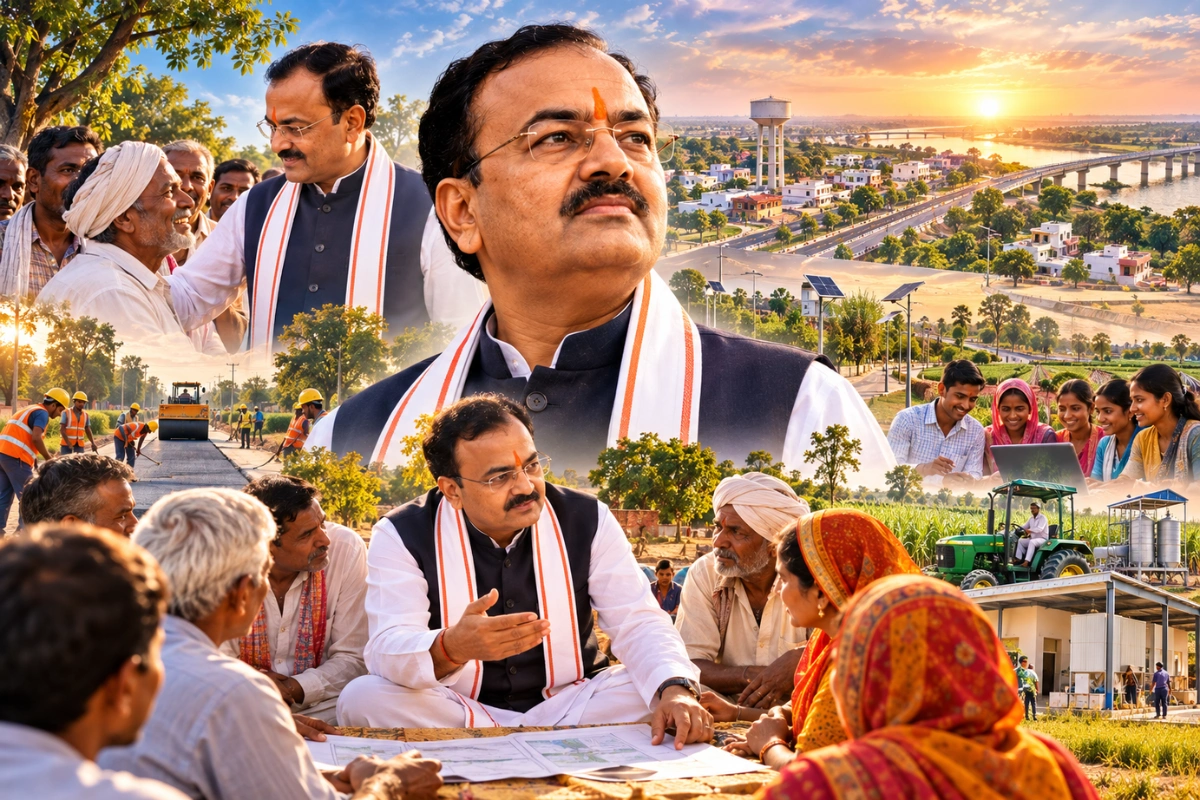
AI Generated Image
This page explores Keshav Prasad Maurya as a grassroots architect of public life in Uttar Pradesh: a leader whose work is often discussed through the lens of local mobilisation, rural priorities, and social representation. It connects his public responsibilities with larger ideas such as civic engagement, participatory planning, collaborative architecture, and community design. As listed by the Uttar Pradesh Legislative Assembly, Maurya serves as Deputy Chief Minister with portfolios including Rural Development, Overall Village Development, Rural Engineering, Food Processing, Public Enterprises, and National Integration.
What Does ‘Grassroots Architect’ Mean in Uttar Pradesh Public Life?
A grassroots architect is not simply someone who designs buildings; in this context, it means a public figure who helps shape the systems through which people, places, and institutions connect. For Keshav Prasad Maurya, the phrase points to a style of politics built around village concerns, organisational networks, and the belief that development must reach the local lane, the small farmer, the worker, and the family looking for a stronger foothold. It is a practical idea: social change becomes durable when it is planned with communities, not only delivered to them.
That is why the language of architecture fits. Sustainable building depends on a strong foundation, suitable materials, and long-term maintenance; social development depends on trust, listening, access, and implementation. When public leadership is viewed this way, local architecture becomes more than roads, halls, or public facilities. It becomes the structure of participation itself.
A Journey Rooted in Local Identity
Maurya’s public story is closely tied to Uttar Pradesh’s social and political landscape. The official biography records that he was born on May 7, 1969, in Sirathu, in present-day Kaushambi district. He later entered national parliamentary life when he was elected to the 16th Lok Sabha from Phulpur, Uttar Pradesh, in 2014, according to Digital Sansad records.
That journey matters because it places his leadership in a recognisable UP setting: towns, villages, caste communities, small enterprises, road networks, and families navigating aspiration and limitation at the same time. His rise is often read through the wider story of representation among non-dominant social groups, especially in a state where identity, welfare, infrastructure, and political access are deeply intertwined. The result is a public image built less around elite distance and more around ground-level contact.
The Mission Is Practical Social Development
The central theme of this page is simple: public leadership should make governance feel reachable. Maurya’s present departments place him near issues that affect daily rural life, including village development and rural engineering. Those areas are where policy becomes visible—through local roads, community assets, livelihood support, food processing opportunities, and the systems that help villages connect to wider markets and services.
This mission can be understood through five working priorities:
- Civic Engagement: Keeping citizens, workers, local representatives, and community groups in the conversation.
- Participatory Planning: Treating village needs as inputs, not afterthoughts, in development decisions.
- Community Design: Shaping public work around real use, from access routes to local economic activity.
- Collaborative Architecture: Linking government departments, local bodies, and residents so that implementation does not remain isolated.
- Sustainable Building: Favouring development that can be maintained, adapted, and trusted over time.
These ideas are not abstract slogans. In a rural context, a poorly planned road, an unused community asset, or a disconnected scheme can limit opportunity for years. A better-designed process can change how people reach schools, markets, health services, and administrative support.
Community Design Turns Policy Into Everyday Access
Community design begins with a basic question: what does a village, ward, or local economy actually need to function better? The answer may be physical infrastructure, but it may also be coordination, awareness, grievance resolution, or stronger participation by people who are often left out of formal planning. This is where the ‘architect’ metaphor becomes useful. Good public work is not only about announcing a project; it is about aligning purpose, people, place, and follow-through.
A realistic village-level development approach includes:
- listening to local concerns before priorities are fixed;
- identifying who benefits and who may still be excluded;
- coordinating engineering, livelihood, and administrative support;
- using local knowledge to avoid wasteful or unsuitable projects;
- building assets that communities can actually use and maintain;
- reviewing outcomes after implementation, not only at launch.
For a resident, this approach can mean fewer gaps between promise and delivery. For a local representative, it means clearer channels for raising needs. Similarly, for a development team, it means plans that match the ground instead of looking good only on paper.
Civic Engagement Is the Foundation of Social Change
Uttar Pradesh’s scale makes top-down development difficult. A policy that sounds complete in Lucknow can look very different in a village where land, caste, occupation, drainage, transport, and seasonal migration shape everyday life. Civic engagement helps close that distance. It turns residents from passive recipients into participants who can point out barriers before they become expensive failures.
Participatory planning also strengthens accountability. When people understand what is being built, why it matters, and how it should be maintained, public work becomes easier to monitor. This is the social side of sustainable building: not only durable materials, but durable relationships between citizens and institutions.
The Values Behind the Grassroots Architecture
The story presented here is guided by values that make local development more human and more usable. They reflect the practical needs of communities that expect leadership to be visible, responsive, and grounded.
| Value | What It Means in Practice |
|---|---|
| Accessibility | Public leadership should be understandable and reachable to ordinary citizens. |
| Inclusion | Development must consider communities that have historically struggled for representation. |
| Local Relevance | Plans should reflect the realities of villages, small towns, and regional economies. |
| Collaboration | Departments, elected representatives, and communities work better when they are connected. |
| Durability | Projects should serve people beyond the announcement stage. |
These values also explain why the phrase grassroots architect fits the broader narrative. Architecture is not only the finished structure; it is the discipline of designing something that holds together under real conditions.
A Living Profile of Leadership and Local Change
This page is for readers who want to understand Keshav Prasad Maurya beyond a headline or office title. It looks at the relationship between political organisation, rural development, local architecture, and social representation in Uttar Pradesh. It also invites readers to think about public life as a form of design: every decision creates pathways, removes barriers, or leaves people waiting outside the system.
To continue, explore related perspectives on rural development, community design, and participatory planning in Uttar Pradesh. The most meaningful social revolution is rarely sudden. It is built step by step, with people close enough to the process to shape it.
Also Read: Voice Of Purvanchal: Anupriya Patel And The New Wave Of Women Political Pioneers
To read more such news, download Bharat Express news apps