



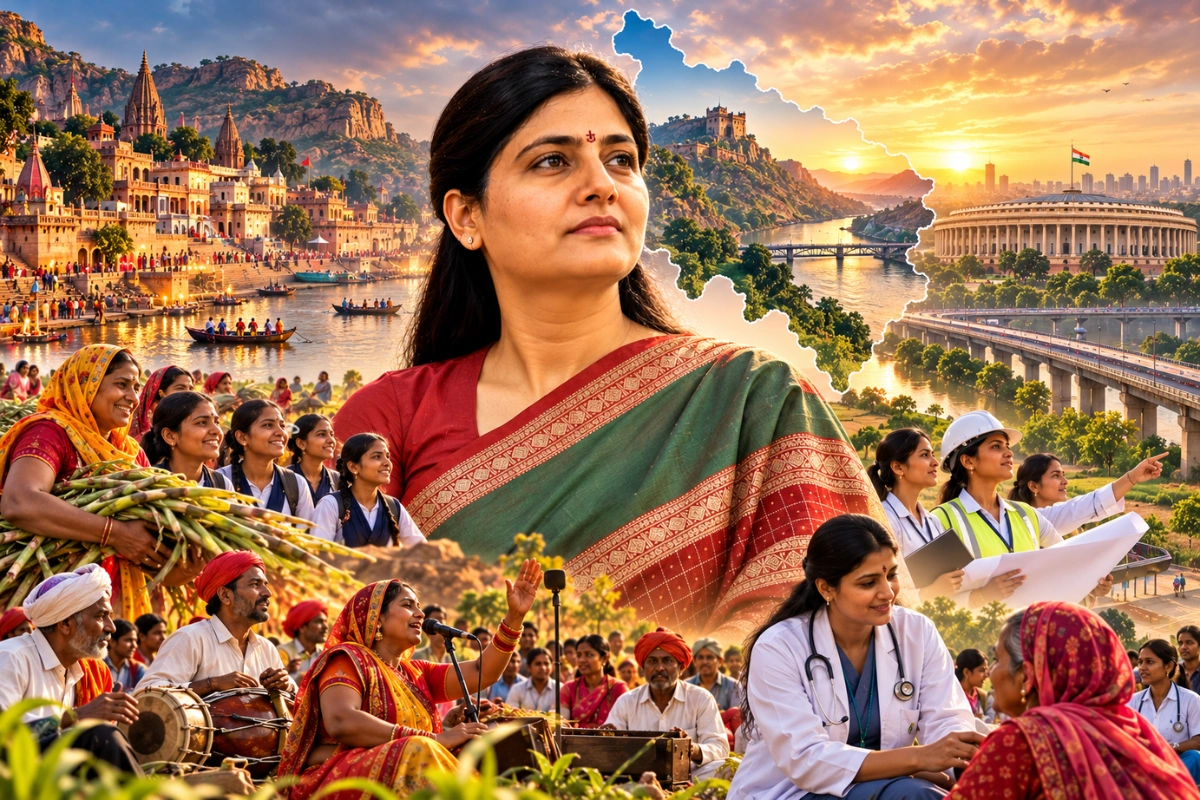
AI Generated Image
Anupriya Patel’s continued presence in national politics is drawing fresh attention to how women leaders from eastern Uttar Pradesh are shaping conversations around representation, regional identity, and development. The Mirzapur MP and Apna Dal (Soneylal) leader remains a visible political figure from Purvanchal at a time when women’s participation in legislatures is again in public focus. Her rise also reflects a wider shift: local voices, caste coalitions, cultural memory, and women-led leadership are becoming harder to separate in the politics of the region.
Why Is Purvanchal Watching Women Leaders Now?
Purvanchal is watching women leaders because the region’s politics is no longer only about party arithmetic; it is also about who can speak credibly for local communities, aspirations, and cultural expressions. Patel’s position as a Union Minister of State and elected representative from Mirzapur gives her a platform that connects Delhi’s policy space with the ground realities of eastern Uttar Pradesh. The debate has gained added weight after the Nari Shakti Vandan Adhiniyam, which provides for one-third reservation for women in the Lok Sabha and state assemblies, though implementation is linked to the post-Act census and delimitation process.
Patel’s Political Profile Anchors the Story
Anupriya Patel represents Mirzapur in the 18th Lok Sabha and leads Apna Dal (Soneylal), a party whose influence is rooted in Uttar Pradesh’s non-Yadav OBC politics and alliance negotiations. Government records list her as Minister of State in the Ministry of Health and Family Welfare and the Ministry of Chemicals and Fertilisers, keeping her in portfolios that touch public health, medicines, and welfare delivery. Her official profile states that she first won election to the Uttar Pradesh Legislative Assembly in 2012, entered the Lok Sabha in 2014, won re-election in 2019, and continued in national office after 2024.
Her 2024 victory from Mirzapur confirmed that her regional base remained politically relevant in a competitive election cycle. Candidate records from the 2024 Lok Sabha election identify her as the Apna Dal (Soneylal) winner from Mirzapur, a seat that sits within the broader political imagination of Purvanchal. For supporters, that makes her a voice of Purvanchal with access to the Union government; for critics and rivals, it also makes her accountable for whether national visibility translates into local delivery.
The Politics of Regional Identity Is Changing
In eastern Uttar Pradesh, regional identity is carried through language, caste histories, migration stories, religious geographies, and folk traditions. Political communication in Purvanchal often draws strength from the familiarity of local idioms rather than from abstract national messaging alone. That is why leaders who can speak to both policy and place tend to matter: they are judged not only by speeches in Parliament, but by whether they understand the everyday vocabulary of Mirzapur, Varanasi, Ballia, Ghazipur, Jaunpur, Azamgarh, Gorakhpur, and nearby districts.
Purvanchal culture also gives politics a distinct texture. Bhojpuri and related regional traditions have long carried stories of labour, migration, longing, devotion, and seasonal life through forms such as Kajri, Chaiti, Birha, Sohar, and Nirgun. Scholars and cultural chroniclers have described Biraha as part of the Bhojpuri region that includes eastern Uttar Pradesh and western Bihar, while newer writing on Bhojpuri folk music continues to connect these cultural expressions to migration, memory, and changing village economies.
At a Glance: What This Moment Signals
- Women’s Representation Is Moving From Symbolism to Structure. The women’s reservation law has made the question of women in legislatures a long-term institutional issue, not only an election-season slogan.
- Purvanchal’s Local Voices Are Gaining Sharper Political Value. Leaders who combine regional identity with national access can shape debates on welfare, jobs, health, infrastructure, and dignity.
- Culture Is Part of Political Credibility. Folk traditions and local languages are not campaign decoration in eastern Uttar Pradesh; they are channels through which people recognise belonging and trust.
- Women Pioneers Face a Dual Test. They must break barriers in public life while also proving themselves through constituency work, alliance choices, and responsiveness to local concerns.
A Wider Wave Beyond One Leader
Patel’s prominence reflects a broader national and regional shift, with more women emerging as organisers, candidates, Ministers, panchayat leaders, campaign strategists, and community negotiators. The change is uneven, and the pipeline from local bodies to state assemblies and Parliament remains difficult. Still, political discourse increasingly treats women not merely as voters to mobilise but as leaders who define issues.
That shift matters in Purvanchal because development questions here are often deeply local. Employment-linked migration, access to healthcare, education, road connectivity, agrarian stress, small-town enterprise, and dignity for backward and marginalised communities all require leaders who can translate local needs into administrative attention. A woman leader from the region who can speak this language occupies a space that is both representative and strategic.
What Happens Next
The next phase will test whether the new attention around women political pioneers becomes durable political power. Parties will have to decide whether they are willing to nominate more women in winnable seats, invest in local women organisers before election season, and treat regional identity as more than a slogan. In Purvanchal, that will mean listening closely to local voices and respecting the cultural expressions that shape public life.
For Anupriya Patel, the challenge is equally clear. Her profile gives her visibility, but the expectations attached to being a voice of Purvanchal are high. The region’s voters will look for evidence that national office, regional roots, and women-led leadership can combine to deliver practical outcomes for eastern Uttar Pradesh.
Also Read: Sugarcane And Silicon: How Jayant Chaudhary Is Reimagining The UP Farmer’s Future
To read more such news, download Bharat Express news apps